
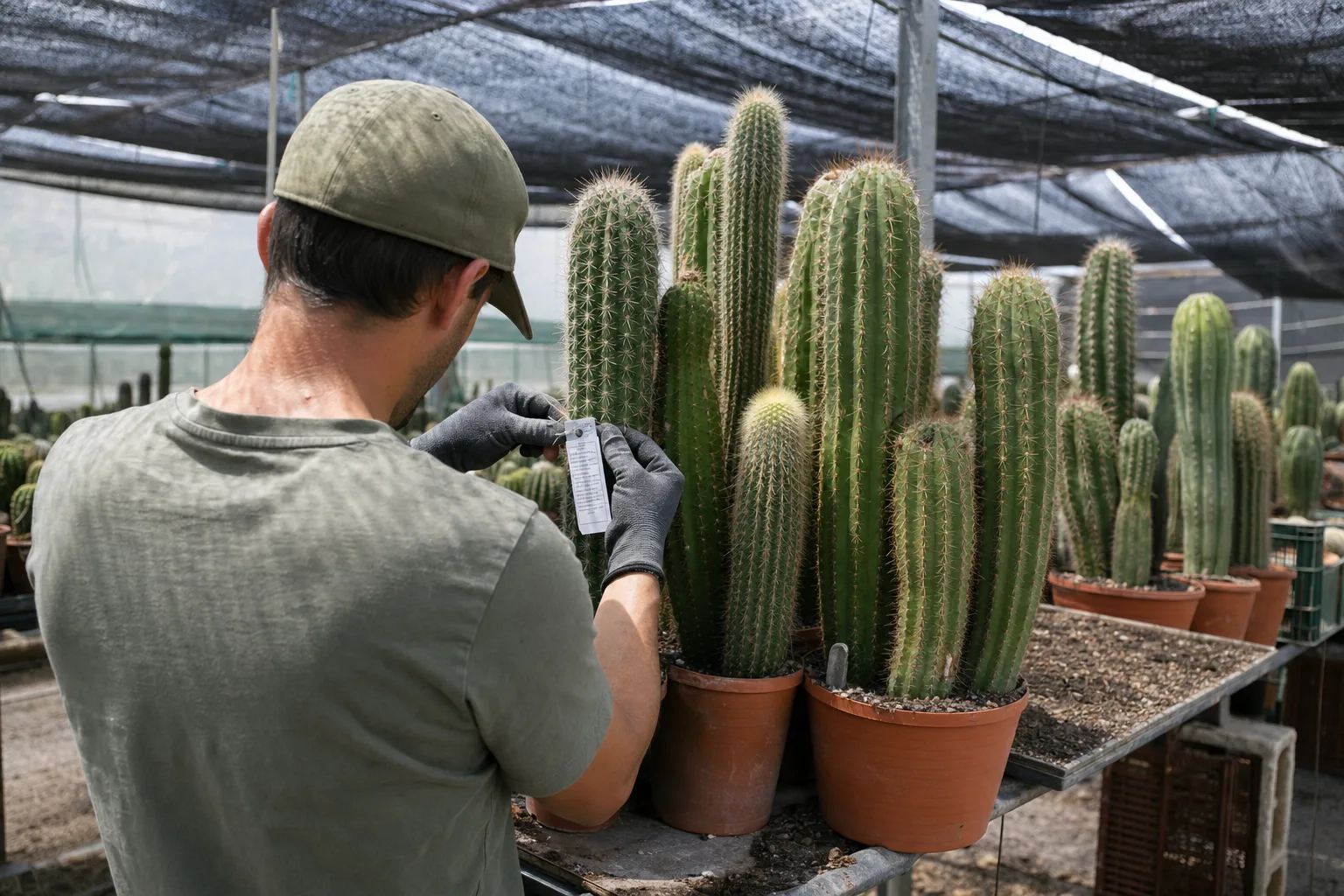
EU phytosanitary passport for cacti: what wholesale trade requires
The wholesale trade of columnar cacti within the European Union is not limited to cultivating well and packing carefully: it requires compliance with the plant health regime that organizes the professional movement of plants. The phytosanitary passport is the official mark that accompanies certain plants —including, in general, those intended for planting— when they circulate among operators in the internal market. For a Trichocereus nursery or a distributor supplying garden centers in various countries, understanding what this mark requires, who can issue it, and how it is placed on the commercial unit is as integral to the product as the size or substrate.
This article translates the regulatory logic into the language of ornamental nursery operations, without replacing legal advice or instructions from the competent authority of each Member State. Tricholand, as a wholesale producer in Murcia with European distribution, regularly integrates phytosanitary documentation into its B2B flows; if you need to align an order with destination requirements, you can speak with the Tricholand technical team.
What is the phytosanitary passport and what is it for?
According to the operational definition disseminated by agricultural authorities, the phytosanitary passport certifies that the shipment is free from quarantine pests —and, where applicable, pests from protected zones— and that it meets the required tolerance levels for regulated non-quarantine pests (RNQP). It is not a certificate of ornamental quality nor an aesthetic guarantee: it is a tool for traceability and management of phytosanitary risk in the professional chain.
The general European framework is primarily articulated in the Regulation (EU) 2016/2031 concerning protective measures against plant pests, complemented by implementing acts and format —including Regulation (EU) 2017/2313 on format specifications— and by uniform lists and conditions associated with Regulation (EU) 2019/2072. For an updated institutional view, it is advisable to also consult the Spanish Ministry of Agriculture's portal on phytosanitary passports and the plant health documentation from the European Commission on plant health.
Do ornamental cacti need a passport?
In the practice of the internal market, the significant novelty of the current regime is the widespread inclusion of plants intended for planting among the materials that require a passport for their professional movement within the EU. A potted columnar cactus, a rooted cutting ready for cultivation, or a mother plant marketed as planting material generally fall under this logic when the movement occurs between professional operators.
It is important to clearly distinguish three scenarios:
- B2B movement between registered operators: the passport is usually the rule when the plant is intended for planting.
- Direct supply to end users for non-commercial personal use: there are exemptions, with important nuances —for example, distance selling or destinations subject to protected zone requirements—.
- Internal transfers between facilities of the same operator: exceptions may apply when proximity and registration conditions are met; do not assume the exception without verifying it with your competent authority.
The detailed list of plants and products that must carry a passport is included in the annexes of the uniform conditions regime (annexes XIII and XIV of the framework associated with Regulation 2019/2072, with subsequent updates). If there is doubt about a borderline case —seeds, specific material, protected zone—, the prudent source is the competent authority or the consolidated text in EUR-Lex, not a generic commercial summary.
Who can issue the passport?
It is not issued by just any nursery with a printer. It is issued by authorized professional operators registered in the corresponding registry —in Spain, the ROPVEG (Registry of Professional Plant Operators)— after demonstrating the ability to examine the material, maintain traceability, and comply with format and placement. Authorization involves periodic inspections by the competent autonomous authority and an internal self-control system.
For a European wholesale buyer, the useful question to ask the cactus supplier is not just whether they carry a passport, but a more precise set:
- Are you authorized to issue it?
- Is the passport placed on the commercial unit —box, tray, or plant— according to the harmonized format?
- Can you maintain lot traceability backwards (mothers, plot, cutting date) and forwards (customer and delivery note)?
- What procedure do you follow in case of suspicion of a regulated pest?
These questions protect the distributor during an inspection at the destination as much as the producer of origin. In a market of 18 or more delivery countries, document homogeneity is a silent competitive advantage.
Content, format, and placement in the commercial unit
The format is harmonized at the EU level. Simplified, the passport includes elements such as the European flag with the mention of plant passport, the traceability code, the botanical name when applicable according to the type of material, the member state code, and the operator's registration number, among other fields defined in the format regulations. There are specific models also for protected zones and for certain certification materials.
A critical operational change compared to old practices: the passport must be placed on the commercial unit as it is issued —each bundle, packaging, package, container, or individual plant—. It may also appear in accompanying documents optionally, but it does not replace placement on the unit. In columnar cacti, this translates into packing design: abrasion-resistant labels, placement that does not damage the epidermis, and readability possible without dismantling the entire box at the destination dock.
In packing spiny columnars, plan the label in an area of the box or on a collar/support that does not require piercing the plant to read the code. An illegible passport after transport is, for practical purposes, a passport that does not fulfill its function during inspection.
Obligations of the professional operator (nursery perspective)
Regulation 2016/2031 raises the level of professionalism. Beyond the adhesive paper, the operator must be registered and keep facility data updated; have a system that identifies critical points of production and movement, with retention of information during applicable legal periods; train staff conducting examinations related to the issuance of the passport; ensure traceability of entries and exits between operators; report suspicions or findings of quarantine pests; and have an action plan in place for the emergence of regulated pests.
In a Trichocereus greenhouse, this translates into daily procedures: receipt of plant material, visual quarantine, control of mealybugs and mites, hygiene of cutting tools, separation of lots, record of treatments, and correlation of label–pallet–delivery note. Plant health ceases to be a separate department and becomes part of the production layout.
Those who purchase recurrently should request, at least once, an explanation of the supplier's lot system. Not to audit as an authority, but to know how to manage a partial withdrawal if it ever becomes necessary.
Plant health in columnars: real prevention
The passport does not eliminate the need for an integrated management program. In ornamental cactus production, the most frequent problems in Mediterranean greenhouses are usually related to mealybugs, mites, neck or root fungi associated with excess moisture, and physiological damage from cold and humidity. The European regime distinguishes quarantine pests, pests from protected zones, and RNQP; the nursery must know which organisms are priorities in its authorization and in the destinations to which it sells.
High-return preventive measures for columnar cacti:
- Drainage substrate and watering with radical oxygenation criteria; waterlogging multiplies biological risks and losses.
- Inspection of apices and areoles during each picking shift.
- Isolation of questionable plants before labeling for shipment.
- Cleaning of tables, reused pots, and field boxes.
- Visual training of the packing team to detect cottony residues, mottling, or basal necrosis.
An aesthetically perfect lot but with an active mealybug focus is a commercial and phytosanitary risk. Documentation does not replace vigilance, just as good vigilance does not replace documentation in an official control.
EU wholesale trade: common scenarios
Producer nursery to distributor in another Member State
This is the typical case of Tricholand to operators in Europe. The material intended for planting circulates with a passport in the commercial unit, delivery note with lot reference, and, when requested by the customer, a packing list with the botanical name aligned to the variety catalog. The homogeneity of species and size also facilitates visual inspection at the destination.
Distributor to garden centers
If the distributor re-ships or re-labels units, they must understand whether they act as an authorized operator and how the substitution or maintenance of traceability is managed. Repacking without criteria can break the passport chain and create a shared problem among links that believed they were covered.
Distance selling and end user
Exemptions designed for non-commercial end users have limits. Distance selling introduces additional obligations in many cases. An e-commerce oriented to individuals should not copy the B2B procedure without reviewing its specific legal fit.
United Kingdom and third countries
The phytosanitary passport is an instrument of the EU internal market and dynamics associated with protected zones. Shipments to the United Kingdom or other third countries follow export and import logics with phytosanitary certificates and requirements of the importing country. Do not confuse EU passport with export certificate. If you operate both channels, separate procedures, templates, and responsibilities.
Practical traceability in a lot of Trichocereus
A useful minimum scheme in columnar production can be structured in six links: mother code or line on the greenhouse map; cutting order with date, length, number of units, and operator; rooting sector and date of first watering after callusing; sales lot code when classifying by size; passport and commercial label on the shipping unit; delivery note that allows reconstructing which lots went to which customer.
With this thread, a phytosanitary alert or a claim of homogeneity is investigated in hours, not weeks. It is also the basis for custom cultivation and for repeating homogeneous batches season after season, something especially valued by chains of garden centers.
Common errors at the dock and inspection
- Place the passport only on the invoice and not in the box or tray.
- Use a non-compliant or illegible format after handling and transport condensation.
- Mix materials from incompatible origins or batches within the same commercial unit with the declared traceability code.
- Assume that, because it is an ornamental cactus, the professional channel does not require documentation.
- Re-label species or size without updating internal records.
- Issue material with obvious symptoms trusting that the passport is already attached.
Most of these failures can be prevented with a two-minute loading dock checklist and a photo of the labeled unit before closing the truck.
How Tricholand fits into this framework
Tricholand is a wholesale producer nursery specialized in Trichocereus and columnar cacti, with its own facilities of approximately 2,500 m² in Murcia and distribution to nurseries, garden centers, and distributors across Europe. The European plant passport is part of the specialized logistics service for professional operators, along with custom cultivation and technical advice on substrate or fertigation when requested by the client. To learn more about the company, visit about us; to schedule a supply, use the contact page.
This article does not invent additional certifications or promise specific deadlines or stocks: each order is confirmed based on availability and destination requirements. Document transparency is part of the service, not a cosmetic extra.
Checklist before a wholesale cactus order
Before closing a B2B intra-EU purchase, align these pieces with your supplier:
- Clear botanical identity (species or line) and size.
- Confirmation that the supplier is authorized to issue passports.
- Format of the commercial unit (individual pot, tray, multipack box).
- Special needs of the destination country or area, including protected zones.
- Responsible recipient at the destination who knows how to preserve labels and batches.
- UK or third country channel separate from the EU channel if applicable.
If your store network requires documented batches and stable types of columnar cacti, you can check availability of sizes and professional supply conditions, and compare species in the catalog.
Frequently Asked Questions
Does the passport guarantee that the plant is free from any pests?
It certifies compliance with the framework of regulated pests and the examinations associated with its issuance. It is not an absolute certificate of the absence of any arthropod or opportunistic fungus. The nursery's integrated management program and the reception inspection remain necessary.
Is the same document used for selling to individuals in stores?
The regime distinguishes between professional movements and supplies to end users. Management at the point of sale depends on the circuit and whether there is re-shipping. Consult your case with the authority or your quality manager.
What should I do if a batch arrives without a passport in the unit?
Do not integrate it into professional stock as if it were compliant. Document the incident with the supplier and apply your internal protocol before re-labeling or redistributing.
Where can I read the legal text without getting lost?
Part of Regulation 2016/2031 can be found on EUR-Lex and complemented by the plant passport page of the MAPA and the plant health resources of the European Commission. The regulations are updated: always verify the version applicable to your operation.
Closing
For wholesale cactus trade, the EU plant passport is a trusted infrastructure: it allows the movement of plants intended for planting in the domestic market with traceability and a common language among operators. Cultivating Trichocereus with agronomic criteria and labeling them with phytosanitary rigor are two halves of the same profession. If you want to delve into species and production types, explore the blog and the variety catalog, or request supply advice through contact.