
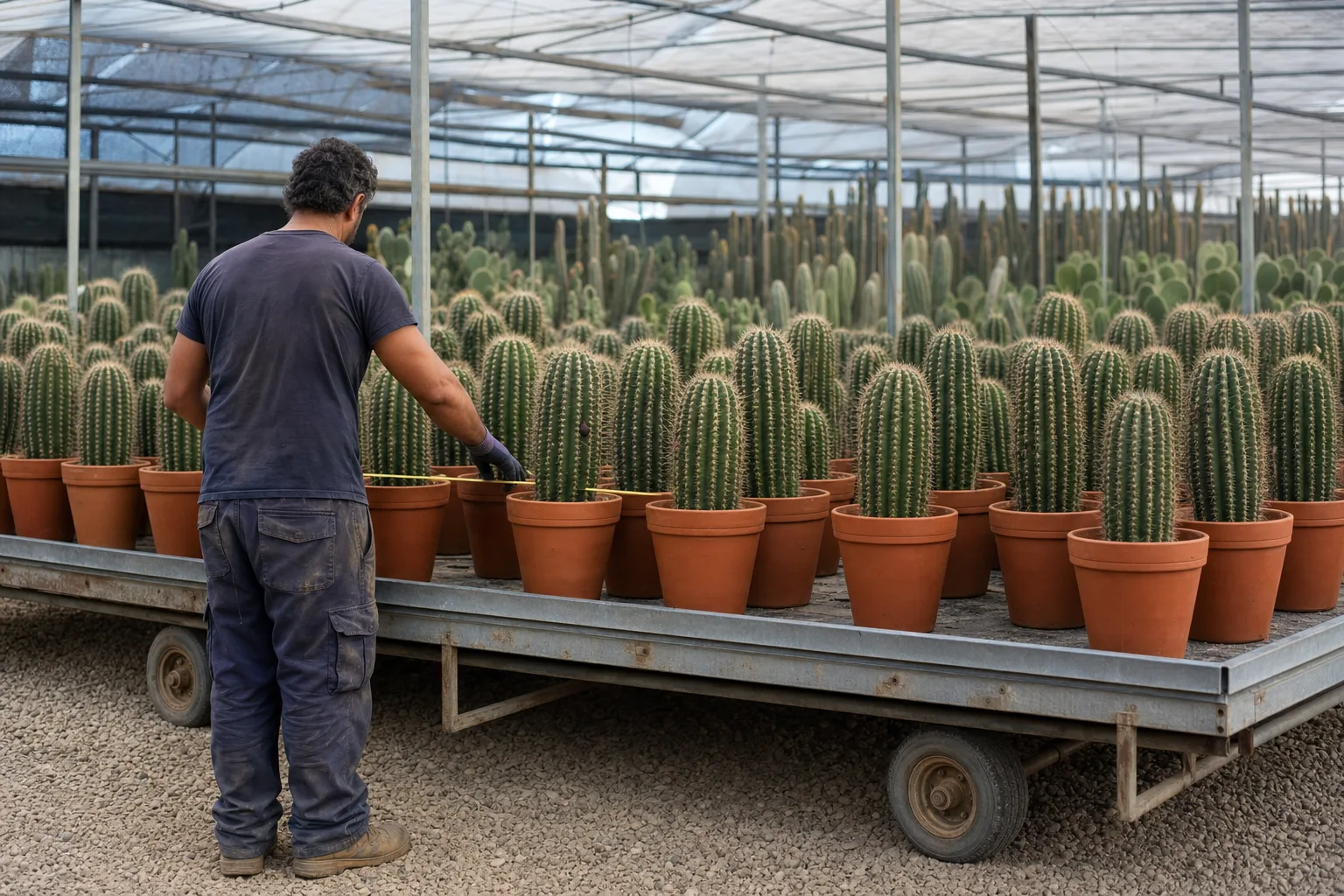
Cultivation densities in benches: cm between plants and lot rotation
The cultivation density on benches is the variable that turns an orderly greenhouse into a profitable system… or into a corridor of humidity, lateral shade, and silent losses. In Trichocereus and ornamental columnar cacti, "putting more plants per square meter" seems like the obvious leverage for margin. In practice, the centimeter between pots determines aeration, uniformity of size, turnover speed of the batch, and labor costs for irrigation, cutting, and shipping.
This guide translates density into operational decisions: cm between plants according to phase and size, design of fixed or mobile benches, batch rotation criteria, and signals that you are over-densifying. The approach is that of a professional Mediterranean nursery, consistent with the production of Tricholand in Murcia (~2,500 m²) aimed at the European wholesale channel. If you are sizing a columnar program or want to compare types and sizes with realistic densities, you can request a wholesale quote or technical advice.
What does "density" mean on benches (and what it does not)
It is necessary to separate three metrics that are often mixed in the same spreadsheet:
- Plant density: units per m² of bench or per m² of greenhouse (gross vs net).
- Spacing: cm center to center or edge to edge between containers.
- Bench occupancy: % of useful table surface relative to the greenhouse floor (aisles, pillars, service areas).
A mobile bench can increase the net occupancy of the greenhouse by reducing permanent aisles, but it does not allow pots to be placed too close together. Air and lateral light remain limited resources. In cacti, the humidity trapped between stems and the lack of substrate drying weigh more than in leafy crops that "close the canopy" intentionally.
Agronomic principles before the numbers
The columnar cacti of the Trichocereus / Echinopsis group grow vertically and demand high light and neck aeration. In dense benches, the following typically appear in this order:
- Lateral shading → stretching, dull color, smaller diameter.
- Humid microclimate between plants → mealybugs, mites, neck fungi.
- Uneven irrigation (edges dry, center remains wet) → heterogeneous type within the same batch.
- Poor labor access → more time per plant in selection, labeling, and loading.
The optimal density is the one that maximizes sellable plants per m² and per week, not the one that maximizes sitting plants. A batch at 95% occupancy with 8% loss and two extra weeks of grading usually loses to an 80% clean occupancy that rotates sooner.
Indicative spacings by phase (northern hemisphere)
The following cm are starting points to validate in your climate, shading mesh, and irrigation system. Measure edge to edge between pots or, if you prefer, center to center subtracting diameters. Adjust upwards in humid winters and in poorly ventilated greenhouses.
Phase A — Rooting cuttings (tray / pot 8–12 cm)
- Objective: secure callus, white roots, visual inspection of bases.
- Spacing edge to edge: 1–3 cm minimum; better 3–5 cm if ambient humidity is high.
- Indicative density: high, but never "closed carpet" that prevents seeing the neck.
- Notes: very mineral medium; first irrigation moderate. High density here is justified because the aerial volume is still low.
Phase B — Young growth (pot 12–17 cm, heights 15–35 cm)
- Spacing edge to edge: 4–8 cm.
- Center to center (e.g. pot Ø14 cm): ~18–24 cm.
- Indicative density: 16–30 plants/m² of bench depending on pot diameter and height.
- Alarm signal: stems leaning against each other or leaves/spines weaving a continuous lateral canopy.
In vigorous types like Trichocereus pachanoi, the diameter increases rapidly in spring: a "just" spacing in March may be insufficient in June. Schedule an intermediate respacing or leave margin from the start.
Phase C — Intermediate commercial size (pot 2–5 L, heights 35–70 cm)
- Spacing edge to edge: 8–15 cm.
- Center to center: 25–40 cm depending on volume and growth habit.
- Indicative density: 6–14 plants/m² of bench.
- Priority: uniformity of type for garden center and export.
Here, batch rotation weighs more than squeezing two extra plants per table. A clean size of T. peruvianus or T. bridgesii sells faster and with less quality negotiation.
Phase D — High size / mothers / landscape in container
- Spacing: 40–80+ cm center to center depending on height and risk of tipping.
- Density: low to very low; often grown in greenhouse soil or large container outside of narrow benches.
- Notes: anchoring, temporary staking, and wheelbarrow access matter more than theoretical m².
For slow-growing cardones like T. terscheckii / pasacana, densifying does not accelerate growth: it only complicates management.
Fixed bench vs mobile bench
Fixed tables require permanent aisles (approximately 60–90 cm for footwork; 90–120 cm with carts; more with pallet jacks). Rolling benches allow collapsing the aisle to a single service street, increasing the cultivable area of the greenhouse. Suppliers of commercial greenhouse systems document occupancy gains when the design balances productive density and labor ergonomics.
Practical criteria for columnars:
- Table height: 70–90 cm usually facilitates neck inspection and labeling.
- Table width: 1.2–1.8 m accessible from both sides; if access is only from one side, do not exceed ~70–90 cm of working depth.
- Weight: pots with lapilli and tall columnars weigh more than cutting trays; check nominal load (kg/m²).
- Table drainage: grid or surface that does not retain puddles under the pots.
The mobile bench does not replace the spacing between plants: it only improves the bench/floor ratio.
Batch rotation: from occupancy to flow
"Batch rotation" is the complete cycle: entry of material (cutting or seedlings) → cultivation phases → selection → shipping → cleaning/disinfection of table → new filling. Density interacts with each link.
Useful indicators
- Days of occupancy per phase (rooting, growth, finishing).
- % of type A / B / rejection at the time of loading.
- Sellable plants / m² / month (key metric).
- Labor hours / 100 plants in respacing, manual irrigation, and picking.
- Hidden loss: plants that "occupy" the table but will not be included in the order.
Professional rotation rules
- Do not mix ages in the same table cell if you can avoid it: single irrigation punishes the most sensitive end.
- Define quality gates (height, diameter, color, health) before moving to the shipping area.
- Clear the table in bulk: emptying and cleaning 10 m² completely is usually more efficient than "creating gaps" endlessly.
- Scheduled respacing: better a planned redistribution than an aggressive initial densification.
- Quarantine for entries: new material does not dilute density in the heart of the healthy batch.
In a Mediterranean climate, spring compresses growth timelines: a batch that "fits" in high density in winter may require opening aisles in April. Anticipate this in bench planning, not when you already have stems rubbing against each other.
Rotation and orders: synchronize table with sales
Density only generates margin if the sales team sells what the table can release. Typical misalignments: selling high sizes that still occupy finishing density; promising type A when the center of the table is still B; or leaving "bridge plants" that block emptying. A weekly ritual of 20 minutes —cultivation manager + sales— reviewing occupancies and pending orders prevents the bench from becoming an improvised warehouse.
In European distribution, the loading window also conditions the density of the shipping area: concentrate there only what will be shipped in 48–72 h and keep the crop active at agronomic densities, not at dock densities.
Light, irrigation, and density: the triangle that cannot be broken
If you increase density, you must compensate (or accept poorer type) in:
- Light: less lateral shade; review mesh; orient tables for uniformity.
- Ventilation: exhaust fans, side windows, air aisles; high relative humidity + density = risk.
- Irrigation: mineral substrate and shifts that allow the center of the table to dry; avoid trays with permanent water.
- Nutrition: do not "force" with high N to compensate for shade: you will get soft tissues.
A draining medium —pumice, lapilli, low fraction of fines— is an ally of moderate-high densities because it accelerates drying between irrigations. Density should never be "fixed" by degrading the substrate towards more peat.
Plant health and densities
Mealybugs and mites take advantage of closed microclimates between columnars. In dense batches:
- Inspect the interior of the table, not just the aisle.
- Leave inspection aisles every certain number of rows.
- Isolate hotspots without waiting for the end of the cycle.
- Clean remnants and old labels when emptying: rotation includes hygiene.
IPM in dense benches fails when the operator cannot see the lower third of the stem. If spacing prevents that inspection, you are over-densifying even if Excel says otherwise.
Quick calculation example
Useful bench of 1.5 m × 10 m = 15 m². Pot Ø14 cm, center to center spacing 22 cm → ~4.5 plants/m linear in width and ~45 in length ≈ 200 theoretical plants. With internal handling aisles or irregularities, plan for 170–190. If after 10 weeks 12% do not meet type A, your "real sellable density" drops to ~150–165. Compare that number with a spacing of 26 cm that fits fewer plants but delivers 95% type A two weeks earlier: flow usually wins.
Density calendar (indicative, northern hemisphere)
Winter: somewhat wider densities in finishing due to slow drying; rooting possible if there is root temperature. Spring: maximum vigilance on respacing; rapid growth. Summer: watch for heat stress on edges; the center of dense tables can bake or, conversely, remain wet depending on irrigation. Autumn: do not densify finishes that will winter: prioritize aeration.
To expand management of species and types, review the variety catalog and the technical blog of Tricholand.
Frequently asked questions
Can I place pots close together in the finishing phase to "fill the visual truck"?
Only temporarily before loading, not as a permanent cultivation. Cultivating pots close together for weeks degrades type.
Does the mobile bench justify more density between plants?
No. Justify more m² of bench per m² of greenhouse. The plant-to-plant spacing follows rules of air and light.
What density should I use for bridgesii cuttings versus pachanoi?
Similar in rooting; in growth, adjust to the expected vigor and diameter. Bridgesii and pachanoi may differ in pace: observe, do not copy a single table forever.
How do I know I need to open the batch?
When there is frequent contact between stems, uneven color between center/edge, wet necks, or inability to inspect without moving three pots.
Conclusion
The optimal density in Trichocereus benches is measured in marketable plants per m² and by cycle time, not in tightly packed pots. Work with explicit cm per phase, program respacing, design tables that drain and ventilate, and rotate batches in blocks with quality doors. If you want to align production calibers with your table plan or check availability for wholesale programs in Europe, the Tricholand team can assist you with cultivation experience in Murcia.