
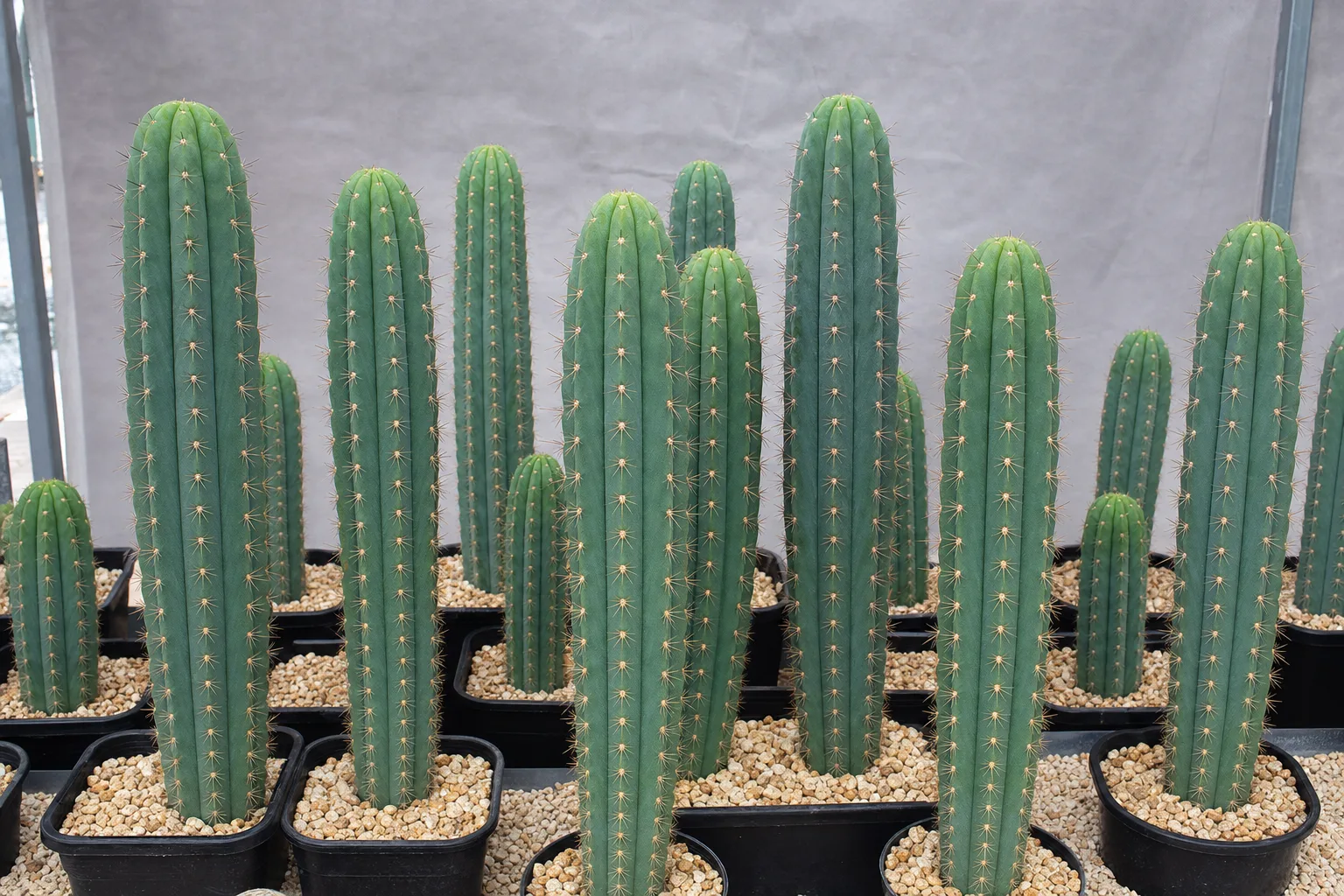
How to Photograph Trichocereus for Wholesale Product Sheets
In the wholesale channel, the product sheet is the plant that the buyer sees before seeing the actual plant. A well-taken photograph of Trichocereus reduces emails asking “what is the real color?”, speeds up the order process, and protects the nursery from claims due to unrealistic expectations. A poor photo—burned light, chaotic background, ambiguous size, made-up typology—does exactly the opposite, even if the batch is excellent.
This guide explains how to photograph columnar cacti for B2B catalogs, availability lists, wholesale websites, and garden center sheets: light, background, angles, scale, minimum set, greenhouse workflow, and representation ethics. The focus is ornamental and commercial, aligned with the production of Tricholand in Murcia. If you need material with consistent typology for your channel, you can request a catalog and conditions or check available sizes.
What a professional buyer needs to see
The B2B buyer is not looking for lifestyle inspiration: they seek a purchasing decision. In just a few seconds, they evaluate:
- Typology: color, apparent number of ribs, spination, columnar growth, vigor.
- Size: relative height and diameter (with scale reference).
- Visible health: clean neck, no active spots, no evident transport damage.
- Commercial presentation: pot, label, cleanliness of substrate/mulch.
- Honesty: that the photographed item resembles what will arrive in the order.
That’s why the wholesale sheet photo differs from the Instagram photo: less drama, more information. Nurseries that document good catalog practices agree on prioritizing clean backgrounds, controlled light, and uniform aspect ratios among references.
Minimum viable set (without studio, impossible)
A fashion studio is not necessary. What is needed is repeatability.
- Neutral background: light gray seamless paper, off-white or beige; matte rigid panel; or clean wall without competing textures. Avoid greens that blend with the stem.
- Surface: stable table of the same color as the background or slightly darker to anchor the pot.
- Diffuser: translucent panel, stretched sheet, or softbox; direct midday sun burns waxy cuticles and distorts green.
- White reflector (porex or cardboard) to open shadows on the side opposite to the light.
- Tripod or support: sharpness and repeatable framing between SKUs.
- Scale: ruler, height witness, or pot of known diameter always in the same protocol (even if you later crop it in some variant, keep the master with scale).
- Camera: mirrorless/DSLR with 35–50 mm (equivalent) or recent mobile in pro mode; what matters is light and consistency, not megapixels.
Color temperature: set a balance (e.g., 5200–5600 K in filtered daylight) and do not change it between photos of the same catalog. A batch that appears “more yellow” on the web than in the greenhouse creates friction.
Light: the factor that most enhances columnar green
Columnar cacti have matte-waxy surfaces and spines that create highlights. Objectives:
- Diffuse side light at 30–45° to model ribs without flattening the volume.
- Avoid strong backlighting in the main shot (it can be used in a secondary texture photo).
- Avoid midday sun without a diffuser: high lights without detail and washed-out greens.
- Early morning or late afternoon outdoors, or filtered greenhouse light + diffuser.
- Circular polarizer (optional) to reduce specular highlights on cuticle and plastic pot.
If you photograph inside a productive greenhouse, visual chaos (other plants, drippers, nets) competes with the subject. Solution: portable background behind the plant or move the specimen to a photographic picking corner. Cleaning the environment is not vanity: it’s B2B reading speed.
Mandatory angles and shots per SKU
A professional wholesale sheet set usually includes:
- Hero front view: complete plant, centered, 5–10% margin at the edge of the frame; pot visible.
- Profile / 45°: for volume and ribs.
- Detail of spination and areoles (soft macro): typological identity.
- Detail of neck and substrate surface: health and presentation.
- Scale photo: with ruler or next to an object of known size / comparison of sizes of the same SKU.
- (Optional) batch group: 3–5 plants to show uniformity—highly valued by garden centers.
Keep the same camera height relative to the pot across all SKUs in a catalog. If one day you shoot at neck height and another at apex height, the typologies may appear different even if they are not.
Scale and size: don’t unintentionally lie
The most costly error in photos of columnar cacti is size ambiguity. A Trichocereus of 25 cm and one of 60 cm can occupy the same frame if you bring the body closer. Protocol:
- Always include a scale reference in the master.
- Standardize focal distance and subject-camera distance by height range (e.g., protocol A <40 cm, protocol B 40–80 cm).
- In the sheet, write the commercial size next to the image (“40–50 cm, 3 L pot”).
- Do not use mother typologies of 1.5 m to illustrate the SKU of 30 cm.
Link the photographed typology with the correct variety sheet: T. pachanoi, T. peruvianus, T. bridgesii, or T. terscheckii. The botanical name and the photo must tell the same story (see also the importance of catalog labeling).
Plant preparation (nursery style, not fashion studio)
- Choose a specimen representative of the medium-high percentile of the batch, not the impossible unicorn to replicate.
- Clean substrate dust from ribs with gentle air or a dry brush; avoid excessive water highlights that simulate an unrepeatable “freshness” at destination.
- Remove old labels, threads, and peat remnants from the edge of the pot.
- Align the mineral mulch if it is part of the commercial presentation.
- Do not hide serious structural defects with impossible angles: if the batch has typology B, photograph typology B or separate SKUs.
A little pre-watering can tense tissues, but excessive droplets and waterlogged substrate appear unprofessional in B2B. Prioritize the appearance of a plant ready for shipment.
Background, cropping, and catalog consistency
For wholesale listings with dozens or hundreds of references, consistency outweighs virtuosity:
- Same background color for catalog season.
- Same ratio (e.g., 4:5 or 1:1) according to channel (web, PDF, marketplace).
- Same margin around the plant.
- Same shadow logic (light direction).
If you shoot in a greenhouse and then clean the background, do it judiciously: edges of spines and areolar hairs are delicate; an aggressive crop leaves halos. Better a clean real background than a dubious mask. Background erasing tools help in e-commerce, but the original must be sharp and well-exposed.
Editing: what is allowed and what breaks trust
Acceptable: cropping, straightening, lens correction, global exposure/contrast adjustment, white balance, dust removal from sensor, minor cleaning of particles in the background.
Dangerous or unacceptable in B2B: saturating greens to an unrealistic typology, thinning or thickening the stem, cloning ribs, erasing relevant structural scars, changing spine color, “stretching” the plant.
The professional buyer compares the photo with the first opened box. The photo should gain clarity, not win a fantasy contest.
Workflow in the nursery (operational)
- Define a photographic calendar by batch rotation (do not photograph on the day of maximum water stress or immediately post-transplant).
- Prepare a fixed photo corner near shipping.
- Shoot by SKU with strict file naming:
SKU_height_date_angle.jpg. - Select 1 hero + 2–4 supporting shots.
- Archive masters without compression (high-quality TIFF/JPEG) and export web in controlled weight.
- Update the sheet and availability PDF the same day; an old photo from another season is technical debt.
- Review quarterly: typologies change with selection and climate.
Integrate the photo into the same system where botanical synonyms and sizes reside. An orphan image on a local disk is of no use to the salesperson responding to WhatsApp at 19:00.
Special cases: spines, height, and groups
Highly spined species
Slightly increase diffusion and use a reflector so that the spine does not obscure the detail of the stem. Always include a macro of the areole: it is a key identifier in bridgesii compared to other typologies.
Tall columnar cacti
Shoot vertically; do not force a 1:1 that cuts off the apex. If the greenhouse ceiling limits, photograph outdoors with a portable background or use two shots (base + apex) labeled as detail, plus one complete hero from a greater distance.
Group photo / uniformity
Place 3–5 plants in a gentle diagonal, same orientation of ribs if possible, with space between pots so they do not visually merge. This shot sells batch confidence.
Frequent mistakes
- Background of a full bench: the eye does not know which is the product.
- Shadow of the photographer or mobile within the frame.
- Different balances per session → rainbow catalog.
- Hero without pot or scale.
- Using exceptional flowering as the only photo of a vegetative SKU.
- Over-compressing: artifacts in fine spines.
- Photographing under stress (cold + humidity) with atypical dull color of the sale size.
Quick checklist before publishing a sheet
- Does the hero show the complete plant with pot?
- Is there at least one typological detail (spines/ribs) and a scale reference?
- Does the color resemble what the customer will see at noon in the greenhouse, not a nighttime filter?
- Does the file name and SKU match the ERP and label?
- Is the photographed typology available in the announced size?
- Does the background and ratio match the rest of the catalog for the season?
If you mark six yeses, the photo is ready for B2B. If scale or typology fails, redo it before retouching.
Relationship with the Tricholand brand and channel
A clear sheet connects typology, name, and wholesale offer. Support your photos with links to varieties and technical content from the blog. Photography does not replace advice, but it reduces friction prior to ordering in a nursery that distributes to 18+ countries with EU passport. In retail and landscaping projects, an honest image shortens negotiation as much as a good price per size.
Frequently asked questions
Is just a mobile sufficient?
Yes, if you control light, background, tripod, and consistency. The cheapest quality leap is not the camera body: it’s the diffuser and the background.
Pure white or gray background?
Pure white requires exposure control to avoid losing the edge of the clear stem. Light gray is usually more tolerant and professional in PDFs.
How many photos per SKU?
Minimum 3 (hero, detail, scale). Ideal 5–6 for wholesale web.
Should I re-photograph each batch?
Re-photograph when the media type, container, or visual season changes. It is not necessary every week if the batch is stable; it is necessary when the sales representative says “it no longer looks the same.”
Closure
Photographing Trichocereus for wholesale sheets is a visual quality control process: diffuse light, neutral background, explicit scale, repeatable angles, and honest editing. When the image, botanical name, and size match, the B2B order flows smoothly. If you want to work with consistently typed material from our own production in Murcia, contact Tricholand for a wholesale quote or to align needs for sheets and European supply.