
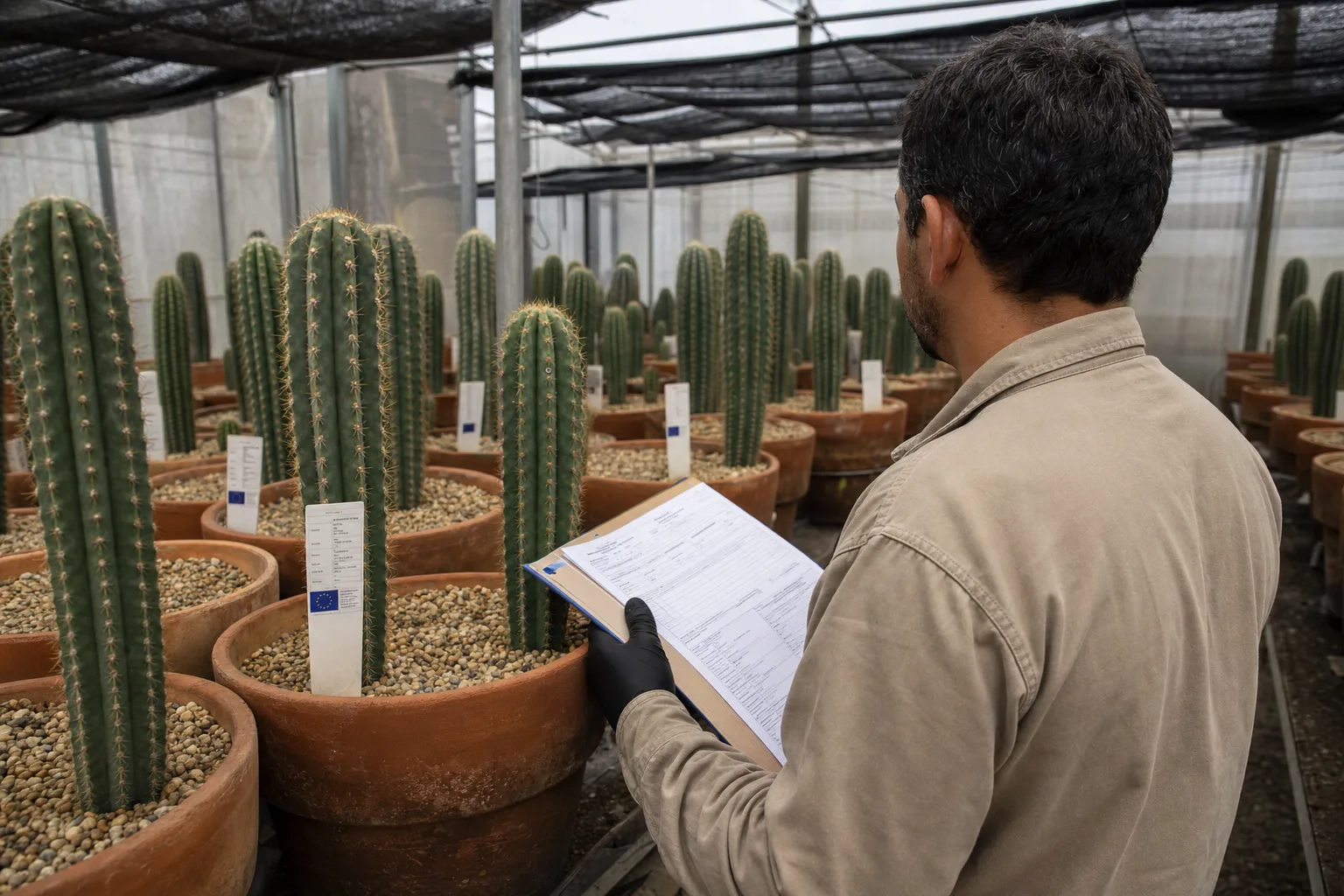
Phytosanitary documentation UK and EU for shipments of columnar cacti
Sending columnar cacti between nurseries, garden centers, and distributors is no longer just a matter of packaging and temperature: phytosanitary documentation determines whether the batch circulates smoothly or is stopped at the border, during a document check, or upon receipt by the professional customer. For operators working with Trichocereus and other columnar cacti from Spain to the rest of the European Union or to the United Kingdom, it is advisable to clearly separate two worlds: the plant passport in the EU internal market and the phytosanitary certificate — along with pre-notification and controls — when the destination is Great Britain.
This guide summarizes, with an ornamental and wholesale focus, which documents are usually involved, who is obligated to do what, and how to prepare a shipment of columnar cacti without inventing deadlines or certifications. Regulations evolve; in case of any operational doubts, it is always advisable to consult the official pages of the European Commission (plant health) and GOV.UK / DEFRA-APHA. If you need to align a specific order with export documentation, you can speak with the technical team at Tricholand.
Why columnar cacti fall under the planting material regime
Columnar cacti marketed in pots or as living material intended for further cultivation are, for practical purposes, plants for planting. This places them at the core of the European phytosanitary regime: traceability, registered professional operators, and, in commercial circulation within the EU, a plant passport. They are not a "dried product" or a souvenir: they travel with a potential risk of pests and are required to maintain backward traceability of the batch.
For the professional buyer — nursery, garden chain, or distributor — documentation is not abstract bureaucracy: it is part of the supplier's quality. A beautiful batch without correct traceability can be unsellable in channels that audit suppliers. A well-documented batch reduces rejections, speeds up warehouse entry, and facilitates re-shipping to other operators.
European Union: plant passport as the rule of the internal game
The general framework of the EU is articulated around the Regulation (EU) 2016/2031 on protective measures against plant pests, developed by implementing acts — including Regulation (EU) 2019/2072 — that detail lists and conditions. In operational terms for an ornamental nursery:
- The movement between professional operators of plants for planting generally requires a phytosanitary passport.
- The passport certifies that the material meets applicable plant health requirements and allows traceability.
- Only authorized operators under the supervision of the competent authority of the member state can issue it.
- Direct sales to the end user at a physical point of sale usually have different treatment than distance sales, where the passport becomes especially relevant again.
In Spain, the reference authority informs about the phytosanitary passport (MAPA) and the registration of professional operators. If you produce or redistribute, your typical obligation is not to "memorize all the annexes," but to be correctly registered, authorized when necessary, and to keep examinations, records, and labeling in order.
What should be seen in practice in an EU shipment
In a wholesale order of Trichocereus between two operators in the Union, it is common for each commercial unit — pot, tray, or defined grouping — to travel with its passport or with the labeling system that allows associating the passport with that unit, according to the authorized format. The professional customer must be able to identify origin and traceability. The carrier does not replace the passport: the documentary responsibility lies with the chain of operators.
Good practices for the producing nursery:
- Do not physically separate the plant and label in a way that loses the batch correspondence.
- Keep outgoing records (customer, date, quantity, traceability code) for the required time.
- Avoid opaque reconfigurations: if pots are changed, batches are mixed, or new compositions are made, it may be necessary to issue a new passport.
- Train the warehouse staff: an operator who "cleans old labels" can invalidate an entire shipment.
Imports to the EU from third countries
When material enters the Union from outside, the typical border document is the phytosanitary certificate issued by the national plant protection organization of the exporting country, in accordance with EU rules. Once inside, to continue moving that material between operators, the passport usually comes into play. The Commission's plant trade page summarizes the principle: inspection, compliance, and certificate for entry; passport for subsequent circulation when applicable.
For a European distributor purchasing already produced columnar cacti within the EU, the day-to-day operation is the passport. For those importing from outside, the process is heavier and requires planning with customs agents and control points.
United Kingdom (Great Britain): phytosanitary certificate and pre-notification
After Brexit, Great Britain does not behave like another member state for the purposes of free circulation with the EU passport. For plants from the EU, the official import guide indicates a scheme that, in operational summary, includes:
- Importer registration when applicable.
- Phytosanitary certificate issued at origin for the shipment.
- Pre-notification to British authorities through the enabled systems (IPAFFS in usual practice).
- Possible documentary, identity, and physical checks, with associated fees.
- Management of the UK plant passport for certain subsequent movements within Great Britain.
The primary reference for importers is on GOV.UK: importing plants from the EU to Great Britain. For the passport framework in British territory, see guidance on issuing UK plant passports and the DEFRA plant health portal. Rules may be updated: do not replace the official consultation with an old PDF from the supplier.
Key difference: EU passport vs. certificate for the UK
A common mistake in warehouses is to believe that "since it already has a European passport, it is valid for the UK." In post-Brexit logic, shipments to Great Britain are treated as export/import with a phytosanitary certificate, not as a simple internal EU transfer. The EU passport remains essential for the life of the batch within the European market; crossing into GB adds a distinct documentary layer.
Practical implications for the exporter in Spain:
- Coordinate with the competent authority the issuance of the phytosanitary certificate for the shipment.
- Align inspection, packaging, and departure dates: certificates have time validity windows concerning dispatch.
- Prepare species and quantity lists consistent with what is actually being shipped.
- Package in a way that allows control to identify the contents without destroying the batch.
- Anticipate with the British customer who will pre-notify, who pays fees, and to which depot the goods will arrive.
Subsequent movements in Great Britain
Once the material has entered, the importer may need a UK plant passport for certain movements to other professional operators, distance sales, or other circumstances described in the official guide. This means that the British customer also has their own obligations: not everything ends when the truck crosses. A serious supplier explains this in the offer; an improvised supplier discovers it when the customer complains.
Northern Ireland and territorial nuances
The United Kingdom is not a homogeneous block for phytosanitary purposes. Northern Ireland has specific arrangements regarding the European internal market that may differ from those of England, Wales, and Scotland. If your customer speaks generically about "the UK," clarify the exact destination before promising documentation. When in doubt, refer to the GOV.UK guides for Great Britain and inquire on a case-by-case basis for Northern Ireland.
What a columnar cactus nursery should prepare (operational checklist)
Before the order
- Confirm that the buyer is a professional operator when the channel requires it.
- Define the destination: intra-EU, GB, or another third country.
- Agree on Incoterms and who manages import procedures at the destination.
- Reserve an inspection/certificate window if the destination requires it.
- Verify botanical names used on labels and documents — Trichocereus / Echinopsis — to avoid formal discrepancies.
During the preparation of the batch
- Health selection: plants free of visible mealybugs, rot, and waterlogged substrate.
- Correct EU passport labeling for European shipments.
- Packaging that prevents injuries — entry points for fungi — and allows inspection.
- Loading list aligned with the certificate when it exists.
- Internal record of batch, customer, and date.
After the shipment
- Keep documentary copies.
- Attend to possible requirements from authorities or customers upon receipt.
- If there is an incident, do not "rewrite" labels informally: correct through the authorized procedure.
Real plant health behind the paper
The document does not replace control at the nursery. A certificate or passport is supported by self-controls, hygiene, separation of suspicious batches, and the ability to react to regulated pests. In columnar cacti, the most common incidents upon receipt are not always exotic quarantine organisms: they are often mealybugs, transport damage, or neck moisture. Nevertheless, a dirty history complicates any audit.
Production recommendations linked to export:
- Clean shipping areas free of reservoir weeds.
- Review axils and base of spines before packing.
- Well-draining substrate and timely irrigation cut to travel reasonably dry.
- Nursery traceability (table, shift, origin of cutting or seed) that supports the batch code.
Tricholand, as a producing nursery in Murcia with European distribution, works with EU plant passports in its shipments and with the additional documentation required for exports outside the internal market. It does not replace the importer in their local obligations, but it does reduce friction when the origin file is well organized. For requesting a catalog and conditions or contrasting a UK destination against an EU destination, the professional contact channel is the starting point.
Common mistakes that generate rejections or delays
- Assuming that the EU passport is sufficient for Great Britain.
- Declaring species or quantities different from those loaded.
- Losing labels during last-minute repackaging.
- Not pre-notifying in time at destination when the regime requires it.
- Sending material with evident symptoms "because the paperwork is already done."
- Using trade names without coherent botanical backing in the documentation.
- Mixing batches from different origins without new traceability.
Any of these mistakes can cost more than the order margin: chain delays, reshipments, partial destruction, or loss of trust from distributor clients.
How to discuss documentation in the commercial offer
In wholesale quotes, a clear and sober clause is advisable:
- EU: plant passport included / movement between professional operators.
- UK or other destinations: phytosanitary certificate and associated procedures according to current conditions; costs and deadlines to be confirmed per shipment.
- Responsibilities of the importer in pre-notification and controls.
- Commitment to consistency between packing list and official documentation.
Avoid promises like "without papers" or "as before Brexit." The professional client appreciates precision more than optimism. If your network sells in eighteen or more European countries, standardize a phytosanitary annex by area instead of improvising in each email.
Relationship with the catalog and logistics of columnar cacti
Documentation travels better when the catalog is clean: well-identified species, defined calibers, and homogeneous batches. A chaotic assortment of hybrids without a clear name complicates certificates and labels. Therefore, in volume purchases, it makes sense to work with stable sheets from the variety catalog —pachanoi, peruvianus, bridgesii, terscheckii— and leave the rarities for channels that can handle that complexity.
Logistics and paperwork go hand in hand: a certificate issued for a departure date does not fit with packaging delayed by two weeks without checking validity. Coordinate production, picking, and administrative dispatch as a single operation. The Tricholand blog delves into batch quality and wholesale purchasing; this article focuses on the documentary layer that supports that quality in transit.
Frequently Asked Questions
Does the EU phytosanitary passport work for selling in a garden center in another member state?
In circulation between professional operators within the EU, the passport is the usual tool. The exact conditions for selling to the final public depend on the channel; distance selling has particularities. Consult the competent authority if you operate a cross-border ecommerce.
What document do I request if I import columnar cacti from Spain to England?
As an importer in Great Britain, the official guide points to the phytosanitary certificate from the exporter, pre-notification, and the rest of the applicable controls. Do not base the process solely on the EU passport from the nursery.
Can I reuse the same passport if I change the potted plants?
Reconfiguring trade units may require a new passport. Do not improvise: if you alter the traceable unit, review the procedure with your operator authorization.
Do cactus seeds follow the same rules as potted plants?
The regime for seeds and that for planting plants may differ depending on species and destination. Do not assume equivalence; verify the specific case in the regulations and with the competent authority.
Does Tricholand manage UK documentation?
Tricholand handles specialized shipments with EU passport and export documentation according to destination, within the verifiable facts of its wholesale service. Each UK shipment must be confirmed under current conditions; requesting a wholesale quote is the way to specify species, volumes, and paperwork.
Conclusion
Phytosanitary documentation is not a decorative annex to the delivery note: it is part of the product when selling columnar cacti on a professional scale. In the EU, the plant passport structures trust between operators. Towards Great Britain, the phytosanitary certificate and pre-notification define whether the batch enters or complicates. Work with suppliers who understand both logics, maintain traceability, and always verify the official sources from the Commission, MAPA, and DEFRA/APHA.
If you are setting up a supply network for Trichocereus from a producer nursery with its own facilities in Murcia, you can learn more about the model at about us or go directly to contact to align catalog, destination, and file. The plant arrives better when the paperwork was well thought out before closing the box.