
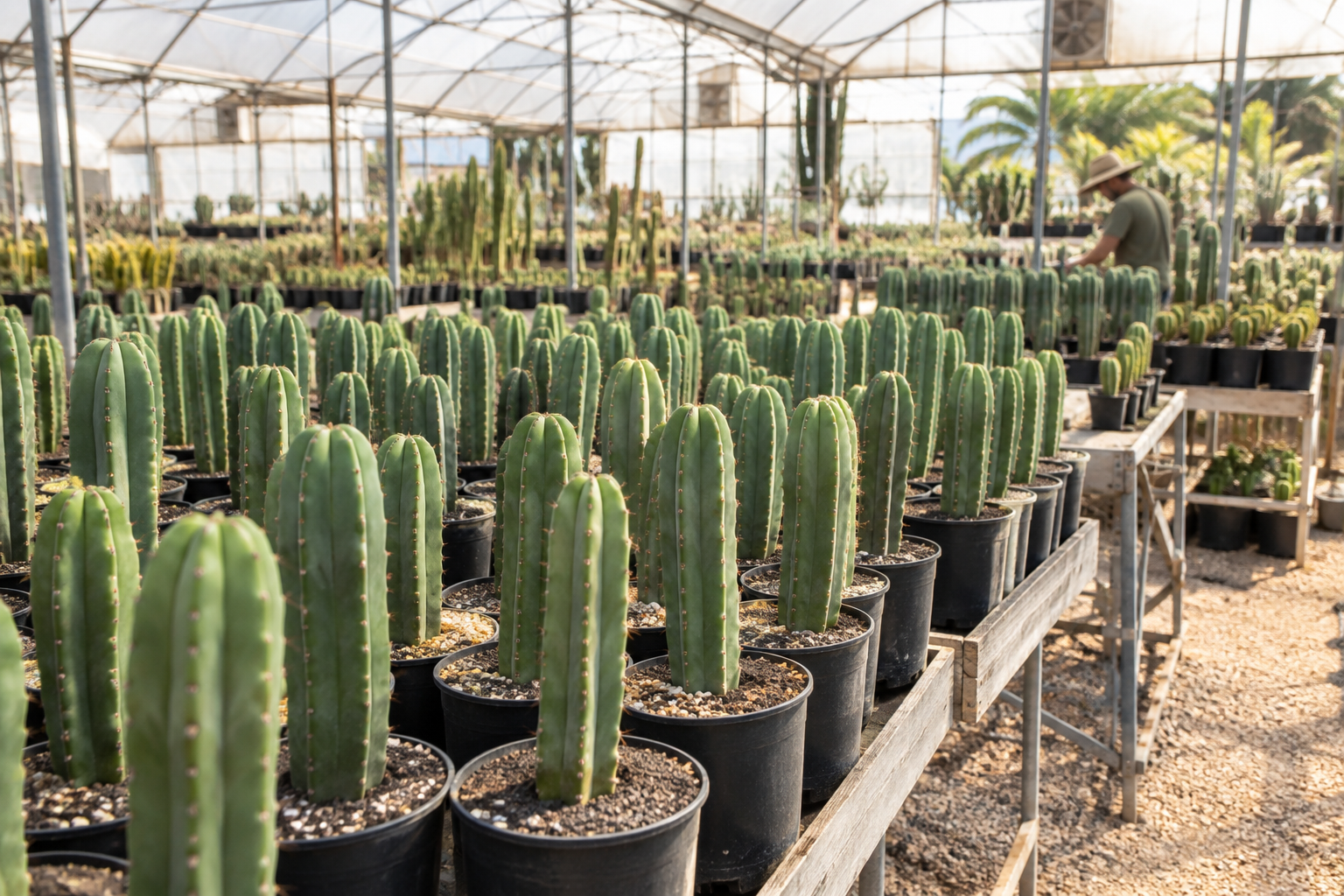
Trichocereus Made-to-Order Order Plan: Lead Times and Reservations with Producer Nursery
Professional purchase of Trichocereus should not be resolved solely when the sales campaign approaches. In columnar cacti, the commercial size depends on biological processes that cannot be accelerated without compromising the root system, plant stability, or its final appearance: material healing, root emission, acclimatization, seasonal growth, and hardening prior to shipment. For a garden center, distributor, or landscaping company, reserving in advance transforms an uncertain purchase into a traceable supply program.
Planning is especially relevant in spring and summer, when demand increases for architectural outdoor plants, cactus collections, and xerophytic gardening projects. A producer nursery can size space, propagation material, container, and tasks if it receives a clear forecast. At Tricholand, a producer nursery specialized in columnar cacti with its own facilities in Murcia, early coordination allows studying orders from professional volume, target sizes, and documentation needs for European destinations.
Why the lead time of a Trichocereus depends on size
The term lead time encompasses from the technical confirmation of the order until the batch is ready to leave the nursery. It does not only mean transport time or visible stem growth. In Trichocereus, a horticultural name that coexists in the literature with Echinopsis, factors include availability of mother material, propagation method, time of year, requested height, diameter, pot type, and required uniformity level.
A batch of freshly prepared cuttings should not be automatically considered sellable. After cutting, the base needs to form a dry, intact callus without soft spots; then it must emit functional roots in an aerated substrate with prudent watering. Only then can it start a commercial thickening phase. The cycle lengthens in autumn and winter due to lower radiation and reduced temperatures, while excess water or heat at the wrong time can delay the process due to sanitary losses.
Therefore, the correct specification is not simply to order a 30 cm plant. It is advisable to define whether the measurement is the height of the plant body or total height including pot, the allowed tolerance, number of stems, straightness, rooting degree, and final presentation. These variables explain why two apparently equivalent offers may require different production lead times and costs.
Reservation windows for spring and summer campaigns
As an operational rule, a spring campaign should begin to be designed during the previous summer and autumn. Between July and October is a good time to submit forecasts for the following spring, especially when homogeneous batches, specific species, or already formed plants are requested. For deliveries between March and May, technical reservation before the end of autumn allows the producer to allocate material and avoid the order being conditioned by late winter surpluses.
Summer deliveries, usually concentrated between June and September for outdoor projects and retail replenishments, should be planned from autumn until the first quarter of the year. A confirmed order in spring can be viable if working with already available plants, but should not be considered as new production of large size. Immediate availability and made-to-order cultivation are two different modalities: the first depends on commercial stock; the second reserves a production itinerary and requires agronomic margin.
- July-October: forecast of spring needs, definition of varieties, format, and destination.
- November-January: closing quantities, size tolerances, container, and delivery schedule.
- February-April: quality review, batch consolidation, and shipment coordination for the main campaign.
- May-July: reservations for late summer, autumn, or to start production for the following year.
This calendar must be adapted to the destination climate. A plant to be shipped to continental Europe or the North Atlantic requires that the receiver can keep it protected against persistent cold and moisture saturation. For outdoor installations, it is preferable to schedule arrival when frost risk is low and soil or container drainage is resolved.
Indicative lead times by commercial size
10-15 cm format: entry-level and rotation sale
Plants of 10-15 cm are useful for table assortments, collector packs, seasonal promotions, and subsequent growth programs in the client nursery. If propagated material is available and production starts in a favorable season, a minimum period of healing and rooting should be considered before evaluating shipment. As a planning reference, a new program usually requires several months to obtain a properly rooted, homogeneous, and hardened batch; for spring campaigns it is sensible to reserve six to nine months in advance.
In this segment, short height should not be confused with immature plant. A compact column can have excellent commercial quality if it has active roots, firm epidermis, healthy base, and a proportionate pot. Label uniformity, diameter, and presentation are usually more important than a minimal height difference between units.
25-35 cm format: central size for garden centers and distribution
The 25-35 cm range is one of the most versatile for specialized retail, garden centers, pot compositions, and medium-scale xerophytic projects. To produce it from cutting or young plant, it is prudent to work with a forecast of nine to eighteen months, depending on species, starting diameter, season of initiation, and quality specification. The plant must have enough time to consolidate roots and develop a stable body, not just to reach a length measurement.
If the purchase demands very uniform batches, unbranched stems, a particular color selection, or a minimum diameter, the period may increase. Demand for production Trichocereus pachanoi, for example, must be scheduled distinguishing between commercial name, batch origin, and required visual standard. Taxonomy is treated with caution: this species frequently appears as Echinopsis pachanoi in botanical and horticultural sources.
60 cm or larger format: structural plant and impact projects
Plants of 60 cm or more follow a different logic. They are structural elements for large containers, reception areas, hotels, restaurants, real estate promotions, and low-water-use landscaping. Their lead time should not be calculated by a simple annual centimeters rate: physiological age, thickness, root development, staking when appropriate, container stability, and capacity to face specialized transport intervene.
For new production of this size, a reasonable reference is eighteen to thirty-six months or more, especially if a homogeneous selection and premium finish are requested. In some cases, the producer may have formed plants for immediate programs, but it is not responsible to base a large-scale project on that possibility without availability confirmation. Reservation with at least a full campaign margin substantially reduces the risk of substitutions or presentation changes.
Minimum quantities, samples, and order scaling
Effective B2B planning distinguishes between commercial validation and production order. A sample pack of 50 units can serve to check acceptance, packaging, labeling, and behavior at the point of sale before replicating the program. However, it does not replace a production batch: the cost of selection, handling, and logistics per plant is higher in a sample than in a consolidated order.
As a reference to organize a professional campaign, a batch of 750 units allows ordering production by species, size, and presentation more efficiently. The real minimum quantity must be agreed in writing with the nursery, as it changes depending on size, variety, container, and customization. It may be convenient to divide the total into staggered deliveries, but that division must maintain agronomic and logistical logic: reserving 750 units of the same size is not the same as requesting small fractions of many singular references.
Before confirming, the buyer must establish a monthly sales forecast, the sales channel, and reception capacity. A garden center may prioritize broad assortment and replenishment; a distributor, stable palletization and reference continuity; a landscaper, visual homogeneity and a specific installation date. The cultivation program must respond to that final destination, not just a total unit figure.
What must be specified in writing to the producer nursery
The made-to-order request is safer when it becomes a clear technical sheet. The first version can be a forecast, but before starting specific tasks it must include criteria allowing batch verification at delivery. Ambiguity about size or presentation usually generates avoidable incidents.
- Botanical and commercial identification: requested species, sales name, and possible accepted alternatives. The Tricholand variety catalog can be consulted to guide columnar selection.
- Quantity and tolerance: total units, accepted variation margin, and distribution by reference.
- Verifiable size: cactus height without pot, allowed range, minimum diameter, number of arms if allowed, and required straightness.
- Format: container diameter and height, substrate, drainage, individual plant or composition, and staking need.
- Cultivation state: rooted, acclimated, hardened for shipment, and required aesthetic condition.
- Schedule: delivery week or window, partial deliveries, unloading point, and responsible person for reception.
- Commercial presentation: label, barcode, protective sleeve, own labeling, or palletization requirements.
- Plant documentation: destination country requirements and data needed to accompany shipment.
It is advisable to attach reference photographs, although they should be understood as a visual standard and not as a promise of absolute identity of each specimen. Cacti are living organisms: a reasonable tolerance of height, diameter, and natural traits allows maintaining program viability without lowering quality control.
Health, plant passport, and transport preparation
Production for professional movement within the European Union must be integrated into a traceability system. The phytosanitary passport is an essential element for plants subject to this obligation and must be handled from the start of the order, not as a last-minute procedure. For shipments outside the EU, including the United Kingdom when applicable, documentation and import requirements must be confirmed well in advance.
Water status before loading also matters. An excessively watered cactus weighs more, marks easily, and has a higher risk of damage on a journey with limited ventilation. Conversely, a properly hardened plant, with substrate that retains structure and without excessive moisture, tolerates handling better. The receiver must prepare a bright and covered area to inspect the batch, avoiding placing it immediately in cold, continuous rain, or intense full sun if transport and environmental change have been significant.
Production contracts: how to professionally share risk
A made-to-order cultivation contract is not just about reserving units. It must define confirmation schedule, acceptance standard, conditions for quantity changes, and how to communicate cultivation incidents. It is advisable to agree on follow-up milestones: confirmation of material and format, review of plants in development, pre-shipment validation, and final transport coordination.
It is also useful to foresee alternatives. If a reference does not reach the expected size on time due to agronomic causes, the parties may have agreed on postponement, a botanically close substitution, or a partial delivery. This planning protects both the buyer, who knows possible scenarios, and the producer, who can avoid hasty decisions incompatible with a quality ornamental plant.
Murcia offers favorable conditions for professional cactus cultivation due to its high luminosity and dry climate, but final quality still depends on technical management: balanced mineral-organic substrate, adjusted irrigation, moderate nutrition, and prevention of scale insects, rots, and cold damage. Requesting information about these criteria allows the buyer to better integrate the plant into their own cultivation or marketing circuit.
Frequently Asked Questions
How far in advance should a spring campaign be reserved?
For a made-to-order program, it is recommended to start the conversation between six and twelve months in advance. Sizes of 25-35 cm usually require more forecast than small formats, and those of 60 cm or more should ideally be planned with one or several campaign margins.
Can a batch of 750 units be requested divided among several species?
Yes, provided the distribution is specified by species, size, and presentation. The more references there are, the greater the need to forecast the order. It is preferable to agree on coherent quantities per reference than to create many lines too small for efficient production.
What is the difference between a stock reservation and made-to-order cultivation?
Stock reservation blocks plants already available or soon to be. Made-to-order cultivation schedules material, space, and tasks to reach a future standard. The latter requires more lead time but offers greater capacity to define size, format, and schedule.
Is it possible to start with a sample pack of 50 units?
A sample pack can be useful to validate the commercial response of a reference before a broader campaign. It must be consulted beforehand, as its availability depends on size, variety, and the producer’s batch planning.
What should be checked when receiving Trichocereus for a landscaping project?
Quantity, identification, agreed size, stem integrity, container stability, substrate moisture, and associated documentation must be reviewed. Before planting, ensure drainage, appropriate exposure, and frost protection according to local climate.
Early reservation allows turning the columnar cactus into a planned category, not an opportunistic purchase. To study sizes, made-to-order production, commercial samples, or a delivery schedule, you can request a wholesale quote and check availability with the Tricholand technical team.