
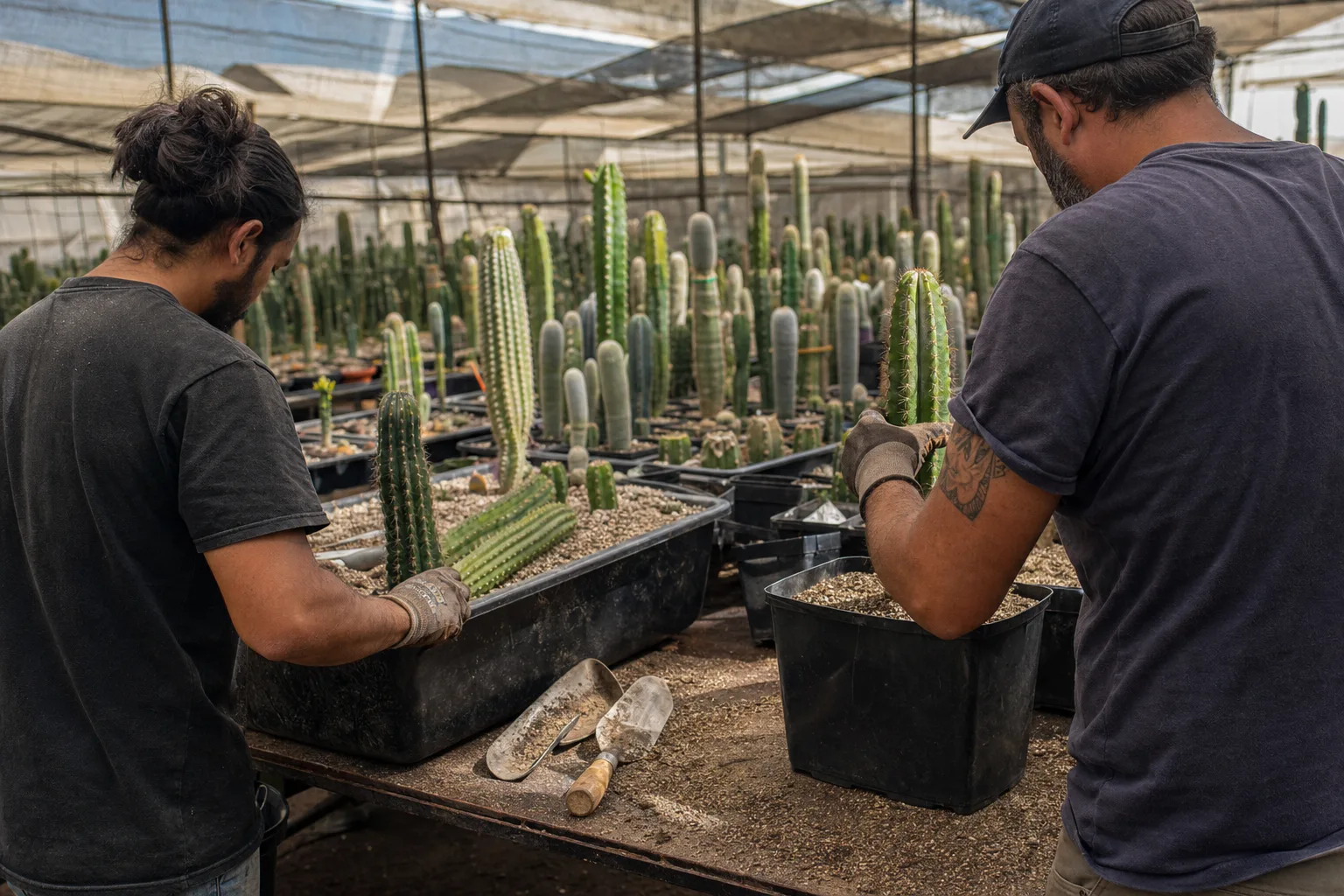
Trichocereus bridgesii (Echinopsis lageniformis): ornamental cultivation on a large scale
Trichocereus bridgesii, treated in much contemporary literature as Echinopsis lageniformis, is one of the most appreciated columnar cacti for ornamental production on a large scale. Native to the dry inter-Andean valleys of Bolivia, it combines vigor, relative drought tolerance, spectacular nocturnal flowering, and a clean silhouette that works well in both Mediterranean xerophytic gardens and garden center displays. In the European professional market, it is sought after as a structural plant that grows faster than many cardones and has a character distinct from T. pachanoi or T. peruvianus.
This article focuses on identification criteria, intensive cultivation, densities, packing, and landscape use. At Tricholand, we produce this type within our catalog of columnar cacti; the reference sheet is Trichocereus bridgesii. For orders or advice on implementation, you can check availability of sizes.
Name, synonyms, and confusions to avoid
In nurseries, it is advisable to label in a dual manner when requested by the client: Trichocereus bridgesii (a widely used historical commercial name) and Echinopsis lageniformis (a common combination in modern databases). The Wikipedia entry on Echinopsis lageniformis summarizes its Bolivian distribution and common synonyms, and emphasizes a critical point of nomenclature: do not confuse it with Echinopsis bridgesii, a distinct taxon with a very different appearance. This homonymy has led to ordering errors and literature mistakes; in professional packing lists, clarity prevents incidents.
Commercially, it also appears as “Bolivian torch.” In ornamental communication, you can use the popular name, but the purchase specification must include the agreed binomial name and, if applicable, the line code. The general framework of the family can be contrasted in resources about Cactaceae.
Origin and habitat: implications for the greenhouse
The wild area is associated with Bolivian departments such as La Paz, Cochabamba, Chuquisaca, and Tarija, within a wide altitudinal range —often cited between approximately 1,000 and 3,300 m—, on rocky soils, slopes, and well-drained margins. The climate of the dry Andean valley provides a growing season with seasonal rains and a cooler, drier rest period, high radiation, and marked daily temperature fluctuations.
Translated to Mediterranean or Central European cultivation under plastic:
- Abundant light after acclimatization.
- Watering concentrated in warm months.
- Bright, cool, and dry winter.
- Dominant mineral substrate; no waterlogging.
- Good tolerance to missed watering compared to other more “thirsty” columnar cacti during active growth, without turning that tolerance into chronic negligence.
The wild plant does not grow in compacted peat or in trays with standing water. The more the environment mimics the logic of a draining slope, the fewer basal problems will arise during stormy summers or humid winters.
Useful ornamental identification upon reception
Without aiming for an exhaustive botanical key, typical commercial material of T. bridgesii shows erect columns, well-defined ribs, variable spination depending on the line —often more conspicuous than in “soft” pachanoi— and a growth habit that, with age, branches and reaches several meters under favorable conditions. In intensive nursery cultivation, rooted cutting sizes and potted plants ready for retail or landscaping are produced.
There are monstrous and crested forms appreciated by collectors; they tend to grow more slowly and should not be mixed in the same SKU as the standard columnar form if the order is for a uniform landscape type. For the general garden center channel, the standard columnar form offers better product visibility and more predictable cultivation.
Always compare with other sheets from the variety catalog when a client requests a generic “San Pedro”: bridgesii is not visually interchangeable with pachanoi or peruvianus, and selling them as equivalents generates friction at the destination.
Cultivation requirements at scale
Light and acclimatization
Quality entry point: without sufficient light, the column thins, loses typicity, and weakens against pests. In the greenhouse, seek high DLI and ventilation. When transitioning from production shade to direct outdoor sunlight, acclimatize over 7–14 days to avoid epidermal burns, especially in clear spring after a covered winter.
Temperature
It grows vigorously with warm days and not excessively cold nights. It tolerates drops if dry, better than many soft succulents; however, the combination of cold + humidity + moisture-retentive substrate is a risk scenario. As a practical guideline for ornamental greenhouses, avoid keeping tissues moist below comfortable root ranges in mid-winter.
Substrate
Dominant mineral formula: 60–75% pumice/lapilli/coarse gravel and 25–40% stable organic matter (washed coconut or fibrous peat, with mature compost only in low percentages). Indicative pH 5.8–6.8. Container with real drainage. In mother plants and large sizes, add a heavy fraction for anchorage. The details of mixtures by density are developed in the technical line of the blog; the essential point is not to suffocate the neck.
Watering
During active growth, water thoroughly and wait for a clear partial drying of the root ball. In heat waves, frequency increases; in autumn, it decreases. In winter, residual or no watering depending on location. Water with moderate-low EC. The symptom of excess usually appears below: soft tissues, dark spots, fermentation smell in the medium.
Nutrition
Fertigation during the season with moderate-low N, sufficient K, and micronutrients. Pushing nitrogen to “gain centimeters” produces watery tissues and worse post-harvest. A constant rhythm surpasses aggressive peaks. Occasional leaching if drainage shows accumulated salts.
Professional propagation
Cutting is the dominant method at scale:
- Select typified and healthy mother plants.
- Cut with disinfected tools to commercial lengths (for example, sections of 20–40 cm depending on the order).
- Heal callus in a dry and partially shaded environment until tissue closure.
- Plant in a very aerated rooting medium.
- Initial watering should be moderate; increase frequency when active roots are present.
Rooting times vary with substrate temperature, ambient humidity, and season; under warm conditions in Murcia, they are often competitive compared to other columnar cacti, but rigid figures should not be promised without lot validation. Seeds are useful for genetic improvement and diversity, not always for short-term gondola homogeneity.
Maintain traceability from mother to lot: it is the basis for stable typology and phytosanitary documentation when material circulates among EU operators.
Densities, sizes, and greenhouse layout
Production at scale is organized by size. A common structure:
- Short rooted cutting: high density in tray or small pot; maximum sanitary control.
- Young retail plant: medium density; prioritize uniformity of height and spination.
- Landscape size: lower density, selective staking, wide picking aisles.
- Mother plants: dedicated sector, easy access, indelible labeling.
In outdoor implementation, separations of about 80–120 cm between specimens allow for clean architecture and maintenance. In deep planters or terraces, respect root volume and drainage; a planter without water outlet ruins even the best genetics.
The layout should facilitate mealybug control: if you cannot see the lower third of the columns, you will arrive late to the focus.
Plant health and IPM
Bridgesii is, in the opinion of many growers, less “problematic” than other columnar cacti when drainage is correct, but it is not immune. Monitor mealybugs in areoles and ribs, mites during hot and dry episodes, and basal fungi related to humidity. IPM protocol: inspection with every lot movement, quarantine of entries, hygiene of scissors, removal of debris, treatments only with criteria, and rotation of modes of action when appropriate.
For professional intra-EU movement, material intended for planting is integrated into the logic of the phytosanitary passport and traceability of authorized operators. Documentation and agronomy go hand in hand: a clean lot poorly documented and a documented lot with an active focus are two ways to lose a client.
Landscape use and sales narrative
In Mediterranean xerophytic design, T. bridgesii provides verticality, minimal filtered shade, and low water requirements once established. It combines well with gravels, hardy grasses, medium-sized Agave, and succulent ground covers in the foreground. Avoid placing it in narrow pathways if the line is very spiny; reserve softer typologies —for example, low-spination pachanoi— for pedestrian edges.
B2B selling points that work:
- Bolivian origin and differentiated typology compared to classic commercial San Pedro.
- Vigor and good response to intensive cultivation.
- Suitability for low irrigation projects.
- Nocturnal flowering as an added value in private gardens.
- European production with logistics and documentation for operators.
The Tricholand team can support implementation briefs and size selection; learn more about the nursery at about us.
Packing, transport, and post-harvest in the channel
Thorns and height define the packaging. Use separators, anti-friction fixation, and orientation that protects apices. Label with the agreed botanical name, size, and lot. Avoid loading plants with soaked root balls: they travel worse and arrive with higher basal risk. Upon arrival, unpack with adequate light, do not water immediately if the medium is still fresh, and acclimatize if the point of sale is much brighter than the truck.
A garden center receiving a uniform pallet of bridgesii can build a display of Bolivian columnar cacti with brief signage: origin, low irrigation, sun, and drainage. This narrative sells more than just an SKU code.
Management calendar (northern hemisphere)
February–March: review of mother plants, planning of cuttings, transplanting when the substrate is no longer cold. April–July: maximum growth, fertigation, weekly pest control, acclimatizations to the outdoors. August: monitoring for heat stress and excessive watering “out of fear.” September–October: hardening, reduction of EC, preparation for autumn sales campaigns. November–January: dry rest, minimal cleaning pruning, no unnecessary transplanting. In the southern hemisphere, reverse the calendar.
Frequent problems and solutions
- Thin columns: lack of light or excessive density; open spacing and increase DLI.
- Soft base: chronic moisture; check substrate, tray, frequency, and ventilation.
- Sun spots: insufficient acclimatization; temporary shading and gradual advancement.
- Recurring mealybug: foci in mother plants; clean the mother sector before continuing to propagate.
- Lot heterogeneity: mixing of lines; separate SKUs and label mothers.
Frequently asked questions
Is bridgesii the same as lageniformis?
In ornamental trade, the same product is often sold under two names. Keep both in the technical sheet if your client works with modern botanical databases, and avoid confusion with Echinopsis bridgesii.
Does it grow faster than pachanoi?
It depends on the line and management. Bridgesii is known for being vigorous and resilient; pachanoi can also be extremely fast. Measure in your conditions and do not generalize from forums.
Is it suitable for permanent indoor use?
Only with very high light. As a typical permanent indoor living room plant, it tends to stretch. Better suited for patios, terraces, or bright greenhouses.
What size should be requested for a landscaping project?
Define the target height at 12–24 months, maintenance access, and proximity to pedestrian pathways. With that brief, a producer can propose planting size and density. You can talk to the technical team at Tricholand to refine your order.
Conclusion
Trichocereus bridgesii (Echinopsis lageniformis) is a high-performance ornamental columnar when grown with well-draining substrate, abundant light, seasonal watering, and a stable mother plant type. At the nursery scale, those who document batches, separate SKUs, and package with criteria will succeed. Explore the sheet for Trichocereus bridgesii, compare it with the rest of the catalog, and request professional supply conditions through contact. Production in Murcia and distribution to European operators allow for alignment of agronomy, plant passport, and logistics with a single interlocutor.