
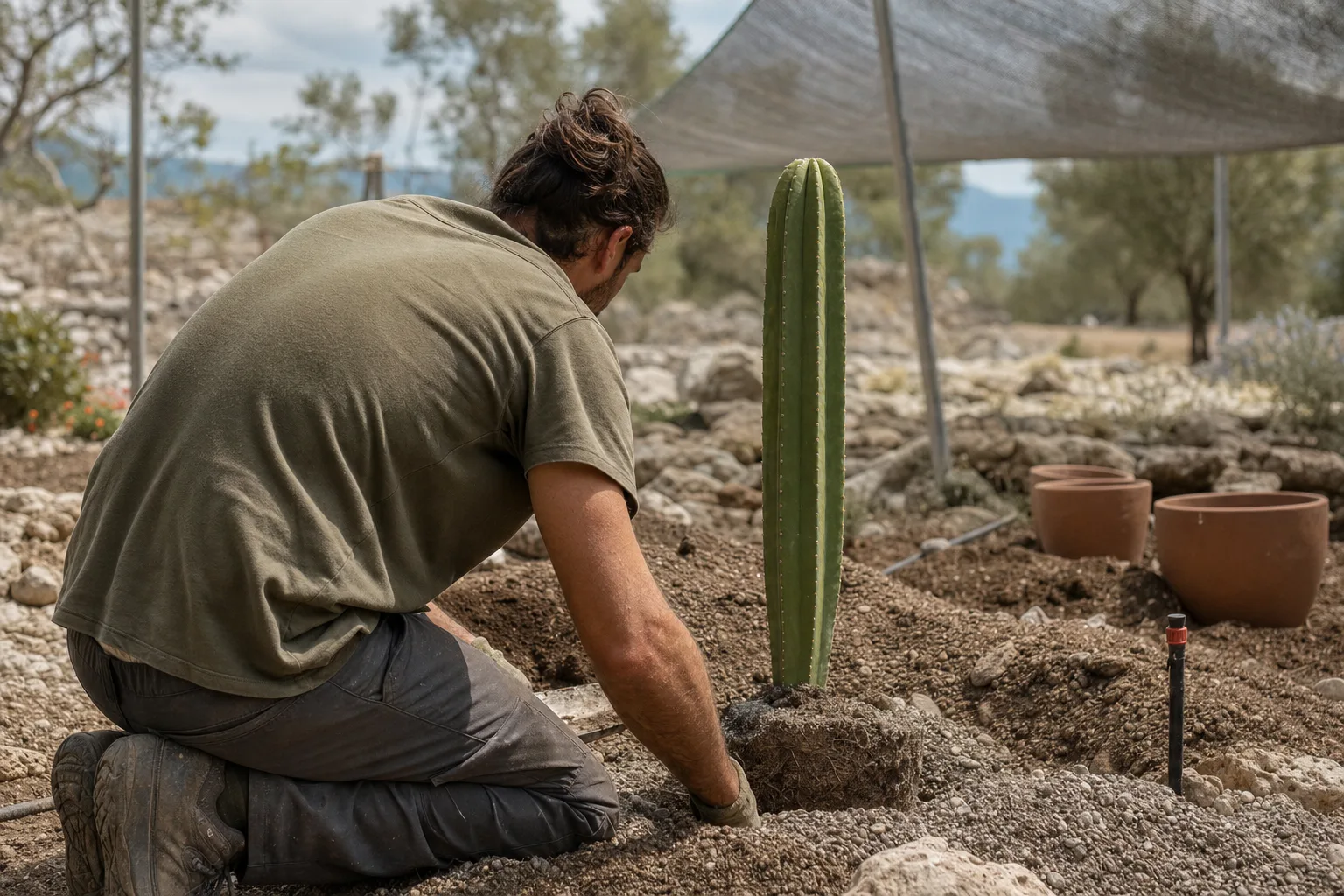
Trichocereus pachanoi outdoors: light, acclimatization, and planting densities
Transitioning from a nursery batch under mesh or greenhouse to a final outdoor planting is the moment when many projects with Trichocereus pachanoi fail or, conversely, demonstrate their full ornamental potential. The species tolerates full sun well once acclimatized, but punishes any errors in light, density, or drainage with epidermal burns, etiolation, or tipping. This guide is designed for landscapers, garden centers, and producers who implement columns in xerophytic gardens, roundabouts, slopes, and Mediterranean flowerbeds.
In the ornamental trade, the name Trichocereus pachanoi is maintained, although in current botanical literature it often appears as Echinopsis pachanoi (with other historical synonyms in circulation). What is relevant for fieldwork is not the nomenclatural dispute, but understanding its Andean origin — inter-Andean valleys of Ecuador and Peru at high altitudes —, its CAM physiology, and its response to strong irradiance after a period under shade. If you manage wholesale purchases or need homogeneous calibers for projects, you can check caliber availability with the Tricholand team from Murcia.
Why the outdoors requires a different protocol than the greenhouse
In a greenhouse or under mesh, the pachanoi receives diffuse light, more stable relative humidity, and protection from the wind. In a Mediterranean or dry subtropical outdoor environment, four new factors emerge simultaneously: direct solar radiation (including UV), thermal fluctuations between day and night, drying winds that move young columns, and episodes of rain or municipal irrigation that saturate the neck. A batch that was doing well in a 12 cm tray can burn in 48 hours if planted in full July sun without acclimatization, or rot in winter if the substrate remains wet during cold nights.
The good news is that, once hardened, the pachanoi is one of the most rewarding columnar species in the xerophytic catalog: rapid growth in warm seasons, architectural stature, spectacular nocturnal flowering in mature specimens, and moderate water demand compared to woody hedges. Success depends less on tricks and more on three variables that must be designed together: light (amount and transition), acclimatization (time and mesh), and densities (space for growth, air circulation, and maintenance).
Light: full sun, but not all at once
Growing manuals agree on a clear goal: full or nearly full sun once the plant is acclimatized, with at least six to eight hours of direct daily sunlight to maintain diameter, color, and well-defined ribs. With insufficient light, new tissue narrows and pales (etiolation); that thinning does not fill in later and remains as a permanent visual defect in the column.
irradiance and plant signals
In professional production, ranges of PPFD are often worked with under cover (for example, 250–400 µmol/m²/s for sustained growth and higher values if there is ventilation and nutrition). Outdoors, it is not necessary to measure PPFD at every site, but it is essential to observe:
- Intense bluish-green and uniform growth: adequate light.
- Thin growth, soft ribs, leaning towards the sun: light deficit or excessive densities.
- Beige, corky, or whitish spots on the west or south face after a move: burn from a sudden excess of radiation.
- Diffuse yellowing in very tender material just out of shade: photo-oxidative stress; usually improves if temporary mesh is recovered.
In extreme summer climates (interior peninsula, very sunny coasts with light gravel albedo), light afternoon shade on juveniles can reduce losses in the first year. In cool Atlantic climates or shady urban gardens, the usual problem is the opposite: lack of light and wire columns. It is advisable to prioritize open orientations and avoid planting under tree canopies.
Appearance, reflection, and microclimate
The Andean habitat combines strong sun with cool nights and, in many places, sloped aspects. In a garden, a white wall or light pavement increases thermal load and reflected light: useful for growth, dangerous for unacclimatized material. A dense hedge to the south can reduce hours of sun just when they are most needed. Before fixing densities, draw the solar path of summer and winter for the flowerbed; the correct densities on paper fail if half a row is in permanent shade.
Altitude and latitude of the project also matter. On the Mediterranean coast, summer sun is intense but nights are usually mild; on the plateau, the same batch faces greater thermal contrast and sometimes dry winds that dehydrate the apex. In both cases, acclimatization remains mandatory, but the duration of the mesh can be extended an extra week during heat waves or for materials with small diameters.
Acclimatization: the protocol that avoids many burns
Acclimatization or hardening-off is the controlled process of increasing exposure to sun, wind, and thermal fluctuations. It is not optional when material arrives from a nursery under mesh, from indoors, or from a packaged shipment lasting several days. A practical scheme of two to four weeks works for most Mediterranean projects:
- Days 1–5: 40–50% mesh or morning sun location with afternoon shade. Moderate watering only if the substrate is dry at depth. Avoid strong fertilization.
- Days 6–12: 30% mesh or half-day exposure to full sun. Monitor the most exposed face to the west.
- Days 13–21 (or up to 28 in heat waves): progressively remove the mesh. If spots appear, revert one step back for four or five days.
- After hardening: full sun as designed, with temporary support for tall and poorly rooted columns.
If the batch arrives during the heat wave, prioritize planting early in the morning or during the late-night window, water the root ball without soaking the neck, and keep the mesh for a longer time. If it arrives in mild spring, you can shorten the intermediate phase, but do not skip the first week under protection. Very juvenile material, with small diameters and tender epidermis, always needs the longer side of the interval.
Acclimatization after transport
Professional packaging protects spines and the growth tip, but it also reduces light and aeration during transit. Upon receipt: open boxes, let breathe for 24–48 hours in a bright area but not in midday sun, check necks and roots, and only then start the mesh scaling. Planting straight from the truck into the work sun is the classic recipe for corky spots in the first week.
If the transport has been long or during warm seasons, add an extra day of recovery before any additional stress (repotting, fertilizing, or full exposure). Plants may look perfect upon opening and show damage two or three days later: the photosynthetic tissue was already compromised in transit.
Planting densities: criteria by use
Density is not a single number: it depends on the output caliber, the visual objective — hedge, xerophytic forest, isolated specimens — and the maintenance plan over five to ten years. The pachanoi branches from the base over time; if you plant too closely, you get competition for light, difficulty accessing for weeding, and a humid microclimate favorable to mealybugs.
Xerophytic flowerbed and columnar forest
For a natural grouping effect with growth and possible offsets, a solid reference is 0.8–1.2 m between plants in the row and 1.2–1.6 m between rows, preferably in a staggered pattern. With nursery calibers of 25–40 cm in height, that framework allows two to four years of growth without severe competition. If the design seeks an immediate impact with taller pieces, open to 1.2–1.5 m so that each column reads as an architectural element.
On slopes, the staggered pattern improves visual anchoring and reduces surface erosion between plants. Maintain sufficient distances to intervene with tools without brushing the epidermis: every brush during work is a gateway for fungi when moisture arrives.
Hedge or vertical screen
In linear hedges, you can reduce to 0.6–0.8 m between axes if you accept thinning maintenance and know that the mass will close. Below 0.5 m only makes sense in temporary exposure projects or when transplanting or thinning is expected in the second year. Remember to leave service aisles every few sections: a cactus hedge without access becomes a plant health problem.
Container production outdoors
When the outdoors is used as a fattening or sales area in the nursery, pot densities differ from those of final planting. On tables or gravel floors, 30–40 cm between centers for 20–25 L pots is common in the first year; in the second year, it is advisable to space out to avoid lateral shading and etiolation. The goal here is a clean commercial diameter, not a closed hedge.
Singular specimens and large format
For accent pieces at entrances, roundabouts, or patios, leave at least 1.5–2 m free around the intended axis of the adult plant. The pachanoi can exceed several meters in height under favorable conditions; the typical mistake is planting it next to a wall or window and discovering five years later that there is no space for structural pruning or safety.
Soil, mounds, and anchoring in final planting
Light and density do not save poorly drained soil. In clay soils or with a high water table, work with mounds or ridges of 15–30 cm with a mineral mix — gravel, coarse sand, pumice, or similar — and avoid basins that accumulate rain against the neck. A simple test before mass planting: open a hole, fill it with water, and observe the draining time; if it remains for hours, redesign drainage before purchasing the entire batch.
Planting depth: bury enough for stability, without burying healthy green tissues that need to be aerated. In newly planted tall columns, a temporary stake reduces tipping from wind in the first summer. Mineral gravel mulch helps control weeds and rain splash; avoid thick organic mulches stuck to the neck.
If the project includes automatic irrigation for lawns or mixed beds, hydraulically isolate the cactus sector. Many outdoor rot issues do not come from rain, but from a timer designed for lawns that wets the neck three times a week.
Irrigation and nutrition outdoors
During the growing season — spring and summer in the northern hemisphere — deep and spaced irrigations usually work better than daily superficial watering. Allow the profile to dry between applications. In autumn and winter, prioritize dry substrate if there is a risk of cold: the pachanoi's tolerance to thermal drops decreases with a wet neck. Many cultivation references place the species around USDA zones 8b–10 for outdoors, with brief episodes near −9 °C in established and dry plants; that is not a guarantee in your microclimate or with poorly programmed automatic irrigation.
Fertilization: outdoors, a moderate growth program, balanced or slightly more potassium-rich, avoiding excess nitrogen that softens tissues, is sufficient for most projects. Excess nitrogen with low light produces soft and etiolated tissue, worse against sun and wind. After transplanting, wait to see signs of rooting before pushing with fertilizer.
Indicative calendar in the northern hemisphere
- Late winter and early spring: prepare soil, drainage, and density marking; order batches and plan logistics.
- Spring: ideal window for planting and acclimatization; install localized irrigation; first review of anchoring.
- Summer: full sun on hardened plants; monitor for burns in juveniles; deep watering; control mealybugs in axils.
- Autumn: reduce watering; remove temporary meshes; review densities if there is excessive shading between plants.
- Winter: keep dry; protect only if your area has prolonged wet frosts; do not force growth.
In the southern hemisphere, shift the calendar by six months. In humid tropical climates, dry neck and drainage weigh more than acclimatization to sunlight.
Common outdoor problems and how to correct them
- Sunburn: immediate shading 30–50%, do not attempt to heal with extra watering; the corky spot does not disappear, but its progression is halted.
- Etiolation: open densities, prune competing vegetation, relocate or accept that the thin segment will remain marked.
- Toppling: stake, replant deeper in stable substrate, reduce watering that softens the root ball.
- Neck rot: improve drainage, elevate the plant, cut affected tissue dry if necessary and allow it to heal.
- Mealybug in dense plantations: improve aeration, check axils, apply an IPM protocol; excessive densities exacerbate the problem.
For a broader view of cultivation in dry climates and implantation techniques, the Tricholand technical blog complements this sheet with articles on substrate, fertigation, and health in professional batches.
Landscape use: fitting light and density into the design
The pachanoi provides verticality without the dense shade of a tree. It combines well with gravels, low-growing agaves, xerophytic grasses, and mineral surfaces. In hedge designs, prioritize uniformity of caliber and a unique acclimatization protocol for the entire stretch: mixing sun plants with shade plants in the same line creates a patchy effect—different widths, different colors—that is difficult to correct.
If your project combines several species of the genus, check the Trichocereus variety catalog to balance growth rates: the pachanoi usually outpaces slower species like cardón; densities should anticipate this differential so they do not excessively shade their neighbors.
In public spaces, document the planting framework and acclimatization protocol in the maintenance plan. Crew turnover is a common cause of removing the shade cloth too soon or scheduling grass watering over the cactus sector.
Frequently asked questions
Can I plant in full sun the same day I receive the order?
Only if the material was already hardened in full sun at the origin and the climate is mild. In the majority of cases, with greenhouse or shade cloth stock, no: apply two to four weeks of acclimatization.
What density should I use if I don't know if I want a hedge or specimens?
Start with 1.0–1.2 m. It is a compromise that allows for selective thinning later without having created an impenetrable forest.
Is afternoon shade mandatory in Murcia or similar climates?
Not for acclimatized adult plants. It is a useful tool the first summer for juveniles or transplants during heat waves.
What is the minimum light to avoid etiolation?
As a rule of thumb, seek the equivalent of direct sun for most of the growing day. Less than half a day of useful sun is usually noticeable in the diameter of new tissue in a single season.
What should I do if I already burned the batch?
Recover the shade cloth, stabilize watering, do not fertilize, and accept that the scars will remain. Assess whether it is advisable to replace visually prominent pieces and relocate the marked ones to secondary areas of the design.
Operational closing
A well-resolved exterior with Trichocereus pachanoi is recognized in three gestures: light transition without burns, a planting framework designed for several years, and soil that never leaves the neck waterlogged. From the producing nursery of Tricholand in Murcia, this columnar material is precisely worked with EU passport and professional batch criteria. If you are sizing a project or a garden center linear, requesting a wholesale quote or seeking implantation advice is the most direct step to align calibers, densities, and planting window. You can also learn more about the origin of the cultivation on the about us page.