
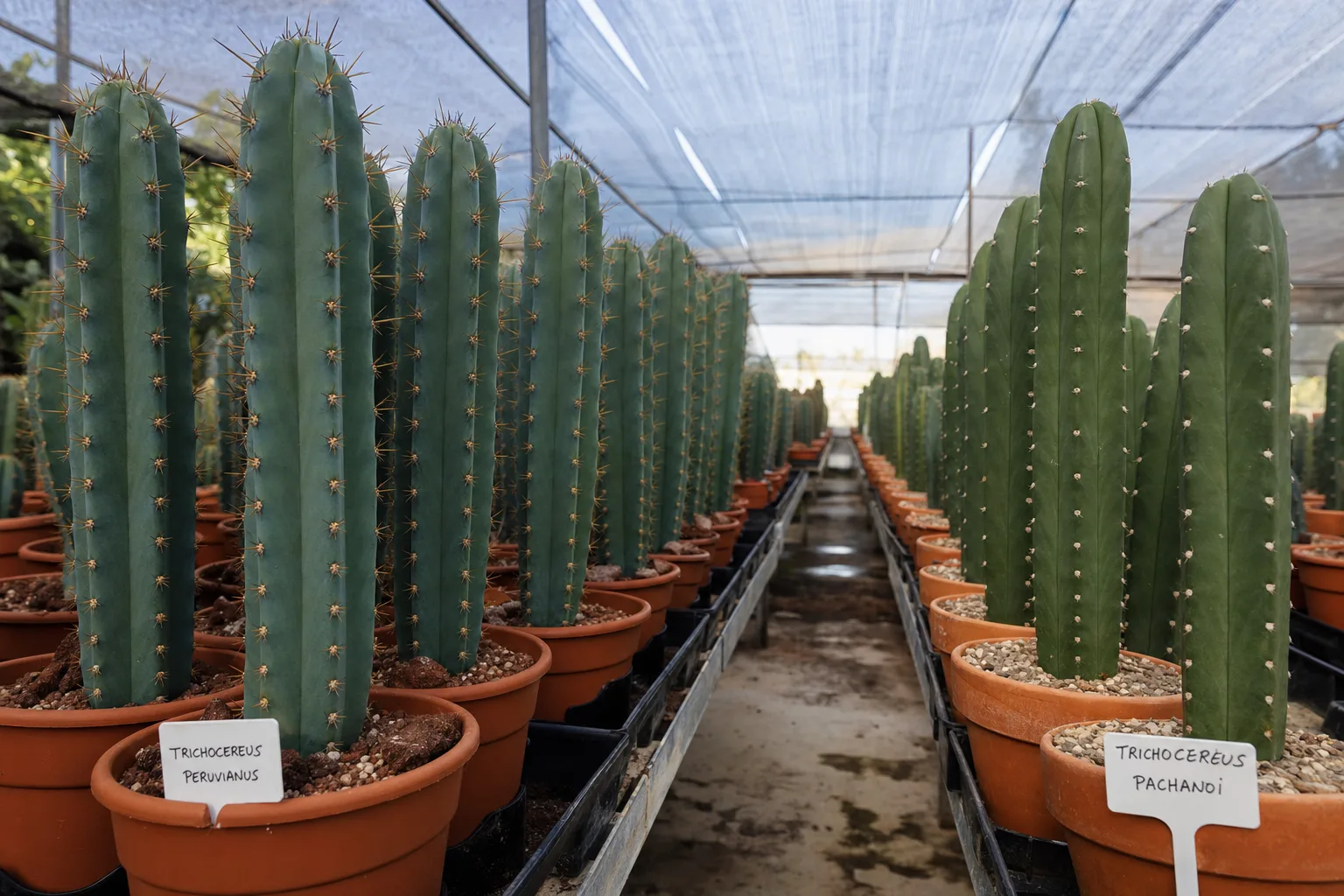
Trichocereus peruvianus vs pachanoi: commercial identification for nurseries
In the wholesale trade of columnar cacti, confusing Trichocereus peruvianus with Trichocereus pachanoi is not an innocuous botanical nuance: it affects the homogeneity of the batch, the aesthetic expectations of the end customer, and the commercial traceability of the nursery. Both species —also treated in modern literature as Echinopsis peruviana and Echinopsis pachanoi— belong to the complex of fast-growing, night-flowering Andean columnar cacti. Their morphological overlap is real, and some authors have proposed grouping them under a single variable taxon. Nevertheless, in a professional catalog, it is advisable to maintain stable, documented, and repeatable commercial identification criteria during reception, picking, and labeling.
This article summarizes an operational guide for nurseries, garden centers, and European distributors: what characters to observe, how to prioritize them, what the limits of visual identification are, and how to align commercial nomenclature with production sheets. At Tricholand, we work on both lines in our own cultivation in Murcia; you can consult the sheet for Trichocereus pachanoi and that of Trichocereus peruvianus within the variety catalog.
Why commercial identification matters in the wholesale channel
The hobbyist may accept some taxonomic ambiguity. The professional buyer does not: they require a code, a size, a predictable appearance, and a lead time. If a batch labeled as pachanoi arrives with long spination and persistent bluish epidermis, the garden center receives complaints about appearance, even if the plant is horticulturally healthy. Therefore, commercial identification is a quality control process, not just a botanical one.
Moreover, both species are used in xerophytic landscaping with different intentions. T. pachanoi is often sought after for its softer profile —short or sparse spines, lighter green color— ideal for public spaces or low-maintenance gardens where interaction with people is frequent. T. peruvianus provides a more sculptural presence, glaucous tone, and more visible spiny armor: perfect for rock gardens, protected edges, and character compositions. Mixing both without criteria dilutes the sales narrative and complicates shelf replenishment.
In spring campaigns, when garden centers focus on the rotation of succulents and cacti, visual typology becomes an argument for average ticket sales. A homogeneous pallet photographs better, trains store staff faster, and generates fewer returns due to “it’s not what I ordered.” That’s why serious producers invest in typified mother plants and in reception protocols as strict as those of conventional horticultural cultivation.
Taxonomic framework without dogmatism
Britton and Rose described Trichocereus pachanoi —type locality associated with Cuenca, Ecuador— and Trichocereus peruvianus —associated with Peruvian material, with historical reference to the Matucana area— in 1920. Subsequently, transfers to Echinopsis and proposals to unify under Trichocereus macrogonus (with varieties or subspecies) have generated a complex nomenclatural landscape. General reference sources, such as the Wikipedia entry on Echinopsis pachanoi, reflect this history of synonyms and recombinations.
For the nursery, the practical recommendation is clear and operable:
- Use the name under which it is sold and produced on the commercial label (usually Trichocereus pachanoi / Trichocereus peruvianus).
- Include the synonym Echinopsis in the technical sheet or packing list when the customer requests it.
- Do not present taxonomy as an absolute dogma: document the origin of the line (seed, cutting, mother) and the characters of the batch.
- Physically separate mother plants and batches in the greenhouse to avoid label contamination from re-sprouts or misclassified cuttings.
The family Cactaceae contains a lot of intrapopulation variation; in Andean columnars, this variation is amplified by historical hybridization and horticultural selection. Therefore, the commercial protocol must be based on a set of characters, never on just one. A single criterion —for example, “it has long spines”— produces as many false positives as correct identifications.
Useful diagnostic characters in the nursery
Reliable visual identification combines epidermis, spination, areoles, growth habit, and, when possible, the origin of the line. No character is infallible on its own, especially in juveniles or commercial hybrids. The key is to observe the batch under comparable conditions of light and nutrition.
Epidermis and stem color
In adult material grown under comparable conditions, T. peruvianus tends to maintain a bluish or frosted glaucous bloom more persistently. T. pachanoi usually shows lighter greens or medium greens and loses some of the juvenile glaucous tone as it matures. Important: in seedlings and young cuttings, both can appear bluish; color only gains diagnostic weight with age and controlled light exposure.
Environmental factors distort color: light deficiency can green and elongate apparent internodes; intense solar excess can bronze or mark; high nitrogen fertilization intensifies green and “washes” the glaucous typicality. Always compare plants from the same batch of the same age and the same greenhouse sector. If possible, establish a typification corner with known DLI to photograph line standards each season.
Spines: length, number, and color
This is the most commonly used criterion in merchandise reception and the one that warehouse staff communicates best after brief training:
- Typical commercial Pachanoi: short spines (often less than 1–2 cm), sparse, yellowish to light brown; almost spineless forms are common in ornamental production lines.
- Typical commercial Peruvianus: around 6–8 spines per areole, 2–4 cm or more, honey to dark brown color, more robust; rarely almost spineless in representative material.
Observe the average of the batch, not the extreme of a single areole. Spination responds to light, water stress, and age: a pachanoi in full sun may appear more armed than one in shade. Therefore, it is advisable to establish an internal photographic standard by mother line and measure, at least once a year, ten areoles from the middle third.
Areoles, ribs, and diameter
The areoles of peruvianus are usually perceived as larger and more spaced —about 2–2.5 cm between areoles in typical material— with beige to brown felt. In pachanoi, the areoles tend to be smaller. Some descriptors highlight a groove or notch above the areole in typical pachanoi/macrogonus material; its expression varies among populations and should not be used as the sole filter.
Both species typically oscillate between 6 and 8–9 rounded ribs. Peruvianus often presents somewhat more robust columns, while pachanoi may maintain slimmer profiles in many lines. The number of ribs alone almost never resolves identification, but diameter at a fixed height (for example, 10 cm below the apex) does help to describe commercial size objectively.
Growth habit, vigor, and growth rate
Given equal substrate, light, and fertigation, many lines of pachanoi show faster longitudinal growth and very generous rooting of cuttings. Peruvianus may grow somewhat more compact or require more light to maintain color and typicality, although there are exceptions depending on the clone. Record growth rates by line: it is a production data point and an indirect support for typification. A sudden change in typology in a sector usually indicates a mix of material, not spontaneous “evolution” of the species.
Operational decision table
Use this list as a reception checklist, not as an absolute dichotomous key:
- Adult color: persistent blue glaucous favors peruvianus; light or medium green without strong bloom favors pachanoi.
- Average spines of the batch: equal to or greater than 2 cm, robust, honey or brown point to peruvianus; short, sparse, or spineless point to pachanoi.
- Areoles: large and well-defined favor peruvianus; small and regular favor pachanoi.
- Line origin: documented Ecuador or northern Peru in selections of soft ornamental type usually aligns with pachanoi; glaucous selections of Peruvian typology with peruvianus.
- Obvious intermediates: label as hybrid or related material and do not force species if the customer demands typological purity.
When sampling leaves doubts, prioritize commercial honesty: it is preferable to sell an SKU of “selected columnar hybrid” with real photos than to force a species label and generate non-conformities in chain.
Juveniles, cuttings, and hybrids: common traps
Classification errors concentrate in three scenarios repeated in the sector:
- Short cuttings without history: without a visible mother or batch photo, juvenile color can be misleading. Require the supplier to provide a photo of the mother plant or line sheet before accepting a large first order.
- Commercial hybrids: crosses of pachanoi × peruvianus and related are common. They can combine light green with medium spines or glaucous with short spination. If you sell species, do not mix hybrids in the same SKU or in the same rooting bed without unequivocal tutors.
- Environmental plasticity: the same genotype under different daily light changes diameter, distance between areoles, and spine length. Always typify under standard conditions of your nursery and be wary of comparisons between shade and direct sun plants.
A simple protocol when creating a new mother: assign an internal code, photograph the apex and middle third at 6 and 12 months, measure ten areoles (length of central spine and number), and archive the data along with the greenhouse sector. That sheet is worth more than a generic taxonomic discussion and speeds up quality audits.
Implications in production, packing, and merchandising
Separation of SKUs and sizes
Maintain distinct SKUs even if the size —for example, 20–30 cm, 40–60 cm, or 80+ cm— is homologous. The European customer planning a campaign needs visual predictability. At Tricholand, the catalog logic clearly separates both species within the Trichocereus variety listing to facilitate homogeneous orders and typified replenishment.
Density, tutoring, and handling
Peruvianus with long spination requires more care in packing, greater separation between columns in trays or boxes, and appropriate protective equipment during picking. Pachanoi of soft typology speeds up packaging and reduces damage from spines to staff and neighboring plants. This impacts logistical costs: it is not just aesthetics. A typification error is also a handling cost error.
Landscaping and client brief
When a landscaper requests soft columnars for pedestrian access, prioritize low-spination pachanoi lines. If the brief is blue-glaucous accent and strong texture in rock gardens, guide towards peruvianus. You can expand the ornamental argument in the technical blog and contrast with the production experience described in about us.
Goods reception protocol
For purchases between operators or internal audits, a minimum sampling works as follows:
- Check the botanical label, batch code, and plant passport when applying the professional movement.
- Sample at least 10 individuals per pallet or wholesale unit.
- Photograph apices under the same lighting.
- Note the predominant color, average spine length, average number of spines per areole, diameter at 10 cm from the apex, and number of ribs.
- Compare with the mother sheet or with the supplier's photographic standard.
- If more than 15–20% of the sampling deviates from the SKU standard, open a non-conformity before re-labeling or mixing in stock.
This control prevents an identification error from multiplying in subsequent cuttings and contaminating mother plants for years.
Comparative Cultivation: Management Nuances
In the Mediterranean greenhouse practice, the basic management is very similar: dominant mineral substrate, spaced irrigation with partial drying, moderate conductivity fertigation, cool and dry winter, and gradual acclimatization to direct sunlight. The useful differences are nuanced. Peruvianus appreciates high doses of light to express glaucousness and compact growth; pachanoi tolerates a slightly wider range but also becomes etiolated with low light. Both dislike waterlogging. In nutrition, balance low-moderate nitrogen and sufficient potassium during the season; excess nitrogen masks typicality and softens tissues.
If you need to adjust substrate or fertigation formulas by species, the Tricholand team can guide you to request a wholesale quote or check the availability of calibers. In-house production in Murcia allows alignment of typology, EU documentation, and shipments to operators in Europe from a single origin.
Recommended Labeling for the European Market
A clear label reduces B2B friction and speeds up store staff training:
- Trade name: Trichocereus pachanoi or Trichocereus peruvianus.
- Synonym: Echinopsis pachanoi / Echinopsis peruviana according to the sheet.
- Caliber and presentation (rooted cutting, potted plant, mother).
- Line or batch code.
- Production origin (Spain / Murcia, when applicable).
- Ornamental indication: xerophytic columnar cactus.
Avoid ambiguous names like “San Pedro mix” in professional orders if the client has specified species. Reserve popular names for point-of-sale communication, not for purchase specification or packing list.
Frequently Asked Questions from Professional Buyers
Can they be considered the same species?
There are academic proposals for unification or infraspecific treatment. In trade, as long as the market distinguishes typologies and the client requests separate SKUs, it is advisable to produce and sell by stable typology. Nomenclatural discussion should not degrade the homogeneity of the lot or the trust in the channel.
Is a very spiny pachanoi actually a peruvianus?
Not necessarily. It could be an environmental response, a particular line, or a hybrid. Cross-reference spine characteristics with adult color, areoles, and mother history before reclassifying. A hasty reclassification in stock can create a second error on top of the first.
What to prioritize in a garden center?
For high turnover and frequent handling, low-spine pachanoi lines tend to be more user-friendly. Peruvianus works very well as a premium character product, with signage highlighting the glaucous tone and texture of the spination.
How to avoid label contamination in the nursery?
Georeferenced mothers on the greenhouse map, cutting by monospecific campaigns, large typography on stakes, and quarterly photographic audits. It is cheaper than managing international returns or losing a distributor client.
Operational Closure
The commercial identification of Trichocereus peruvianus versus Trichocereus pachanoi is based on a bundle of characters —epidermis, spines, areoles, growth habit, and lineage origin— applied under comparable conditions and documented by batch. Taxonomy provides context; the nursery's internal standard provides repeatability. If you are looking for homogeneous batches, typology advice, or European production material with a plant passport, check the sheets for pachanoi and peruvianus, or contact Tricholand to request a catalog and conditions.