
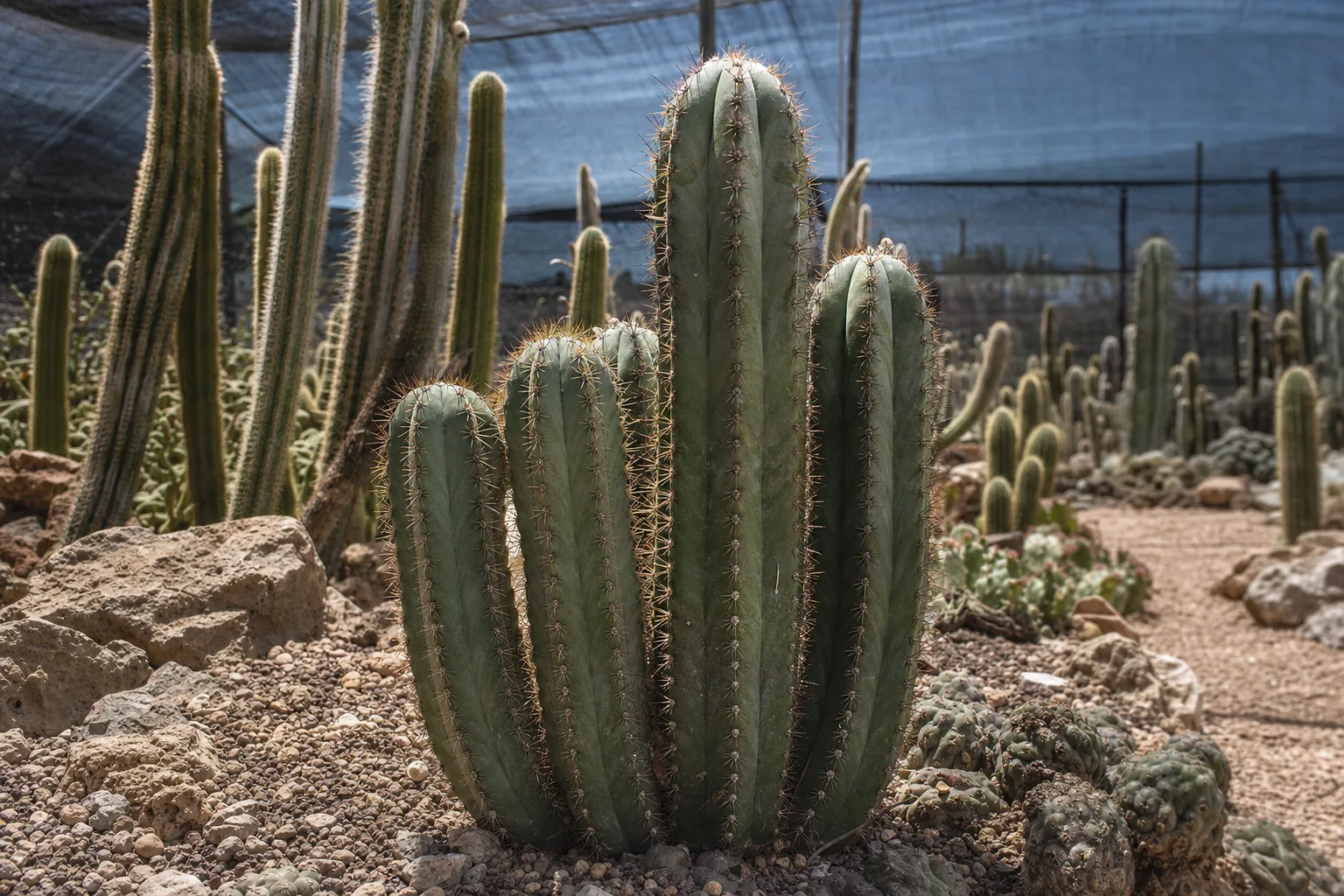
Trichocereus terscheckii (cardón): slow cultivation, cold climate, and landscape use
Trichocereus terscheckii —also treated in modern nomenclature as Leucostele terscheckii or, in frequent synonyms, Echinopsis terscheckii— is the large cardón of northwest Argentina: a columnar tree-like cactus, slow-growing and monumentally present, appreciated in arid landscaping as a structural alternative to American saguaros. In the European nursery trade, it is sought after for its stature, its golden spines, and a relative cold tolerance superior to many tropical columnars, provided that the substrate remains dry in winter.
This article addresses slow cultivation, cold management, cautious identification regarding related forms (pasacana / atacamensis in contact zones), and professional landscaping use. Tricholand includes this line in its varieties catalog and produces in Murcia for the European wholesale channel; the reference sheet is for Trichocereus pasacana–terscheckii.
Taxonomy and commercial identification
The species was historically described as Cereus terscheckii, went through Trichocereus and Echinopsis, and in recent treatments is placed in Leucostele. In nurseries and project work, the name Trichocereus terscheckii remains the most recognized by buyers and landscapers. It is advisable to declare synonyms in technical sheets to avoid order duplications.
Useful identification features:
- Columnar stature that branches with age and can exceed several meters in habitat (over 7–10 m in long-lived specimens).
- Considerable stem diameter (approximately 10–25 cm in adults), with 8–14 ribs.
- Robust spines, often yellowish, long (several centimeters), in spaced areoles.
- Large white nocturnal flowers (long floral tube, around 15–20 cm according to cultivation sources and botanical descriptions).
The sheet of Leucostele terscheckii on Wikipedia and the entry in Plants of the World Online (Kew) help to establish the nomenclatural framework. In habitat, the species gives its name to the Los Cardones National Park (Salta, Argentina) and occupies dry Andean slopes at moderate altitudes.
Commercially, the binomial “pasacana–terscheckii” groups in the catalog forms of cardón of landscape interest; the technical team can clarify the specific material when consulting availability of calibers.
Origin, habitat, and implications for cultivation
The large cardón comes from semi-arid environments in northwest Argentina and nearby areas of Bolivia, with mineral soils, intense radiation, and marked thermal amplitudes. This origin explains three cultivation requirements:
- Full sun once acclimatized.
- Extreme drainage; intolerance to winter waterlogging.
- Slow growth compared to pachanoi or other “fast-rotation” columnars.
Those expecting the pace of a San Pedro will be frustrated. Those seeking a structural piece with a 10–20 year outlook will find in terscheckii an ally of longevity and character.
Slow cultivation: realistic nursery expectations
In production, the cardón is planned with a long-term horizon. From seed, the first years are of slow fattening; the adult segment cutting accelerates the attainment of a marketable caliber, but it remains slower than in fast-growing species from the same catalog. Cultivation densities must allow space for future diameter and handling with long spines.
Recommended substrate (pot or nursery container):
- 60–80 % coarse mineral (pumice, volcanic gravel, coarse sand).
- 20–40 % stable and fibrous organic fraction.
- pH close to neutral or slightly acidic; monitor for iron chlorosis in very calcareous waters.
Watering: wide cycles in heat (completely dry profile between waterings); almost none in cold winter. Moderate fertilization in the active season; excess N produces soft tissue less resistant to cold. Optimal growth temperature in the warm range (approximately 20–35 °C), with tolerance to higher peaks if acclimatization occurs.
Light: direct sun after hardening. Juveniles appreciate gradual acclimatization to avoid burns. Etiolation due to lack of light ruins the commercial aesthetics of the cardón, which is valued precisely for its compactness and defined ribs.
Cold: real tolerance and conditions that negate it
Terscheckii stands out among South American columnars for its hardiness to dry cold. Cultivation and landscaping sources report survivals against frosts of around −8 to −11 °C in acclimatized and dry specimens, with variation depending on origin, age, and duration of the episode. Horticultural guides often place tolerance around −8 °C / 18 °F under favorable conditions. This does not equate to “a plant of humid Atlantic climate without drainage.”
Factors that break tolerance:
- Wet substrate during frost (cell rupture and subsequent rot).
- Juveniles of small diameter.
- Persistent freezing winds without protection.
- Daytime thaw + repeated nighttime cooling over saturated tissues.
In European practice: in dry interior Mediterranean or continental climates, the cardón can live outdoors with good drainage; in humid northern facades or clayey soils, the winter risk is high even if the thermometer does not drop to extremes. In USDA, cultivation references often place it in bands of type 8b–11 with expert management —always as guidance, not as a guarantee.
Compared to T. pachanoi, terscheckii usually offers more margin in dry cold points; compared to tropical columnars, the difference is even greater. Nevertheless, in northern European projects, winter demands a microclimate, cover, or movable container.
Propagation
Seed: viable, with germination under controlled heat and humidity, followed by a long juvenile period. Cutting: feasible with complete callus (long timelines in thick diameters) and rooting in mineral substrate; patience is part of the protocol. In a professional nursery, cutting from selected mothers allows for uniform spination and vigor within what the genotype permits.
For a general cutting protocol for the genus, callus practices of 10–21 days and deferred watering applied to other Trichocereus are valid; the apical meristem of the cardón deserves mechanical protection due to weight and spines.
Landscaping use: when to choose cardón
The cardón terscheckii shines as:
- A solitary sculptural specimen in xerophytic gardens and hotel entrances.
- A substitute for “saguaro-type” silhouette in climates where Carnegiea is not viable.
- A composition with agaves, yuccas, and gravels in low irrigation public works.
- Botanical collections and ethnobotanical gardens with an ornamental focus (without claims unrelated to landscaping).
In bioarchitecture and contemporary gardening, columnars provide verticality without the water demand of a leafy tree. Terscheckii adds the narrative of the Andean cardonal and a texture of long spine that must be managed in pedestrian spaces: distanced from pathways, signage, or use in raised beds.
Planting densities in soil: respect the adult diameter and branch projection; a classic mistake is to plant “pretty when young” at 50 cm and create a maintenance problem in ten years. In large format containers, it works in sunny patios with mineral substrate and free drainage trays.
Health and common problems
- Winter basal rot: excess water; improve drainage and suspend watering.
- Chlorosis: high pH / iron; correct water and provide chelates if necessary.
- Mealybug in areoles: inspection and IPM; long spines hinder treatment: act promptly.
- Post-greenhouse sunburn: gradual acclimatization to full sun.
- Almost no growth: often normal in cold or in exhausted pots; check roots and light before over-fertilizing.
Implementation in projects: technical detail for landscapers
In public or private works, the success of the cardón is decided in the planting bed. Digging a generous volume, replacing clayey soil with coarse mineral mix, and creating a slight raised mound prevents rainwater from concentrating at the neck. A gravel ring visually washes the base of the plant and reduces mud splashes on the epidermis. The temporary stake is only justified in newly planted tall specimens; it should be removed when root anchorage is stable, to avoid rubbing against ribs or spines.
The establishment watering in the first summer is different from maintenance: deep and very spaced waterings help explore the profile, but never with lawn frequency. From the second year, in Mediterranean climate, many specimens live almost off the natural rainfall regime if drainage is correct. In containers, however, control remains with the gardener: the limited volume dries quickly in a heat wave and waterlogs if the tray retains water.
For project specifications, it is advisable to cite species (with synonyms), minimum caliber upon receipt, type of container, solar acclimatization requirements, and drainage clause. The technical blog and contact with production allow aligning that sheet with real nursery material, without compromising stock figures that change by season.
Indicative calendar (northern hemisphere)
Spring: transplant if necessary, start watering, light fertilization, solar acclimatization.
Summer: maximum relative growth; deep and spaced waterings; monitor for mites in dry heat.
Autumn: reduction of water and N; hardening.
Winter: dry; protection only if the episode combines cold and humidity or if the specimen is young.
Flowering, in mature plants, can extend over a wide window of warm months depending on local climate; the flowers are nocturnal and ephemeral, consistent with the rest of the group.
Wholesale production and catalog fit
In a specialized nursery, terscheckii complements the fast rotations of pachanoi/peruvianus: it adds project value and catalog differentiation. Tricholand, with facilities of about 2,500 m² in Murcia and European distribution, works with these columnars within an approach of in-house production and advice. Stocks and prices are not detailed here; the correct channel is to request a wholesale quote or ask for conditions based on caliber and professional volume.
The sheet Trichocereus pasacana–terscheckii is the entry point for specifiers and buyers. To compare with other columnars in the assortment, also review pachanoi, peruvianus, and bridgesii in the same catalog, and the nursery's narrative in about us.
FAQ
Is it really slow-growing? Yes, compared to other commercial Trichocereus; plan for long timelines or start from thick cuttings.
Does it withstand frosts? Better than many columnars, if it is dry and acclimatized; winter humidity is the enemy.
Is it suitable for Mediterranean gardens? Very suitable with drainage and sun; it is one of the best cardón bets in southern Europe.
How does it differ from a saguaro? South American origin, distinct flowers and spination; the tree-like silhouette is analogous in the landscape, not identical in botanical detail.
Can it be used near pedestrian walkways? With careful design: distance, mineral mulch, and, if necessary, low barriers; the spines are long and rigid.
Conclusion
Trichocereus terscheckii (cardón) requires accepting slowness in exchange for monumentality, longevity, and an uncommon hardiness to dry cold in catalog columnar species. Cultivation can be summarized as sun, mineral content, controlled watering, and dry winters. In European xerophytic landscaping, few species offer such presence with so little water when drainage is well managed.
If your project requires professionally produced cardones or you want to compare sizes with the Tricholand team, check availability and review the sheet for Trichocereus pasacana–terscheckii. More cultivation articles and wholesale channel information can be found in the blog.