
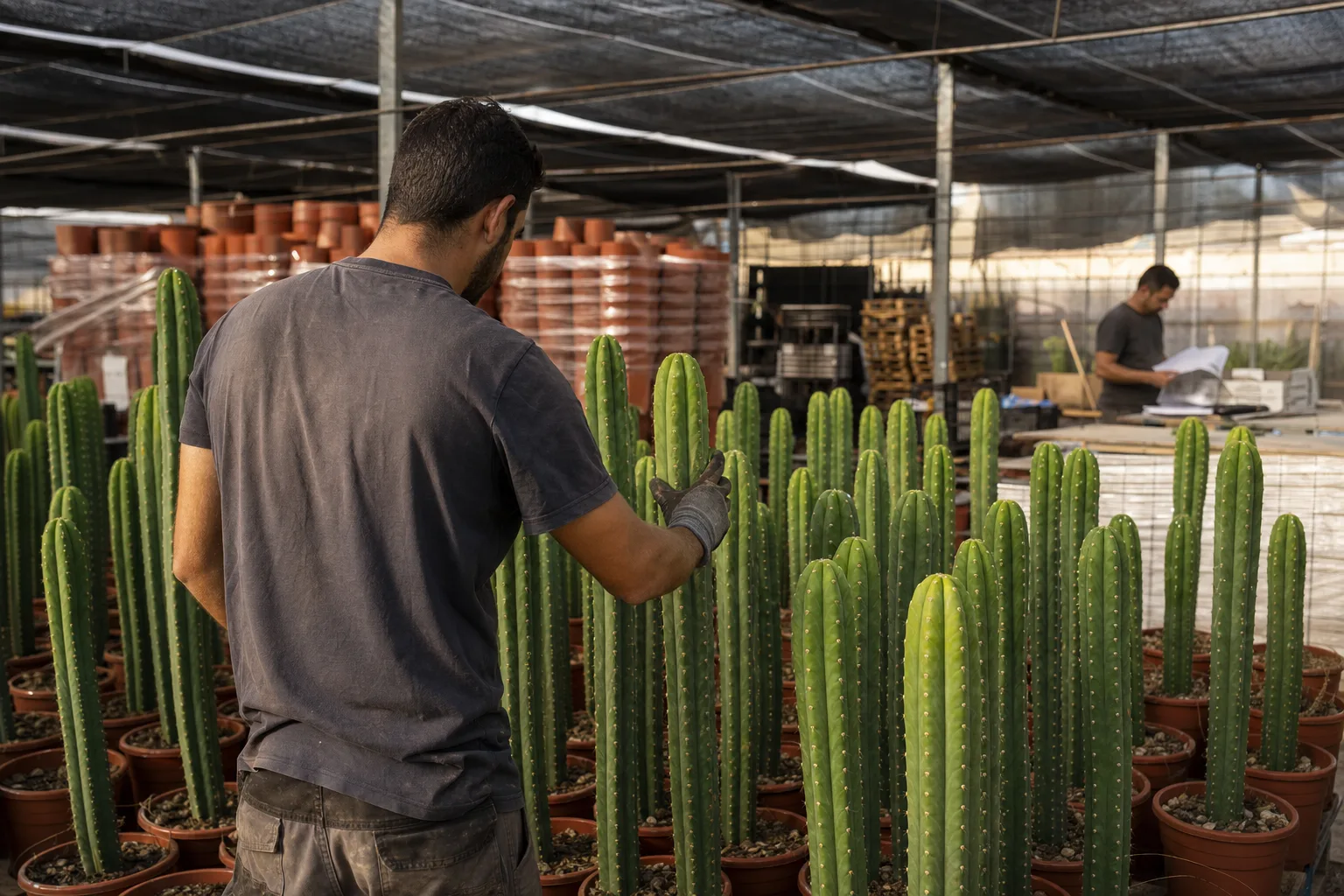
Buy Trichocereus Wholesale in Europe: Quality and Logistics Criteria
Buying Trichocereus wholesale in Europe is not just about negotiating a price per unit. For a garden center, a redistributing nursery, or a xerophytic project landscaper, the difference between a good supplier and a logistical problem is measured in caliber uniformity, health, phytosanitary documentation, and the ability to repeat orders. This guide summarizes quality and logistics criteria aimed at professional operators working with ornamental columnar cacti —from Trichocereus pachanoi to T. terscheckii / pasacana— in the European market.
Tricholand operates as a wholesale production nursery in Murcia (Spain), with approximately 2,500 m² of its own facilities and distribution to nurseries, garden centers, and distributors in over 18 countries. The focus of this article reflects that B2B reality: professional volume, EU plant passport, and specialized shipments, without inventing deadlines or specific stocks.
What “quality” means in a wholesale lot of Trichocereus
The commercial quality of a columnar cactus is not just about “being alive.” At the counter and on-site, the end customer sees turgidity, color, symmetry, and cleanliness of areoles. The professional also looks at the root system, traceability, and the lot's ability to withstand transport and reconditioning.
1. Botanical identity and variety consistency
The trade uses nursery names (Trichocereus pachanoi, peruvianus, bridgesii) even though modern taxonomy often places them under Echinopsis sensu lato. What matters in wholesale purchasing is that the lot is consistent with the requested specifications: number of ribs, spination, diameter, and habit. Mixing “types” on the same pallet generates returns and loss of trust. Request photos of the actual lot, not just from the catalog, and cross-check with the Trichocereus variety catalog.
2. Caliber and homogeneity
Define caliber by column height, diameter, and, if applicable, number of offsets. A serious B2B order specifies ranges (for example, 20–25 cm, 40–50 cm, 80–100 cm) and acceptable tolerance (±10%). Homogeneity within the pallet is more important than the “star” plant of the lot: a garden center display sells based on visual repetition.
- Seedlings and juveniles: ideal for self-fattening or promotional packs.
- Medium calibers: rotation in retail and landscaping projects.
- Tall columns / specimens: landscaping and focal points; require reinforced packaging.
3. Visible health status
Inspect (or request a photographic report) for:
- Absence of mealybugs in axils and at the base.
- No spider webs or chlorotic speckling from mites on young tissue.
- Firm neck, without black lesions or rotten smell.
- Epidermis free from severe sunburn or generalized edema.
- Substrate without extreme salt efflorescence or uncontrolled substrate flies.
Health is built at the source with IPM protocols; it cannot be “cleaned” entirely at the destination. A supplier that documents entry quarantine and weekly monitoring reduces its risk.
4. Root system and prior cultivation
Prefer rooted plants in draining substrate, not recently transplanted “for the journey.” A stable root ball tolerates transport stress better. Inquire about irrigation regime and greenhouse conditions: material fattened with excess nitrogen and permanent shade often fails when exposed to full sun in the customer's garden.
5. Presentation and labeling
Label with botanical/commercial name, caliber, and lot code. The phytosanitary passport must be associated with the commercial unit according to European regulations. Clear labeling speeds up warehouse reception and traceability in case of incidents.
Phytosanitary documentation in the EU
The movement of plants for planting among professional operators within the Union is structured around the phytosanitary passport provided for in the Regulation (EU) 2016/2031. Operational summary for buyers:
- The supplier must be a registered professional operator authorized to issue passports when applicable.
- The passport accompanies the commercial unit (tray, box, pallet as appropriate) and includes identity, operator registration, traceability code, and origin.
- Retain documentation for at least the legal period of your member state (usually several years) for audits.
- For destinations outside the EU (including post-Brexit UK), phytosanitary certificates and additional procedures are often required: do not assume that the EU passport is sufficient.
As a buyer, ensure that the documentation arrives complete and legible. A low price without clear papers is not savings: it is a risk of detention at internal borders or rejection in retail chains.
Supplier selection criteria
Beyond the unit price, evaluate:
- Own production vs. pure trading. A producer controls substrate, irrigation, and health; an intermediary may offer a variety of origins but with more heterogeneity.
- Specialization in columnars. Those who rely on Trichocereus understand densities, fattening, and spine packaging.
- Ability to cultivate on demand. Useful for seasonal programs or landscaping projects with specific calibers.
- Technical advice. Substrate, fertigation, and establishment: real added value for redistributors.
- References in your country. Ask for clients in climatic conditions similar to yours.
- Communication in your language or clear English. Avoids caliber and documentation errors.
If you are looking for a producer interlocutor in southern Europe, you can request a catalog and conditions from Tricholand or check availability of calibers according to your campaign plan.
Logistics: from the cultivation table to the destination dock
Packaging
Columnars are protected from rubbing and crushing: separators, perforated film or mesh, rigid boxes, and, for tall specimens, vertical reinforcement. The spines of bridgesii and similar materials require more space between units. Cheap packaging that damages 8% of the lot becomes expensive.
Temperature and time in transit
Avoid extremes: closed heat in summer and humid cold in winter. Ideally, fast transport with ventilation and no prolonged condensation on the stems. Coordinate departures at the beginning of the week to reduce weekend warehouse stays. Universal deadlines cannot be promised: they depend on route, customs (if applicable), and season; however, traceability and incident communication can be demanded.
Loading units
Define whether you are purchasing by tray, box, half pallet, or full pallet. Standardize calibers by loading unit to facilitate picking at the destination. Clearly mark “top/fragile” and visible lot codes without opening the film.
Reception at destination
Recommended protocol within 30–60 minutes after unloading:
- Count units and cross-check with the delivery note.
- Photograph incidents before dispersing the lot.
- Verify passports and labels.
- Open a sample (5–10%) for health and moisture of the root ball.
- Acclimatize: do not move from a dark truck to full sun on the same day; provide light shade for 3–7 days if coming from intense greenhouse conditions.
- First watering only when the substrate requires it and the plant is stable; avoid immediate strong fertigation.
Purchase planning by channel
Garden centers and retail
Prioritize medium calibers, clean presentation, and rotation. It is better to replenish than to saturate with hard-to-move specimens. Attractive labeling and xerophytic care sheets increase conversion.
Nurseries that fatten
They can purchase dense juveniles and finish fattening locally. Demand impeccable health: a seedling with mealybugs multiplies the cost of IPM.
Landscaping and projects
They need predictability of caliber and delivery dates aligned with establishment. Request cultivation on demand with a time margin. Include rejection criteria in the contract (rotten roots, active pest, out-of-range caliber).
Multi-country distributors
Value suppliers with experience in EU documentation and the ability to consolidate routes. A single stable origin simplifies the training of sales teams on “what each Trichocereus is.”
How to read a wholesale offer
When comparing quotes, align:
- Exact species / commercial name.
- Height and diameter range.
- Type of container and volume.
- Status (rooted, recently transplanted, bare root).
- Inclusion of passport and packaging.
- Incoterm or delivery conditions (departure from nursery vs. delivered).
- Minimum order quantity and price scaling by volume (without assuming figures).
- Policy on losses / claims and notification window.
An incomplete offer invites misunderstandings. Prefer clarity over opaque discounts.
Common risks and how to mitigate them
- Heterogeneous lot: specify ranges and request photos of closed and open pallets.
- Latent pest: quarantine 14–21 days at destination for sensitive material; isolate new arrivals.
- Transport stress: do not fertigate or expose to strong sun the next day.
- Commercial taxonomic confusion: use agreed sheets and names; internal link to specific varieties on your website or supplier sheet.
- Incomplete documentation: do not unload for sale until papers are squared away.
Frequently asked questions
What is the minimum order to buy wholesale?
It depends on the producer and logistics. Typically, it is customary to work from professional volume (trays or pallets), not single units from a showroom. Check direct conditions at Tricholand contact.
Can I buy without a phytosanitary passport?
Among professional operators in the EU, the general framework requires a passport for plants for planting. Operating outside this complicates audits and retail chains. Demand documentation.
Which species should I order first for a European display?
Many redistributors start with pachanoi and peruvianus due to ornamental recognition, add bridgesii for silhouette and spination, and reserve terscheckii/pasacana for slow-growing landscaping clients. Explore sheets on bridgesii and the rest of the catalog.
How to manage orders to multiple countries?
Centralize a supplier with export/EU experience, unify calibers and labeling, and train local warehouses with the same reception protocol. The Tricholand blog publishes useful technical guides to align criteria.
Supplier audit checklist (before the first large order)
Before consolidating a high volume, a light audit is advisable —in-person or via video call with a greenhouse tour—. Questions that separate a serious producer from an opaque intermediary:
- Where is the material actually produced and since when?
- What substrate and irrigation regime do they use for fattening?
- What is the quarantine protocol for incoming shipments and monitoring for mealybugs/mites?
- Who issues the phytosanitary passport and how is it associated with the pallet?
- Can you show examples of labeling and delivery notes from a recent shipment (anonymized)?
- How do you handle claims regarding size or health, and within what time frame?
- Do you offer custom cultivation for landscaping project sizes?
A supplier that responds with operational clarity—without inventing miracle deadlines or dubious certifications—is usually more reliable than one that only competes on price. In the case of Tricholand, the verifiable facts are in-house production in Murcia, a European wholesale focus, EU passport, and technical advice; the rest of the conditions are specified order by order via contact.
Integration with the retail space and communication to the end customer
Wholesale purchasing does not end at the dock: it ends when the plant is sold. Prepare brief care sheets for xerophytic plants (light, spaced watering, draining substrate) for store staff. A well-presented batch of Trichocereus pachanoi, with a legible label and cultivation advice, sells better than a taller specimen that is poorly communicated. Reducing returns due to consumer overwatering is part of the channel's margin.
For Mediterranean landscaping projects, anticipate planting densities and temporary staking on-site. Young columnar cacti need anchoring in windy areas; the supplier can advise on minimum planting sizes, but the project management defines the final design.
Seasonality of European demand
The demand for ornamental cacti in Europe tends to concentrate in spring and early summer, with a second push in fall gardening in mild climates. Plan orders in advance of peaks: do not assume infinite availability of a specific size. Working with a producer that allows for custom cultivation enables alignment of fattening and campaigns without last-minute improvisation.
In harsh winters in Northern Europe, prioritize well-hardened material and transport that avoids condensation. In the south, monitor heat in closed trucks. Logistics is not a detail: it is part of the perceived quality upon opening the pallet. Coordinate with your supplier on shipping windows and receiving protocols before the peak season.
Conclusion
Successfully purchasing Trichocereus wholesale in Europe is a discipline: measurable quality criteria, proper EU documentation, and logistics designed for columnar cacti, not for soft seasonal plants. Choose suppliers that produce with traceability, that clearly communicate sizes, and that provide technical guidance. If you wish to request a wholesale quote or learn about availability for your channel, the Tricholand team in Murcia is ready to discuss varieties, sizes, and professional supply conditions.