
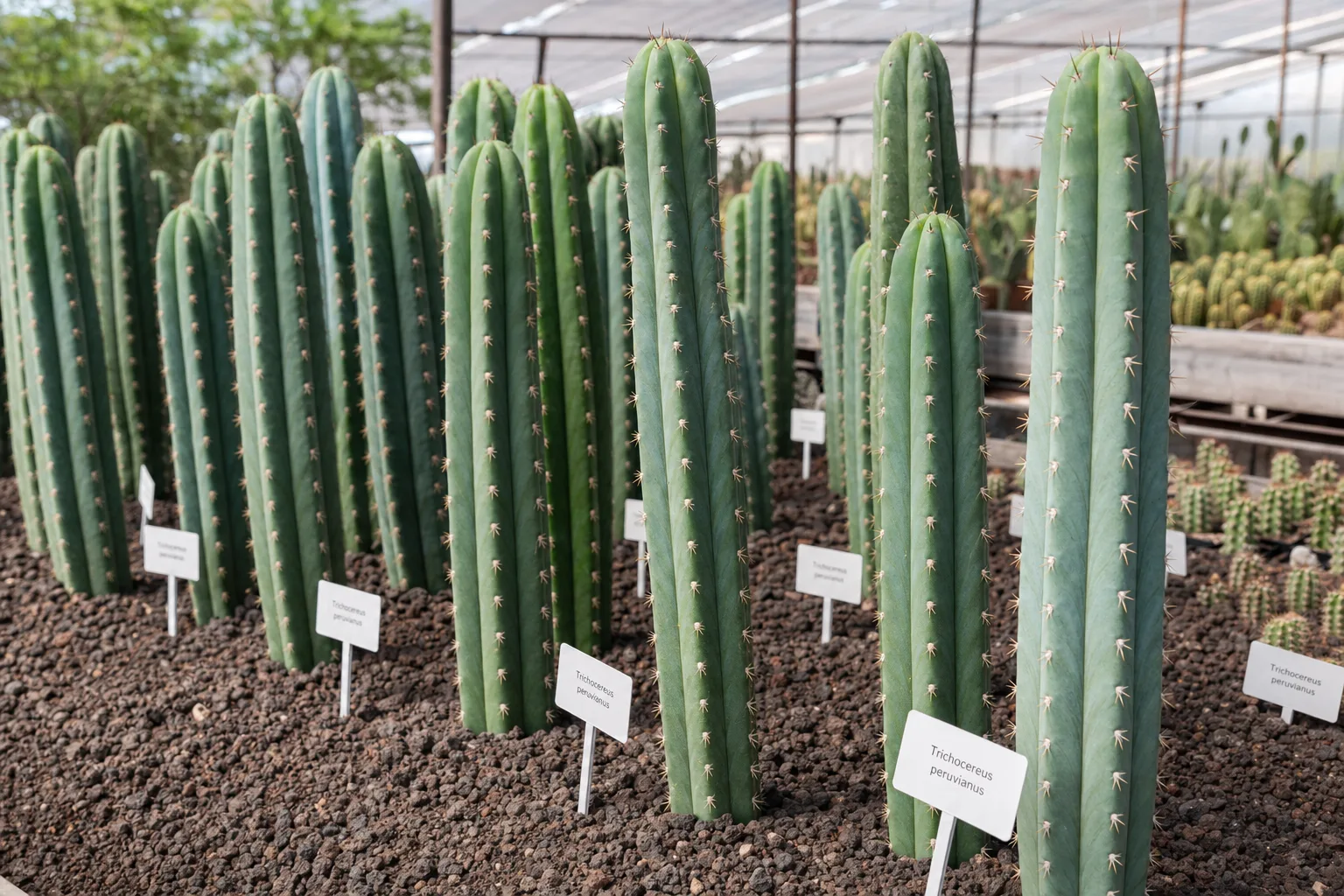
Correct Botanical Labeling: Trichocereus vs Echinopsis in B2B Catalog
In the wholesale trade of columnar cacti, the botanical name is not just a label decoration: it is the identifier that connects the catalog, order, plant passport, product sheet, and expectations of the professional buyer. When the same batch appears as Trichocereus bridgesii on the delivery note, Echinopsis lageniformis in the database, and “Bolivian San Pedro” on the website, the B2B channel loses traceability, generates returns due to “this is not what I ordered,” and weakens trust in the supplier.
This article explains, from an ornamental nursery perspective, how to correctly and usefully label the tension between Trichocereus and Echinopsis: what current taxonomy says, which names are still alive in the market, how to structure B2B sheets, and what mistakes to avoid. The tone is horticultural and commercial; it does not delve into ethnobotanical uses. At Tricholand, we work with the Trichocereus variety catalog featuring clear commercial names and visible synonyms for European buyers; if you need to align nomenclature with your ERP or store, you can speak with the Tricholand technical team.
Why labeling matters more in B2B than in retail
The amateur buyer tolerates some ambiguity (“green columnar cactus”). The professional buyer — nursery, garden center, landscaper, distributor — compares typology, size, price per unit, and scientific name among suppliers. A mismatch in name is interpreted as a mismatch in product. Furthermore, in the European Union, the professional movement of plants requires coherent documentation: the name on phytosanitary documents must be identifiable and stable within your system.
The problem is not just “choosing a name.” It is about maintaining three synchronized layers:
- Catalog commercial name (what the customer searches for and requests).
- Reference scientific name (what validates taxonomy and documentation).
- Synonyms and notes (what prevents historical confusion).
If you only publish one of the three, the internal SEO, warehouse, and sales end up speaking different languages.
What taxonomy says today (without dogmatism)
The genus Trichocereus was historically used for South American columnar cacti. For decades, databases and floras treated Trichocereus as a synonym of Echinopsis, a broad genus that also includes globose forms. Plants of the World Online (Kew) reflects this line: Trichocereus appears as a synonym of Echinopsis in its current treatment.
At the same time, the horticultural market — and part of the specialized literature — continues to use Trichocereus because it is operational: it communicates “Andean columnar” versus Echinopsis globosa with classic ornamental flowering. Morphological and genetic studies have argued at different times that Trichocereus can be treated as a distinct group within the Echinopsis sensu lato complex. The practical conclusion for a B2B catalog is not to declare a taxonomic war: it is to document both names with clear hierarchy.
Useful equivalence table in the nursery
- Trichocereus pachanoi ↔ frequently listed as Echinopsis pachanoi (and with a history of combinations under T. macrogonus in some proposals).
- Trichocereus peruvianus ↔ Echinopsis peruviana / related complex (check commercial typology; there is much heterogeneity among clones).
- Trichocereus bridgesii ↔ commonly accepted name Echinopsis lageniformis in POWO/ITIS.
- Trichocereus terscheckii ↔ Echinopsis terscheckii (cardón / pasacana in ornamental use).
These equivalences should appear in the sheet, not just at the top of the nurseryman's mind. Always consult a live source (POWO, ITIS, or another updated database) before fixing the “accepted name” field in your ERP, as the nomenclature of the Echinopsis complex has fluctuated.
Golden commercial rule: one primary name, visible synonyms
For the European wholesale catalog, we recommend:
- Primary sales name: the one used by your channel (in Tricholand and in much of the ornamental trade of columnars, Trichocereus + epithet).
- Reference scientific name / accepted synonym: Echinopsis + epithet when applicable, clearly labeled as a synonym or alternative name.
- Abbreviated authorship (optional but professional): e.g. Britton & Rose / Friedrich & Rowley, without overcrowding the physical label.
- Common ornamental name (if it adds value): “San Pedro” only when it does not create species ambiguity; it is better to specify (“pachanoi type”) than to use a generic common name for three different taxa.
Example of a clean catalog line:
Trichocereus bridgesii — synonym: Echinopsis lageniformis — size 40–50 cm — pot 3 L — typology light green columnar, marked ribs.
This line allows searching by either of the two binomials and reduces tickets of “is it the same?”.
Physical label versus digital sheet
Space on pot stickers is minimal. Prioritize:
- Legible primary name.
- Internal code / SKU.
- Commercial size or height.
- QR or short URL to a sheet with complete synonyms (optional but powerful in B2B).
In the web or PDF availability sheet, you must display synonyms, typology notes, and honest photos. The classic mistake is to put one name on the label and another on the web without mapping. Also check multilingual translations: in DE/FR/IT, the customer may search for the synonym Echinopsis even if you sell as Trichocereus.
Conflictual cases you should anticipate
Bridgesii / lageniformis
This is the clearest case of double nomenclature in the professional channel. If your buyer asks for “bridgesii” and your system only indexes “lageniformis,” the order fails. Solution: index both in search and show the pair in the sheet. Example product link: sheet for Trichocereus bridgesii.
Pachanoi / peruvianus / related complexes
Here the risk is not only the genus but the identity of species and clone. Two batches labeled “peruvianus” may differ in spination, color, and diameter. In B2B, reinforce with photographic typology and, if applicable, batch code or selection. See T. pachanoi and T. peruvianus.
Echinopsis “flowering” versus columnars
A garden center that buys flowering Echinopsis globosas does not expect a 1 m columnar. If your catalog mixes both under the same genus without typology, you create friction. Use descriptors: “columnar,” “globose,” “floral hybrid.”
Nursery names and trendy names
Commercial clones and selection names do not replace the binomial. They can go as a “selection / typology” field, never as the sole scientific identifier.
Phytosanitary documentation and name consistency
In EU trade, the plant passport and accompanying documents must allow for the identification of the plant. Do not invent certifications or numbers: align the name you use on the invoice, packing list, and label. If your authority or customer requests the “accepted” name according to a specific database, have the synonym mapped. Tricholand operates with a EU plant passport in European distribution; nominal traceability is part of that professional flow.
For more context on wholesale trade and lot quality, the Tricholand blog and the about us page describe the production framework in Murcia and shipping to 18+ countries.
How to structure the B2B catalog (minimum fields)
name_primary: Trichocereus …name_synonym: Echinopsis …family: Cactaceaegrowth_form: columnarcommercial_size: height / diameter / pot volumesku/ batchsearch_aliases: list of strings (bridgesii, lageniformis, etc.)notes: typology, color, spination (without non-ornamental claims)
In marketplaces and availability PDFs, always show name_primary + name_synonym in the same cell or line. The cost of an extra column is less than that of a misinterpreted order.
SEO and internal search: do not choose just one world
Customers search for “Trichocereus pachanoi,” “Echinopsis pachanoi,” “columnar cactus nursery,” “bridgesii wholesale.” A well-labeled B2B catalog captures both intents without duplicating products. Avoid creating two distinct sheets for the same SKU (one for each synonym): it generates cannibalization and phantom stock. One sheet, two names, one inventory.
In practice, the content team and the warehouse must share the same operational taxonomy. If marketing publishes “Echinopsis” because “it sounds more scientific” and operations prepares orders under “Trichocereus,” the picking fails even if the stock is correct. The naming policy is a living document: an internal page is enough — primary, synonym, search aliases, revision date — attached to the labeling procedure.
Text template for web sheet (usable example)
An introductory block for a sheet can follow this scheme without overwhelming the professional reader:
- Title: Trichocereus bridgesii (syn. Echinopsis lageniformis)
- Growth form: ornamental columnar cactus
- Horticultural origin: nursery material / typology described in photo
- Use: xerophytic gardening, container, Mediterranean landscaping, resale garden center
- Identification notes: color, ribs, relative spination — without claims unrelated to ornamental
This block, repeated consistently throughout the variety catalog, turns labeling into a competitive advantage: the buyer learns your system and stops doubting.
Labeling quality protocol in the nursery
- Establish a written policy: primary name + mandatory synonym in sheets.
- Quarterly review 10 SKUs against POWO or another database.
- Audit physical labels vs ERP (sampling by batch).
- Train sales staff: “bridgesii = lageniformis” should be an automatic response.
- Include synonyms in the customer area / web search.
- Update typological photography by SKU (the name is not enough if the clone differs).
Frequent mistakes (and how to avoid them)
- Changing names between seasons without redirecting searches or notifying regular customers.
- Using only the common name in export documents.
- Mixing typologies under the same SKU due to “green similarity.”
- Copying internet lists without verifying synonyms (there are homonyms and obsolete combinations).
- Forgetting languages: the German customer may filter by Echinopsis even if you sell in Spanish as Trichocereus.
Frequently asked questions
Should I label only with Echinopsis because “it is the correct one”?
Not necessarily. You must be correct and usable. If your market requests Trichocereus, use it as primary and declare the synonym Echinopsis. Taxonomic correctness without commercial usability generates friction.
Do ITIS and POWO always agree?
They usually align with key synonyms, but the complex is dynamic. Work with an internal reference source and revision date.
What should I do with hybrids and selections?
Label the parent or group when traceable; if not, declare “hybrid / ornamental selection” and describe the typology. Do not invent a false binomial.
Does the name affect the phytosanitary passport?
The consistency of the identifier in the documentation does matter. Maintain the same criteria on the label, invoice, and passport.
Conclusion
Properly labeling Trichocereus versus Echinopsis in the B2B catalog is not pedantry: it is commercial quality control. A stable primary name, visible synonyms, photographic typology, and alias search fields prevent misunderstandings among European nurseries. If you want to request a catalog and conditions or verify nomenclature with your own production material in Murcia, the Tricholand team can help you align the sheet, caliber, and documentation for the professional channel.