
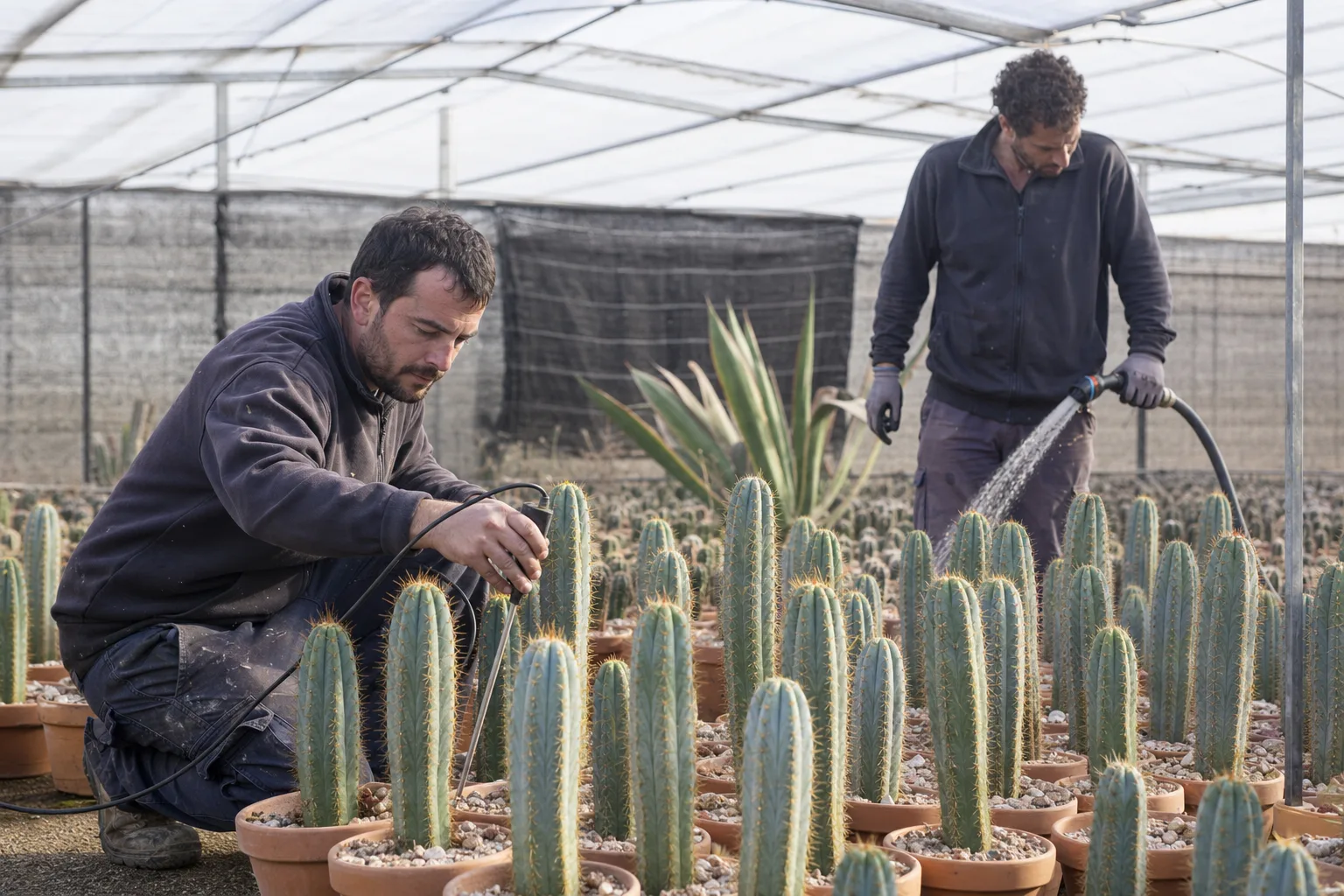
Irrigation of Trichocereus in the greenhouse: frequency, water quality, and drainage
In the production of Trichocereus under greenhouse conditions, irrigation is not a routine gesture: it is the variable that most influences the growth rate, the quality of the epidermis, cold tolerance, and the risk of rot. A well-watered batch thickens uniformly; a poorly watered batch accumulates salts, chlorosis, edema, or suffocated roots even if the rest of the management is correct. This article details frequency, water quality, and drainage with professional nursery criteria, applicable to both ornamental columns of Trichocereus pachanoi and T. peruvianus, T. bridgesii, and related materials from the South American columnar group.
The species marketed as Trichocereus (in broad taxonomy often treated within Echinopsis) come from Andean and semi-arid environments with marked humidity pulses and dry periods. In a Mediterranean greenhouse —such as the one in Murcia, where Tricholand produces in its own facilities— this ecological pattern must be translated into a controlled regime: deep and spaced irrigations, high root aeration, and water with known chemistry.
Operating principle: complete soaking and partial drying
The most useful rule in containers is the soak-and-dry method: wet the profile until water comes out of the drainage holes and do not water again until 50% to 80% of the available substrate volume has dried. Watering "a little every day" encourages shallow roots, root mealybugs, and salt accumulation in the upper part of the root ball. Overwatering with cold or poorly porous substrate is the fast track to Pythium, Phytophthora, and neck necrosis.
The decision point is not the fixed calendar, but the water status of the batch. In production, the following is combined:
- Container weight (trained workers detect the change between saturated and almost dry).
- Probe or tensiometry in representative beds.
- Observation of the epidermis: slight contraction of ribs indicates deficit; excessive turgor and soft tissue indicate excess.
- Color and odor of the drainage: anaerobic odors or black water indicate aeration problems.
Guideline frequency by season (northern hemisphere)
Spring–summer (active growth)
With daytime temperatures of 22–32 °C, good ventilation, and high PPFD, in pots of 1–3 L, usually one irrigation every 5–10 days is sufficient. In containers of 10–25 L, the interval extends to 7–14 days because the substrate volume buffers more. In deep beds or pots with a very mineral mix (60–80% inorganic), drying is faster and the frequency increases, but the volume per event must remain generous.
During heat peaks (>35 °C under plastic), do not respond with daily superficial irrigations: anticipate the event, water early, and force ventilation to ensure the neck dries before nightfall. Wetting the stem in cold night temperatures increases edema and fungal entries.
Autumn
Events are gradually spaced as temperature and radiation decrease. The goal is to mature tissues (more potassium and less nitrogen in fertigation) and not to keep the root ball permanently wet. A common mistake is to maintain the summer program until October: growth slows down, but the risk of rot increases.
Winter (dormancy or semi-dormancy)
In a cold greenhouse or with nights close to 5–10 °C, the substrate should remain almost dry. In a temperate greenhouse (≥12 °C), very light and spaced irrigations are allowed only if there is marked contraction and no risk of frost on turgid tissue. The cold tolerance of many columnar species is lost if the greenhouse remains humid in winter: the "green and soft" plant fails at temperatures it would have tolerated when dry.
For the southern hemisphere, reverse the calendar: the dry dormancy corresponds to May–August in the southern hemisphere; the peak of irrigation corresponds to the local warm season.
Water quality: pH, EC, alkalinity, and salts
Before designing the fertigation program, it is advisable to analyze the irrigation water at least once a year (and after changes in well or network). The critical parameters for container cacti are electrical conductivity (EC), pH, bicarbonates/alkalinity, sodium, chlorides, boron, and, in calcareous areas, calcium and magnesium. Nursery guidelines such as those from university horticultural extension emphasize that the EC of the water conditions the fertilizer dose and the need for washings.
Recommended working ranges
- pH of irrigation solution: 5.8–6.2 (broad substrate tolerance ~5.5–7.0).
- EC of starting water: ideal <0.8–1.0 dS/m; acceptable up to ~1.2 dS/m if washed regularly.
- EC of nutrient solution in growth: usually 0.8–1.2 mS/cm (includes fertilizer), adjusted to species and size.
- High alkalinity: hard waters from the southeastern Iberian Peninsula tend to raise the substrate pH; acidifying (nitric or phosphoric acid according to plan) prevents iron chlorosis.
If the water is very hard or saline, professional options include: controlled acidification, mixing with rainwater or reverse osmosis water, and choosing low-salinity fertilizers. Water softened with sodium chloride is not suitable: it exchanges calcium/magnesium for sodium and worsens the structure of the root ball.
Water-related symptoms
- Interveinal chlorosis / yellowing: typical of high pH and iron blockage; correct irrigation pH and provide Fe-EDDHA.
- Necrotic tips or ribs, stunted growth: possible excess of salts or sodium; measure drainage EC and leach.
- White spots on the surface of the substrate: saline efflorescence; wash and review fertigation doses.
- Edema (corky blisters): abundant watering with cold substrate and low evaporation; water during warm hours and improve aeration.
- Longitudinal cracking: extreme pulses after prolonged drought; stabilize intervals and volumes.
Drainage: the invisible partner of irrigation
Without real drainage, there is no good irrigation. Drainage is not a decorative layer of gravel at the bottom of the pot: it is the capacity of the substrate and the container to evacuate excess water in minutes and to refill large pores with air.
Substrate and container
For Trichocereus in production, mixes with 50–80% coarse mineral fraction (pumice, lapilli, coarse perlite, washed gravel 3–6 mm) and stable organics in minority (washed coconut fiber, screened blonde peat, very mature compost) are sought. The target pH of the medium is usually set at 5.8–6.5. Containers with multiple holes or side slots (air-pots, slotted pots) improve root oxygenation compared to blind pots with a single hole.
Avoid saucers with standing water under the pots: the drainage that "returns" upward by capillarity reintroduces salts and creates an anaerobic microenvironment at the base of the root ball. In growing tables, prioritize trays with slope and drainage, or cultivation in raised soil with sacrifice trenches.
Leachate percentage and salt washings
In each growth irrigation, a leachate of 10–20% of the applied volume (clear water that comes out below) is desirable. Every 6–8 weeks —or every 4 weeks if the water is saline— schedule a more intense washing (20–30% excess, or 2–3 volumes of pores) with low EC water to wash away accumulated salts. If the drainage EC exceeds that of the input by more than ~0.5–0.7 dS/m persistently, increase the frequency or volume of washing and review the fertilizer dose.
The PourThru method (sampling the drainage extract after irrigation) allows monitoring pH and EC of the batch without destroying plants. It is a cheap tool that separates nurseries that "water by memory" from those that truly control salinity.
Irrigation systems in columnar greenhouses
Drip irrigation
This is the standard in production: 2 L/h drippers, one or two per plant depending on size, placed 10–15 cm from the neck to stimulate lateral roots without waterlogging the base of the stem. In beds, drip irrigation allows for homogeneous fertigation and scheduled washings towards the trench. Periodically check for blockages: a clogged dripper generates a local "dry" area that is then overwatered all at once.
Flood irrigation / subirrigation
Useful in trays of young seedlings if it drains and excess is emptied. In adult plants with dense root balls, top irrigation until drainage is preferable because it leaches salts. Chronic subirrigation without washings concentrates salts on the surface.
Spray or aerial irrigation
Not recommended for adult Trichocereus: it wets areoles and neck, encourages fungi, and leaves marks. Reserve spraying only for specific phytosanitary treatments, during fast-drying hours, and with good ventilation.
Irrigation–nutrition–climate interaction
Irrigation transports nutrition. During active growth, many producers apply 50–100 ppm of N every 2–4 irrigations with formulas low in nitrogen and relatively high in potassium (for example, profiles like 3-5-7 to 4-7-8), plus chelated micronutrients. Urea as the main source of N is less convenient in these systems. At the end of summer, reduce N and prioritize K (and sometimes silicon) to harden tissues.
High relative humidity + frequent irrigation + little air movement is the ideal scenario for mealybugs and neck fungi. Ventilate, remove debris, and do not leave puddles in aisles. Dust on the epidermis also worsens mites: orderly water management reduces stress and, with it, pest pressure.
If you need to adjust fertigation or washing protocols to your local water, you can speak with the Tricholand technical team: we advise nurseries and distributors in Europe based on our own production experience in Murcia.
Practical decision protocol (batch checklist)
- Is the substrate temperature >15 °C and is there a forecast for drying hours? If not, postpone irrigation.
- Is the weight/moisture of the root ball in the dry-partial range? If it is still wet at depth, wait.
- Are the EC and pH of the prepared solution within range? Adjust acidification if necessary.
- Water until visible drainage; do not unnecessarily wet the stem.
- Evacuate excess from trays in <30 minutes.
- Record date, volume, entry/output EC in 5–10% of sentinel pots.
- Every 6–8 weeks: scheduled salt washing.
Common mistakes in the greenhouse
- Confusing "wrinkled plant" in winter with summer thirst and watering thoroughly with cold water.
- Using gardening substrate rich in peat without sufficient minerals.
- Ignoring water analysis and correcting chlorosis only with foliar fertilizers.
- Keeping saucers with water "for convenience."
- Fertilizing every irrigation without leaching: the root ball becomes salinized in two months.
- Watering at sunset in autumn-winter.
Summary calendar for Murcia and similar Mediterranean climates
March–May: reactivate deep irrigations; first salt washing after winter; start gentle fertigation.
June–August: maximum consumption; short intervals but always with partial drying; washings every 4–6 weeks if the water is hard; temporary shade only for young seedlings.
September–October: space out; reduce N; prepare for hardening.
November–February: almost dry; exceptional irrigations; maximum ventilation on sunny days to avoid condensation.
Frequently asked questions
How often is Trichocereus irrigated in the greenhouse?
There is no fixed number. In heat and a small pot, often every 5–10 days; in winter, it can go a month or more without watering. The signal is the drying of 50–80% of the substrate and the temperature of the medium.
What pH and EC should I use?
Work with a pH of 5.8–6.2 in the solution and a target nutrient EC of 0.8–1.2 mS/cm during growth, starting with the cleanest water possible. Monitor the drainage.
Does drip irrigation dry out the neck too much?
On the contrary: if properly placed, it prevents waterlogging of the neck. The problem arises when the dripper is stuck to the stem or when there is surface runoff without moistening the profile.
Can I use untreated hard tap water?
Yes, in the short term, but expect pH drift and chlorosis. Acidify, wash salts, and provide chelated iron according to analysis. In the medium term, mixing with RO or rainwater stabilizes production.
How does irrigation relate to wholesale sales?
A well-managed batch arrives at its destination with clean epidermis, free of edema spots and black roots. This reduces losses in transport and claims. If you are looking for already acclimatized material cultivated with professional criteria, check the variety catalog and request a wholesale quote.
Conclusion
Irrigation of Trichocereus in greenhouses is summarized in three pillars: frequency guided by the drying of the profile (not by habit), water with controlled pH and EC, and real drainage of the container and the table. Master these three points and the rest of the cultivation —nutrition, health, size increase— becomes predictable. For production on a European scale, phytosanitary passport and technical advice, the Tricholand team is available through the contact form or on the technical blog, where we continue to publish guides for professional ornamental cultivation.