
Mealybugs and Mites in Trichocereus: IPM Protocol for Professional Lots
In professional batches of Trichocereus, mealybugs and mites are the pests that most erode margins: they degrade the epidermis, hinder growth, and can ruin an entire wholesale order if detected upon receipt. An IPM (integrated pest management) approach is not an emergency spray: it is a system of prevention, thresholds, biology, and supporting chemistry. This guide describes a protocol applicable in greenhouses for ornamental columnar species —pachanoi, peruvianus, bridgesii and related species— with a nursery mindset that sells to Europe.
The cacti of the commercial group Trichocereus / Echinopsis offer many hiding places (axils, ribs, neck, roots) where mealybugs hide under wax and where tetranychid mites go unnoticed until young tissue appears speckled. That is why IPM starts before seeing “cotton.”
Why IPM Matters in Wholesale Production
A garden center can return an entire pallet due to visible mealybugs. A landscaper may reject material with bronzing from mites. Additionally, European plant health regulations —the framework of the Regulation (EU) 2016/2031— require professional operators to know pests, maintain traceability, and not circulate material with quarantine organisms. Although common mealybugs and mites are not always quarantine pests, they are pests of reputation and cost.
At Tricholand, health is part of the value of the wholesale batch along with size and EU passport. The protocol followed is the type of discipline that a buyer should demand from any serious supplier.
Quick Identification
Mealybugs (Pseudococcidae and related)
Appearance of white cottony masses in axils, at the base of the stem, under epidermal debris, or in roots (root mealybug). They excrete honeydew; sooty mold may appear. They are introduced with plant material, tools, and clothing. They survive in cracks of tables without plants for significant periods, according to greenhouse extension bulletins.
Damage: weakening, deformities, chlorotic spots, commercial rejection. Young nymphs are the most vulnerable stage to contact; waxy adults are difficult to wet.
Mites (especially Tetranychus urticae and related)
The two-spotted spider mite (Tetranychus urticae) is ubiquitous in greenhouses. In cacti, it manifests as fine speckling, loss of shine, bronzing, and, in heavy infestations, delicate webs in growth areas. It is confirmed by tapping tissue onto white paper: “dust” that moves.
Favored by warm and dry environments, dust on epidermis and stressed plants. Unlike mealybugs, they explode on days when ventilation is poor and there is dust + heat.
Useful diagnostic references for succulents: guides from the Missouri Botanical Garden on cactus and succulent pests.
Pillars of the IPM Protocol
- Prevention and exclusion
- Monitoring and thresholds
- Cultural measures
- Biological control
- Mechanical / physical control
- Rational chemical control (last tactical resort)
- Record keeping and continuous improvement
1. Prevention and Exclusion
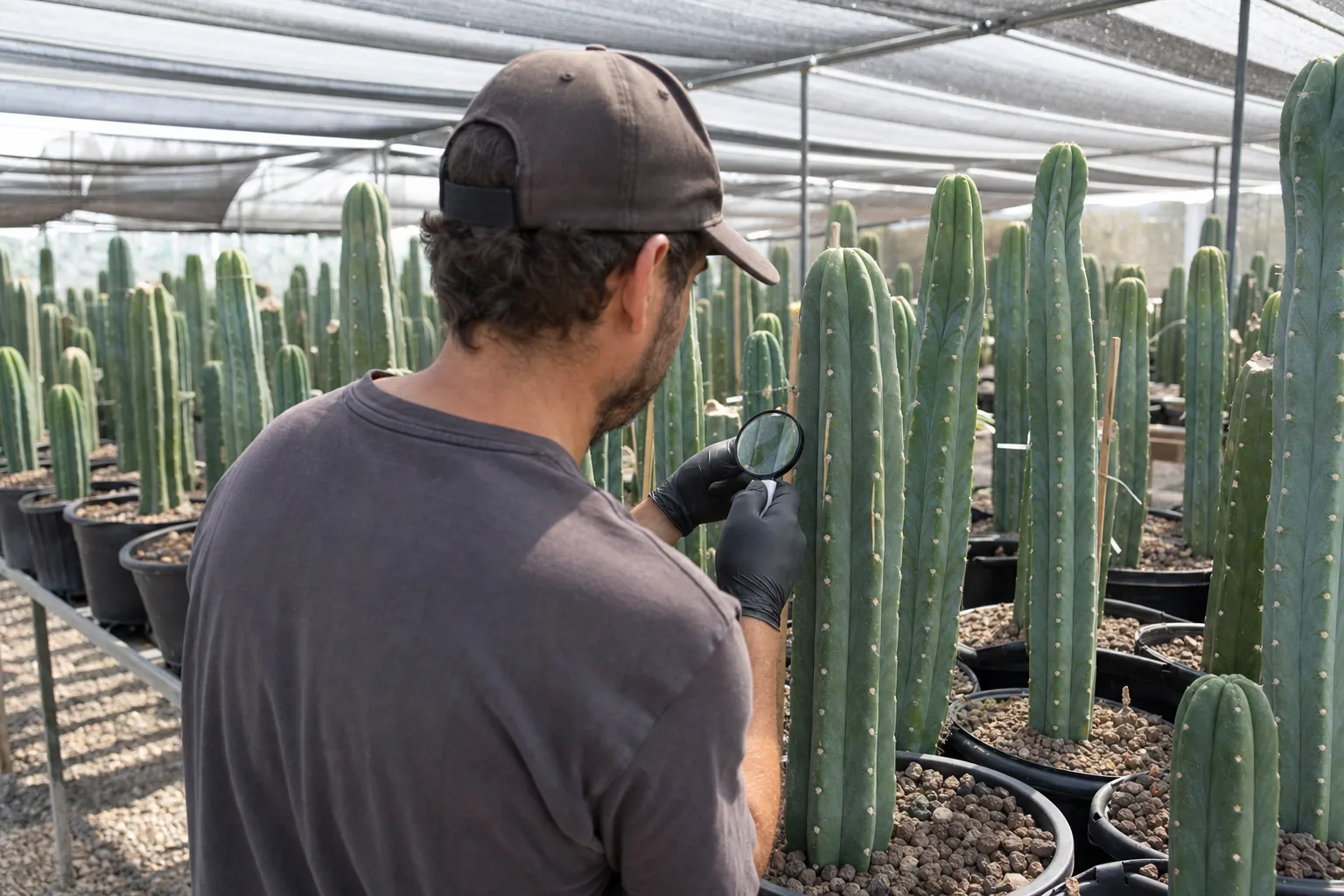
- Quarantine of entries: 14–28 days in an isolated area for new material, exchange cuttings, or plants from other nurseries. Inspection with a magnifying glass 10–20× in axils and neck.
- Personnel and tools: avoid moving from dirty to clean areas without changing gloves; disinfect scissors between batches.
- Weeds and debris: eliminate alternative hosts under tables and in aisles.
- Do not “plant pets” infested in the same module as the sale batch.
- Used packaging: do not reuse boxes with residues of honeydew or cotton.
Exclusion is the measure with the best ROI in long-cycle columnars: one infested cutting on a growing table can be very costly.
2. Monitoring and Thresholds
Design a weekly sampling (in summer, twice a week in hot spots):
- Walk in a zigzag covering edges (where many hotspots begin) and center.
- Inspect 20–50 plants per module depending on size.
- Use a magnifying glass and, for mites, white paper.
- Record: date, module, pest, intensity (0–3), action.
Indicative thresholds in ornamental sale batches:
- Visible mealybug on sale plant = immediate action (local treatment or destruction of hotspots). Commercial threshold close to zero in demanding retail.
- Mite: at the first confirmed speckling on young tissue, release biologicals or treat hotspots; do not wait for widespread webbing.
- Irrecoverable material (>30–40% of surface with dense active colony): assess destruction versus the cost of repeated treatments (economic criteria from MSU and other greenhouse extensions).
3. Cultural Measures
- Avoid excess nitrogen: soft tissues and rich sap favor mealybugs. Adjust fertigation (EC 0.8–1.2 mS/cm during growth, without excessive N).
- Deep and spaced irrigation: waterlogging favors root mealybugs and fungi; extreme water stress favors mites.
- Ventilation and dust: moving air and clean epidermis reduce mites. Avoid stagnant corners.
- Crop density: excessive density complicates inspection and coverage of treatments.
- Ant management: ants protect mealybugs in exchange for honeydew; control nests in the structure.
A well-cultivated batch —light, drainage, irrigation— tolerates pressure better and responds better to biologicals. For complementary irrigation criteria, also consult the guides from the Tricholand blog.
4. Biological Control
Against Mealybugs
- Cryptolaemus montrouzieri (mealybug destroyer): effective in greenhouses with moderate temperatures and detectable hotspots.
- Green lacewing larvae (Chrysoperla spp.): generalist support in early hotspots.
- Specific parasitoids according to mealybug species and local commercial availability.
Release in early hotspots; do not wait for massive cotton. Avoid residues of broad-spectrum insecticides that annihilate beneficials.
Against Mites
- Phytoseiulus persimilis: specialist against T. urticae; very effective in greenhouses, optimal around 13–27 °C and not extremely low RH (references from biological control suppliers indicate problems above ~30 °C or RH <70%).
- Neoseiulus californicus: more tolerant to variable conditions; useful in preventive measures or in drier climates.
Release upon detecting the first hotspots, not when the plant is already bronzed. In cacti, distribution must be careful (predators move across the surface): focus on growth areas and sentinel plants.
5. Mechanical and Physical Control
- Manual removal of mealybug colonies with a swab and isopropyl alcohol on mother plants or high-value specimens (test tolerance in a small area: some epidermis are sensitive).
- Directed water jet (protecting the substrate) to dislodge nymphs and mites in localized hotspots.
- Immediate removal of irrecoverable “trap” plants.
- Cleaning of tables, supports, and walls of the module after a hotspot.
In mass production, mechanical measures do not replace the system, but they save mother plants and reduce inoculum before treatment.
6. Rational Chemical Control
Use chemicals when the commercial threshold requires it or when biologicals cannot contain the hotspot. Principles:
- Rotation of modes of action to limit resistance (especially in mites).
- Coverage: the wax of mealybugs requires real wetting of axils and neck; often 2–3 spaced applications 5–7 days apart are needed to cover hatchings.
- Insecticidal soaps and horticultural oils: useful on nymphs if there is good wetting and applied in cool hours; risk of phytotoxicity in cacti in full sun or with high temperatures — test and avoid burns.
- Insect growth regulators and authorized contact insecticides: according to the country's label, ornamental crop, and safety period. Do not mention specific products without verifying local registration.
- Systemics: can help with hard-to-reach mealybugs, but efficacy varies and there are environmental implications; use them only within legality and your IPM plan.
- Compatible with biologicals: choose selective materials when intending to maintain predators.
Never a “blind calendar” of broad-spectrum applications: select resistances and trigger mites by killing beneficials.
Typical Weekly Protocol (Growing Module)
Monday: monitoring with a magnifying glass; mark hotspots with tape.
Tuesday: cultural actions (cleaning, ventilation, adjustment of irrigation/N).
Wednesday: release of biologicals or localized treatment according to threshold.
Thursday–Friday: verify coverage; second pass in axils if there was chemical contact.
Weekend: quick review of mother plants and quarantine area.
Adapt to your workforce; the critical factor is consistency, not the exact day.
Protocol for Receiving Purchases and Shipments
- Sampling upon arrival (5–10% of units).
- Timestamped photos if there is an incidence.
- Preventive isolation of doubtful batches.
- Do not mix on the same table with clean material until passing quarantine.
- In wholesale shipments: final inspection of pallet; zero tolerance for visible cotton in premium orders.
If you are a redistributor and need origin material with sanitary criteria, you can check availability of sizes or request a wholesale quote indicating your country and channel.
Case Studies: Mistakes that Reinforce the Pest
- Treating only the plant with cotton and forgetting the asymptomatic neighbors.
- Applying oil at noon in summer: it burns the epidermis.
- Introducing an “amateur rescue” into the sales module.
- Increasing nitrogen to “recover color” after mite: it produces soft shoots and more pests.
- Stopping monitoring in winter: mealybugs continue in the warm greenhouse.
Frequently Asked Questions
Is alcohol used on all plants in the greenhouse?
No. It is a precision tool for mother plants and small hotspots. At batch scale, prioritize exclusion, monitoring, biologicals, and authorized treatments with good coverage.
Do mites go away just with more humidity?
Increasing RH may slow down T. urticae, but in cacti, excess ambient humidity without ventilation creates other problems. Combine reasonable climate with predators and dust cleaning.
Can I export with a “nearly clean” hotspot?
Do not play that card. The reputational and return cost exceeds the pallet value. Sanitize or do not ship.
Does the IPM replace the phytosanitary passport?
No. They are distinct layers: the passport certifies the legal framework for movement; the IPM is your internal quality system. Both are necessary in professional trade.
Registration, traceability, and continuous improvement
Without registration, the IPM degrades to intuition. Record by module: monitoring dates, hotspots, beneficials released, active substances (if any), climate conditions, and results at 7–14 days. When a pallet leaves with an issue, you will be able to trace the source table and correct the critical point — entry, density, fertilization, or inspection gap —.
Train new staff with reference photos of mealybug in the axil and stippling from mites on young Trichocereus tissue. Early detection is a team competency, not just the responsibility of the health manager. A nursery that sells to European garden centers gains or loses reputation on that detail.
Integrate the IPM with the rest of the cultivation: irrigation, EC, and ventilation described in other technical guides on the blog. Pests are rarely an isolated phenomenon; they almost always indicate a prior cultural mismatch.
Conclusion
Mealybugs and mites on Trichocereus are managed with discipline: quarantine, magnifying glass, low thresholds in ornamental, sober cultural practices, timely biologicals, and chemistry only as a scalpel. This protocol protects the lot margin and the trust of the European customer. For material produced with a professional approach in Murcia and wholesale distribution, visit the varieties catalog or contact Tricholand to speak with the technical team about health and size requirements.