
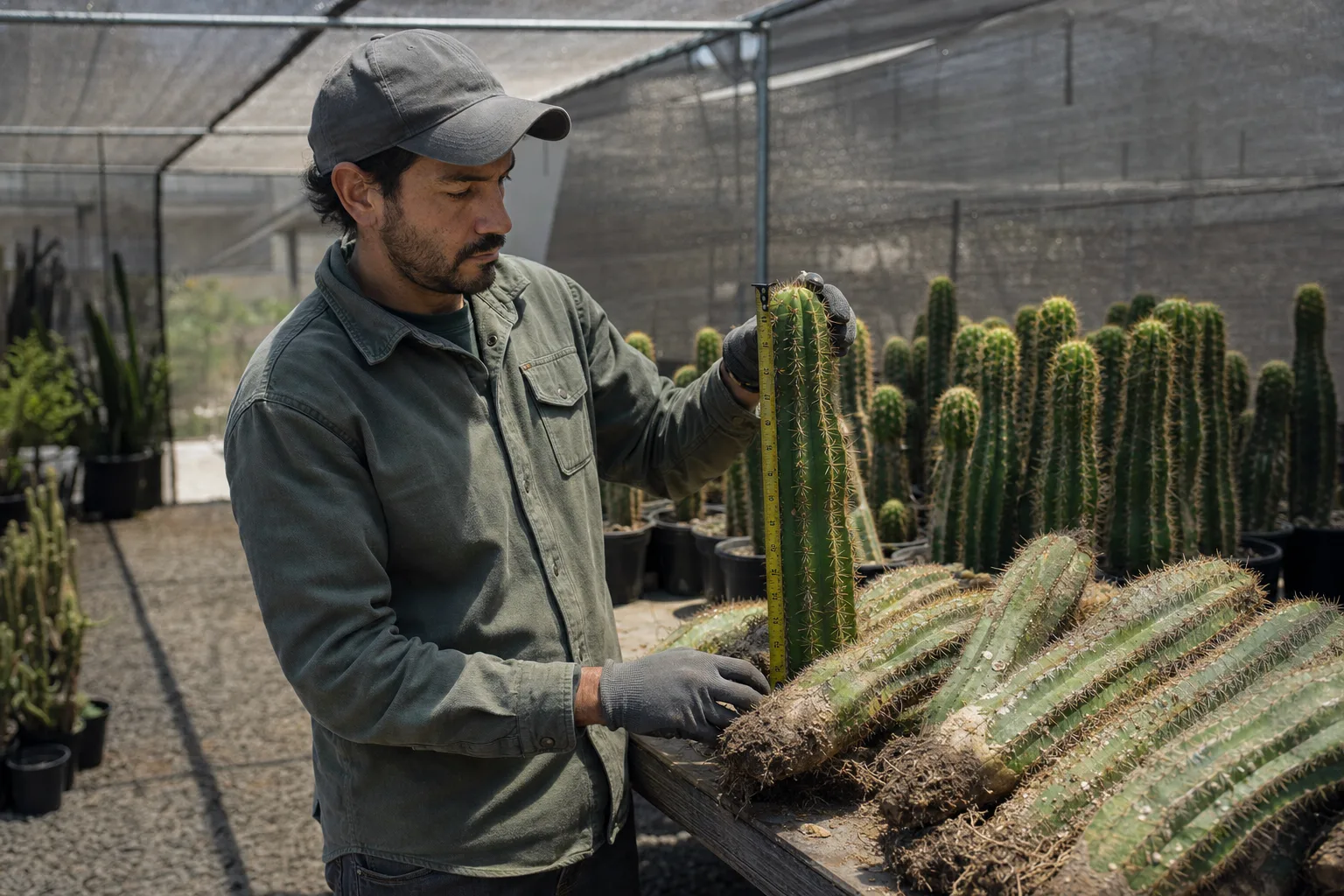
Post-Transport Acclimatization of Trichocereus: Nursery Reception Protocol
Transport is an inevitable physiological stress: darkness, vibration, temperature changes, and often substrate that is drier or wetter than ideal. A Trichocereus that left the Murcia greenhouse in perfect condition can be lost at its destination if the receiving nursery waters it on the same day and places it in full sun. Post-transport acclimatization is not a luxury: it is the protocol that protects the margin of the batch.
This guide describes an actionable reception procedure for nurseries, garden centers, and distributors working with columnar cacti. It combines inspection, short quarantine, light management, and deferred watering. If you need to align logistics and sizes with European production, you can check availability at Tricholand or review species in the variety catalog.
Why does the “good” plant fail after 10 days
The most common deferred losses after a truckload of Trichocereus are:
- Sunburn from immediate sun exposure after darkness.
- Neck rot from early watering on micro-wounds of roots.
- Collapse from cold and humidity in a dock or warehouse without ventilation.
- Contagion of undetected mealybug at reception.
- Etiolation from placing the batch in permanent shade “out of fear.”
The common pattern is to intervene too soon (water, fertilizer, extreme sun) or too late (leaving plants for days in closed packaging). The professional middle ground is: air out now, water later, gradually expose to sunlight.
Phase 0 — Before the truck arrives
- Reserve a quarantine area with bright shade, good air, and clean soil.
- Prepare meters, cameras, gloves, alcohol/clean tools, and incident sheets.
- Be clear on the packing list and expected codes.
- Define who signs the delivery notes and under what reservation criteria.
- Avoid scheduling automatic fertigation on the new batch for the first 14 days.
Without an acclimatization area, the linear space becomes an improvised hospital. A side aisle with 30–50% shade cloth is usually sufficient in spring-summer.
Phase 1 — Unloading and unpacking (day 0)
- Count pallets/colli and cross-check with the packing list.
- Open packaging as soon as it is safe: plants should not remain for days in a closed box.
- Carefully remove film and protectors without tearing spines or damaging tips.
- Place pots in the quarantine area, without stacking weight on columns.
- Do not water as a “welcome.”
After cold journeys, allow the tissue to recover to ambient temperature for 12–24 hours before handling roots or transplanting. The cold-wet contrast is a rot accelerator.
Phase 2 — Quality and health inspection
Indicative sampling: 2–5% of the batch or a minimum of 5–10 plants per code, plus a visual review of 100% of accessible tips in premium sizes.
Inspection checklist:
- Stem firmness: reject soft, watery, or foul-smelling areas.
- Tip: no crushing or necrosis.
- Neck: dry, without dark, wet tissues.
- Areoles: look for mealybug cotton, residue of honeydew, ants.
- Epidermis: distinguish transport abrasion from old burn.
- Substrate: smell for sanitized soil versus anaerobiosis; free drainage.
- Pot stability/height: container consistent with size.
- Documentation: EU phytosanitary passport present and consistent.
Photograph incidents with a visible lot label. Sign the delivery note with a reservation if there is any doubt. Separating doubtful plants prevents contaminating the healthy block.
For identification of cactus and succulent pests, resources like those from the Missouri Botanical Garden help train the reception team.
Phase 3 — Dry rest and root management (if applicable)
If the material arrives in an intact and healthy pot, do not unpot by default. If there are exposed roots, fresh breaks, or mandatory transplanting:
- Trim only dead or mucilaginous tissue with clean tools.
- Allow wounds to heal for 1–3 days in a dry and ventilated environment (longer if humidity is high).
- Plant in completely dry and draining substrate.
- Do not bury the neck deeper than original.
- Delay the first watering for 7–14 days depending on the season and temperature.
The golden rule of cactus acclimatization after shipping is: roots first, water later. Specialized reception guides agree on waiting several days before the first generous watering.
Phase 4 — Light: from the truck to display sun
A Trichocereus grown in full light at origin can still burn if it traveled for days in darkness. Indicative protocol (spring-summer, northern hemisphere):
- Days 0–3: bright shade / 40–50% mesh, no midday sun.
- Days 4–7: morning sun for 1–3 hours; shade during peak hours.
- Days 8–14: increase exposure; monitor for whitening or corky spots.
- Day 15+: destination sun if there are no symptoms; during heat waves, maintain some protection with black pot plastics (root temperature).
In winter, the dominant risk is not burning but cold and humidity: prioritize ventilation, dryness, and maximum available light without forcing watering.
Phase 5 — Watering and nutrition during acclimatization
- First watering: only when the plant is firm, the substrate is dry, and the nighttime temperature is reasonable (generally above ~10 °C in many cold greenhouse contexts).
- Peripheral watering, without flooding the neck.
- Let the profile dry before the next watering.
- No strong fertilizer for the first 2–3 weeks.
- Quality water: avoid high salts if possible; if in doubt, moderate flushing waterings later, not on day 1.
The classic error in the linear space is to “compensate for the journey” with a soak. What compensates for the journey is air, temporary shade, and patience.
Health quarantine: duration and exit criteria
Guidance: 7–14 days of observation separated from old stock. Extend if mealybug appears, suspicious spots, or if transport was very long.
Criteria for releasing to sale/production:
- No active pests in the expanded sample.
- No progression of necrosis.
- Stable or improving turgor.
- Color recovering without new burns.
- Trained personnel in handling (hold the pot, not the stem).
Frequently rotated species such as T. pachanoi and selections of T. bridgesii follow the same protocol; premium sizes and terscheckii deserve stricter sampling due to unit value.
Protocol by season (northern hemisphere)
Spring
Best acclimatization window. Watch for cold rains on new outdoor batches. Increase light faster if nights are mild.
Summer
Risk of heat shock in black pots and burning. Extend the bright shade phase. Water only when completely dry and preferably during cool hours.
Autumn
Reduce fertilization. Ensure the batch enters winter with a dry neck. Do not perform late mass transplanting without necessity.
Winter
Transport during rest is common and viable. Keep dry, ventilated, and with light. Delay watering until clear days and kinder temperatures. Do not store in damp garages without air.
In the southern hemisphere, shift the calendar six months.
Transplanting at reception: when to do it
- Broken or unstable container for the height.
- Collapsed/oversaturated substrate from origin.
- Need to unify sales format.
When not to:
- Healthy plant in a consistent pot.
- Personnel without time for healing.
- Cold or extreme heat wave on the same day.
If you transplant, mix draining mineral substrate, moderately increase pot diameter (about 2.5–5 cm), and defer watering. The container is part of the acclimatization system; do not ignore it.
Indicators that acclimatization is going well
- Tip maintains color and firmness.
- No new corky spots appear after increasing sun exposure.
- The substrate dries predictably.
- No progression of cotton in areoles.
- The plant does not soften after the first watering.
If there is basal softening after the first watering, isolate, reduce humidity, and evaluate tissue surgery/discard. A 1% controlled sacrifice can save the remaining 99%.
Integration with packing list and purchase
Acclimatization begins at the purchase: well-described sizes, packaging that does not crush tips, and reasonable transit times. Learn to demand a clear packing list and cross-check reception with documents. The technical blog and the about us page help understand production criteria before European shipping.
For morphology and context of common species, you can compare botanical sheets like Echinopsis pachanoi while maintaining the ornamental nursery focus.
Printable reception checklist
- Quarantine area prepared.
- Colli count = packing.
- Unpacking on the day of arrival.
- Sample inspection + incident photos.
- Delivery note with reservation if applicable.
- No watering on day 0.
- Initial bright shade.
- Light increase program for 7–14 days.
- First watering only with criteria met.
- No early strong fertilizer.
- Release to linear space after health observation.
Frequently asked questions
How many days without watering after the truck?
Usually 7–14 days for healthy potted plants; longer if there was root trimming or cold. The plant dictates more than the calendar.
Can I put the batch for sale after 2 days?
Only if the inspection is clean, the exposure light is controlled, and you accept the risk. The professional approach is to complete at least a week of observation during the active season.
What should I do with wrinkled plants?
A slight post-journey dehydration is normal. Do not correct it with daily watering. Wait for settling and give a single deep watering when appropriate, then dry.
What if rot arrives?
Isolate, document, remove soft tissue or the entire plant depending on the extent, disinfect the area, and check the humidity of neighbors.
Does acclimatization change by species?
The logic is common to ornamental Trichocereus. Adjust for size, spination (handling), and value: premium deserves more sampling, not another dogma.
Most costly mistakes
- Watering upon unloading.
- Midday sun on day 0.
- Fertilizing “to recover.”
- Mixing new batch with infested stock.
- Signing off without opening the sample.
- Leaving plants in packaging over the weekend.
- Mass transplanting during a heat wave.
Conclusion
A post-transport acclimatization protocol turns the dock into a quality filter, not a bottleneck. Airing out quickly, inspecting methodically, delaying irrigation, gradually increasing light, and releasing after a short quarantine is the sequence that minimizes losses in Trichocereus. If you want to combine this protocol with a homogeneous supply from our own production in Murcia, request a wholesale quote and align reception, packing, and sizes with the technical team at Tricholand.
The best acclimatization is the one your team can repeat every Tuesday from the truck without relying on a specific “expert.” Document the protocol on a one-page sheet, train it in 20 minutes, and measure it with losses at 30 days: when that number decreases, the nursery benefits twice — in plants and in shelf reputation.