
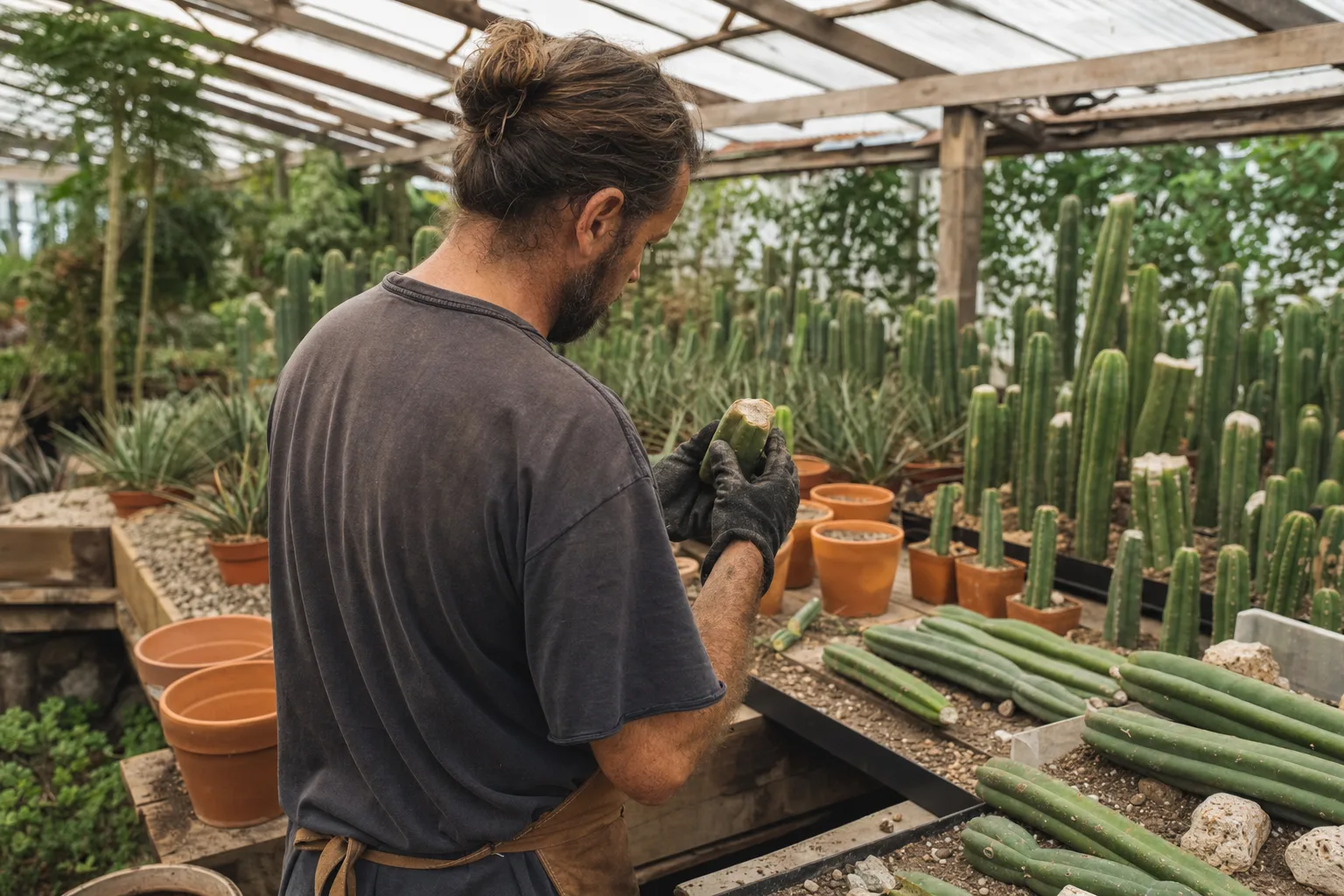
Propagation by cutting of Trichocereus: rooting, timelines, and losses
In ornamental production of columnar cacti, the vegetative propagation of Trichocereus is the dominant method when seeking clonal uniformity, predictable commercial size, and batch rotation. The cutting allows starting from adult tissue, shortening the time until a marketable product, and maintaining selected characters of epidermis, spination, and vigor from the mother plant. In return, it requires discipline in the callus, in the rooting substrate, and in loss control: most losses do not occur due to “lack of roots,” but rather due to excessive moisture on still open wounds or due to cold, damp conditions out of season.
This article summarizes a nursery protocol applicable to common species in the catalog—from Trichocereus pachanoi to more glaucous or spiny forms—with indicative timelines, causes of loss, and batch acceptance criteria. The approach is horticultural and commercial; taxonomy is treated with caution (Trichocereus / Echinopsis according to the nomenclature used in each sheet), without delving into uses outside ornamental cultivation.
Why cuttings dominate in professional nurseries
Seeds provide genetic diversity and are useful for improvement or for seedling batches, but the cycle until a saleable size is long. Cuttings, on the other hand, start with water and carbon reserves already accumulated in the stem: the plant only needs to emit adventitious roots and resume apical growth. In vigorous species of the group, a well-callused and rooted segment during the active season can regain elongation rhythm in one or two campaigns, compared to several years from seed to reach a similar stature.
Moreover, the cutting clones the genotype of the mother. This is important when the market demands homogeneous epidermis, low spination, or a stable rib profile in retail. In a wholesale nursery that supplies garden centers and distributors across Europe, batch repeatability reduces complaints and facilitates the standardization of sizes. Those needing to check size availability or propose a custom rooting program can do so with the technical team at Tricholand, with in-house production in Murcia and a EU plant passport for professional trade.
Selection of mother plant and segment
The quality of the cutting is determined before the cut. A healthy mother, free from mealybugs and basal necrosis, with active growth and no etiolation, drastically reduces subsequent losses. It is advisable to mark mother batches by clonal origin and record cutting dates: this correlates rooting and loss with season, diameter, and species.
Selection criteria
- Segments of 15–40 cm depending on commercial destination: shorter for multiplato or starter; longer for impactful pieces in gardening.
- Sufficient diameter for stability (avoid very thin or soft stems).
- Absence of lesions, open scars, chlorosis, or signs of soft rot.
- Preference for tissue from the active season (spring–summer in the northern hemisphere), not from material stressed by cold or extreme drought.
In species like Trichocereus peruvianus or Trichocereus bridgesii, spination and the weight of the segment require handling with gloves and lateral support; the stem should not be buried halfway to “hold it”: better to use a stake or mineral wedge.
Cutting, disinfection, and callus: the phase that prevents 70% of rots
The cut must be clean, with disinfected tools (alcohol or diluted hypochlorite between plants). A slight bevel at the base helps drain condensation and prevents puddles at the cutting plane. If the internal tissue shows discoloration or cavities, it should be trimmed to healthy parenchyma and callused again.
The callus—dry and firm healing of the wound—is non-negotiable. Under conditions of bright shade, good ventilation, and dry air, 10–21 days is usually sufficient. In humid climates or with large diameter cuts, the timeframe extends. A ready callus is noticeable to the touch: dry, somewhat leathery, without exudate or smell of fermentation. Sulfur or cinnamon powders are traditional aids in humid environments; they do not replace the drying time.
According to cultivation guides for Andean columnar cacti and botanical reference sheets like that of Echinopsis pachanoi on Wikipedia, these species are vigorous and propagate easily by segment; this does not imply that they tolerate wet wounds in cold substrate. The physiology of columnar cacti prioritizes sealing the wound before absorbing water.
Substrate and rooting container
The most common mistake is using a dense, moisture-retentive “generic cactus” compost with excess fine peat. For rooting Trichocereus, a very mineral, aerated, and fast-drying matrix is advisable:
- 60–100% mineral fraction: pumice, pozzolana, volcanic gravel 3–8 mm, washed coarse sand.
- 0–40% stable organic fraction (washed coconut fiber or fibrous peat) only if the climate is very dry and irrigation is controlled.
- Indicative pH of irrigation/substrate around 6.0–7.2; avoid waterlogging and accumulated salts.
The container must drain completely. In trays or individual pots, the depth is sufficient to stabilize 2–4 cm of callused base; the rest of the stem remains exposed. Excessive burial multiplies the risk of lateral rot. Favorable substrate temperature: approximately 22–28 °C. Bright light without aggressive direct sun during the first weeks prevents burns on tissue still under water stress.
Rooting timelines: realistic ranges, not promises
The timelines depend on species, diameter, season, temperature, and humidity. As a production guideline (northern hemisphere):
- Callus: 10–21 days (longer in high humidity or thick cuts).
- Visible irrigation emission / first roots: 2–6 weeks in stable heat; it can extend to 8–12 weeks in cool spring or with cold nights.
- Commercial rooting (roots several cm long, plant stable to gentle tug): often 4–10 weeks in the active season.
- Out of season (cold autumn–winter): the cutting can remain dormant for weeks or months without rotting if it is dry; do not force irrigation “to encourage rooting.”
Some enthusiasts report very fast rooting in water or humid systems; in professional batches, the criteria are different: homogeneity, low loss, and clean transplant to growth substrate. A dry or barely humid mineral protocol is more scalable and safer against rot fungi. After the first root emission, moderate irrigation begins, and the cutting moves to the final growing mix (dominantly mineral with a bit more retention), gradually increasing sunlight exposure.
Watering, hormones, and environmental conditions
Until functional roots exist, the stem relies on reserves. Premature abundant watering is the number one cause of loss. Recommended practice: dry or barely moistened substrate at planting; first significant watering when there are signs of roots (resistance to movement, visible roots through drainage) or after a minimum period of stable heat (often 2–4 weeks), always with visual assessment of the batch.
Indolebutyric acid (IBA) powder can be used on the callus as an aid, not as a miracle. Its usefulness is greater in slow material or under suboptimal conditions; in vigorous pachanoi at 25 °C, it is usually optional. What remains critical is temperature, aeration, and absence of free water on the wound.
High ventilation, controlled relative humidity, and exclusion of splash irrigation on recent cuts reduce Botrytis and bacterial rots. In greenhouses, avoid nighttime condensation on newly planted batches.
Losses: types, thresholds, and how to reduce them
In production, “loss” is not just dead plants: it includes cuttings that root late, etiolate, partially rot, or lose commercial size. It is advisable to classify:
- Post-planting basal rot: incomplete callus, early watering, cold and wet substrate.
- Lateral rot due to excessive burial: more than 4–5 cm of stem under wet gravel.
- Extreme dehydration / irreversible wrinkling: callus too long in very dry air + strong sun without water support; or material too thin.
- Etiolation: low light during rooting; correct with more PPFD, not with more water.
- Pests on the wound: substrate flies or mealybugs on mothers; hygiene and quarantine of batches.
A well-managed nursery's goal in optimal season is to keep losses low through small batching, daily inspection in the first week, and rejection of doubtful segments before callusing. It is cheaper to discard a suspicious cutting than to contaminate an entire tray. Documenting the percentage of loss by species and month allows for adjusting densities and cutting schedules.
Indicative calendar (northern hemisphere)
March–June: main window for cutting and rooting; long days and warm substrate accelerate roots.
July–August: viable with partial shading and very controlled watering; monitor heat stress and burns.
September–October: possible in warm climates (e.g., southeastern Iberia) if root temperature is still present; prioritize long calluses and less watering.
November–February: better to stock callused cuttings in dry and ventilated conditions, or plant with the expectation of dormancy; do not force with humidity. In the southern hemisphere, reverse the seasonal logic.
For designing growth substrates after rooting, the technical blog of Tricholand offers complementary guides on fertigation and mineralization; the rooted cutting should enter a gentle nutritional program, avoiding excess nitrogen that softens tissues.
From rooted cutting to saleable size
Once established, management shifts to standard cultivation: high light, spaced watering to a dry profile, balanced nutrition, and densities according to target size. The 25–30 cm cutting can be destined for terrace retail; larger segments or already branched plants go to landscaping. Traceability (mother → cutting date → tray → sales batch) facilitates claims and continuous improvement.
In operations serving 18+ European countries, the homogeneity of rooting also simplifies packaging: fewer “soft” plants in transit and less logistical loss. The phytosanitary passport and batch cleanliness are part of the same quality system as well-done callusing.
Common problems and quick solutions
- “It’s been two months and it hasn’t rooted”: check the nighttime temperature of the substrate; if it’s cold and dry, wait. If it’s cold and wet, dry and warm it up.
- Black and soft base: trim to healthy tissue, re-callus, do not water; consider discarding.
- Stem wrinkles but base is healthy: often normal in long callus; bright shade and patience; a minimal watering only if the wrinkling is extreme and there is heat.
- Thin roots that rot when watered: reduce water volume, increase substrate mineral content, enhance aeration.
Brief FAQ
Can rooting occur without hormones? Yes. In warm conditions and with proper callus, most vigorous Trichocereus root without IBA.
How much to bury? The minimum for stability, usually 2–4 cm of callused base; the stake prevents excessive burial.
Top watering or absorption? Avoid wetting the wound. Lateral moistening or watering the substrate without soaking the scar is preferable.
Cutting in winter? Possible dry storage; active rooting is unreliable without root heat.
Seed or cutting for a garden center? Cutting for rotation and uniformity; seed for diversity and new lines.
Conclusion
Propagation by cutting of Trichocereus is a robust process when three pillars are respected: healthy mother plant, complete callus, and mineral substrate with deferred watering. Rooting times of 2–8 weeks during the active season are realistic; losses decrease when water is no longer "helped" to a tissue that does not yet have roots. In a wholesale scheme, measuring and recording each phase turns the experience into a protocol.
If you manage a nursery, a garden center, or a xerophytic landscaping project and need rooted material or protocol advice, you can request a wholesale quote or speak with the Tricholand technical team. You can also explore the Trichocereus variety catalog and the production sheets to align species, calibers, and order schedules with your sales campaign.