
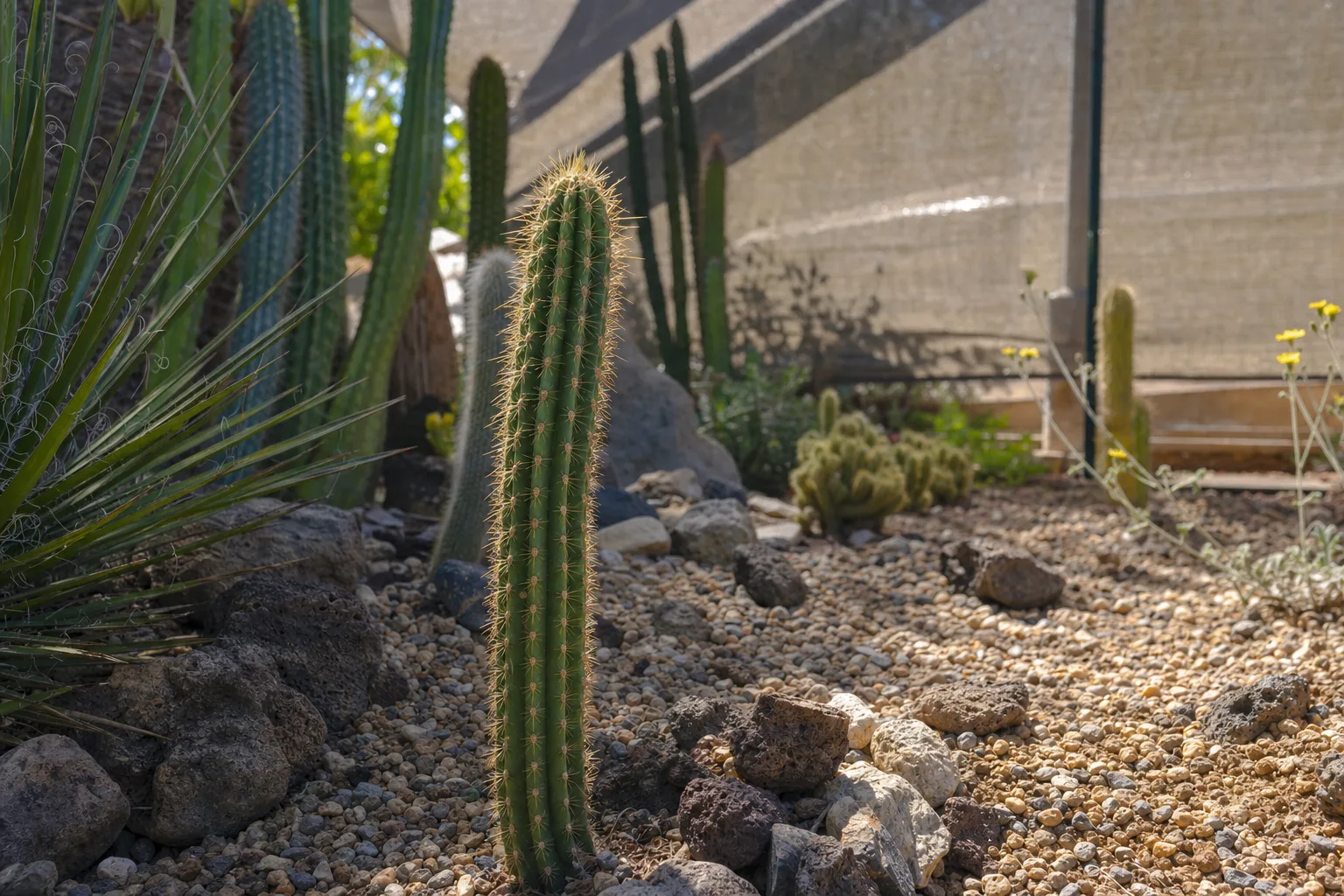
Trichocereus spachianus as an ornamental: cultivation and uses in the European landscape
In the European line of columnar cacti, Trichocereus spachianus —often referred to as Echinopsis spachiana— offers a different perspective compared to pachanoi or peruvianus: finer columns, numerous ribs, and golden spines that catch the light. It is a rockery, terrace, and xerophytic section plant with strong ornamental value, easily recognizable and attractive to customers seeking green architecture without a monumental specimen.
This cultivation and merchandising sheet focuses on ornamental and nursery use. It mentions taxonomic synonyms with caution, without dogmatizing. For wholesale assortment of columnars from Murcia, you can check availability at Tricholand and compare with the rest of the variety catalog.
Name, synonyms, and how to label in store
In nursery and collector catalogs, the name Trichocereus spachianus remains in use. In current treatments, Plants of the World Online and many floras place the species in Echinopsis spachiana (Lem.) H.Friedrich & G.D.Rowley. Historical combinations and synonyms such as Soehrensia spachiana, Cereus spachianus, or references to Trichocereus santiaguensis / Echinopsis santiaguensis also appear in the literature.
Commercial recommendation:
- Main label: the name that your customer and your ERP already use (often Trichocereus spachianus).
- Subtitle: “syn. Echinopsis spachiana”.
- Common ornamental name: golden torch, antorcha dorada, golden columnar.
Do not present taxonomy as a unique and immutable truth: the genus Echinopsis in a broad sense is complex and has been subject to reorganization. For an accessible synthesis, consult Echinopsis spachiana on Wikipedia and contrast serious horticultural sources; at the point of sale, prioritize ornamental clarity.
Useful ornamental identification in line
Features that help staff avoid confusing it with other columnars from the same batch:
- Habit: columnar, with vertical branches from the base (clumping habit).
- Indicative height: up to ~2 m in favorable conditions; in retail pots, it is usually sold much shorter.
- Stem diameter: about 5–6 cm in classic descriptions; slimmer than many production-grown pachanoi.
- Ribs: 10–15, rounded.
- Spines: initially reddish-yellow/golden, later whitish; central spine ~1–2 cm with shorter radials.
- Areoles: relatively large, with wavy yellowish hairs when young.
- Flowers: white, large (around 15 cm in diameter and 18–20 cm in length according to descriptions), nocturnal; in the northern hemisphere, they are usually associated with June–July.
In the display, the visual “hook” is the golden spines against the light and the orderly multi-stem base. Compared to T. pachanoi (thicker, often less spiny in commercial lines) or T. peruvianus (glaucous), spachianus offers golden texture and torch silhouette.
Origin and cultivation context
The species is associated with South America, with references to Argentina (including mentions of Santiago del Estero / northwest) and Bolivia. It is widely cultivated as a potted and rock garden plant. It has been cited as introduced in various territories and, in some contexts (e.g., South Africa), as a problematic plant: in European ornamental line, the focus is on controlled cultivation in containers or designed gardens, not irresponsible naturalization.
For the Mediterranean garden center, the useful message is: columnar, full sun, drainage, and watering to dryness, suitable for xerophytic compositions with agaves, dasylirion, and gravels.
Professional cultivation requirements
Light
Full sun or very high light. Indoors only with exceptional south/west window or light support; otherwise, rapid etiolation (apical thinning). After transport, acclimate for 7–14 days before exposure to midday sun.
Temperature and cold
Grows well in USDA zones 9–11 in many horticultural guides. It tolerates some cold if the substrate is dry, but the cold + humidity combo rots necks. In continental Europe, winter in a cold dry greenhouse or protection under cover. Do not promise extreme hardiness: protect from prolonged frosts.
Substrate
Mineral-draining mix: cactus substrate base + pumice/perlite/coarse gravel. Avoid fine peat compacted in large pots. pH close to neutral or slightly acidic usually works; the critical factor is air in the profile.
Watering
Soak-and-dry method: generous watering and then allow to dry completely. In summer, frequency depends on pot and climate (often every 7–14 days in exposed containers). In winter, minimal or none if it’s cold. Never leave a plate with permanent water in the line.
Nutrition
Gentle fertilization during the active season (spring–summer), low in excessive nitrogen to avoid forcing soft tissues. In post-purchase acclimatization, avoid strong fertilizers for the first weeks.
Pots and sizes for the European line
- Impulse: 25–40 cm in C.12–C.14; ideal for showcasing the species.
- Sweet spot: 40–70 cm in C.17–C.19; better rotation in garden center.
- Premium terrace: multi-stem 70–100 cm+ in C.21–C.25; anchor of golden section.
Due to its relatively contained diameter, spachianus tolerates somewhat narrower containers than a heavily grown pachanoi of the same height, but do not overdo it: stability and root volume are paramount. Increase pot diameter moderately during transplanting (about 2.5–5 cm).
Ornamental propagation
The most commonly used method in nurseries is cutting or separating basal offsets:
- Clean cut of a healthy segment or separation of a pup.
- Dry healing in shade for 7–14 days (longer if the cut is large).
- Settle in dry draining substrate.
- Delayed watering until signs of rooting.
Seed is viable for genetic programs but is slower and more variable for line homogeneity. For retail replenishment, prioritize uniform vegetative lines in spine color and rib number.
Plant health in production and store
- Mealybugs in areoles: inspection with a magnifying glass, quarantine, cleaning/treatment according to nursery IPM protocol.
- Mites in hot dry environments: monitor for dull epidermis.
- Rot: excess watering, cold humidity, unhealed wounds.
- Mechanical damage: spines and rubbing during packing; require protectors in shipments.
Document batches with EU phytosanitary passport in professional movement. Training staff prevents a reception pest from becoming a section pest.
Uses in the European line: merchandising that sells
Spachianus works particularly well in three store narratives:
- “Golden torch”: backlight, light gravel, sun label, and watering to dryness.
- Multi-texture composition: alongside blue agave, sedum, and a thick columnar (pachanoi) for diameter contrast.
- Mediterranean terrace: presentable heavy pot, without a plate with water, southern zone.
Avoid placing it in a dark gondola interior: etiolation = return. Also, avoid mixing it in the same SKU code with bridgesii or pachanoi: the customer compares spines and complains.
As a visual anchor, a well-formed multi-stem competes with more expensive specimens of other species because it “fills” horizontal volume from the base. This is an advantage for average ticket in independent garden centers.
Xerophytic landscaping use
In low-water gardens of the Mediterranean arc:
- Groups of 3–5 specimens spaced 40–80 cm apart depending on size.
- Raised or draining mound soil.
- Mineral mulch (gravel) that communicates dryness and reduces splashes to the neck.
- Companions: agaves, small yuccas, sage, lavender in non-waterlogged periphery.
Do not use it as a dense hedge like a Mexican cereal: its value is as a sculptural group. In areas with frequent frosts, use a mobile container or protected microclimate.
Quick comparison with other columnars in the catalog
- Vs pachanoi: spachianus is finer, has more ribs, and more “golden” spines; pachanoi grows thicker and is often more “clean green” in commercial lines.
- Vs peruvianus: peruvianus excels in glaucousness; spachianus in spine brightness.
- Vs bridgesii: bridgesii adds character and distinct marked spination; spachianus reads more as a “classic torch”.
- Vs terscheckii: terscheckii is a monumental slow-cycle landmark; spachianus is more manageable in retail. See terscheckii sheet.
Building a line with two or three of these readings avoids monotony and allows for a price ladder. The commercial team at Tricholand can help you request the catalog and conditions without mixing codes.
Indicative calendar (northern hemisphere)
- Feb–Mar: reception and acclimatization; minimal watering.
- Apr–May: growth; transplanting; start of gentle fertigation.
- Jun–Jul: maximum light; possible flowering in mature plants; control of watering.
- Aug–Sep: monitor heat in black pots; terrace sales.
- Oct–Jan: dry out, reduce fertilization, protect from cold humidity.
Southern hemisphere: shift six months. Night flowering, when it occurs, is a storytelling argument in store (ornamental), not an invasive claim of ethnobotanical marketing.
Frequent problems and solutions
- Thin apex: lack of light → gradually increase exposure.
- Soft base: excess water/cold → dry out, isolate, evaluate for discard.
- “Washed” spines without shine: sometimes natural aging; difference between young vs old batch in purchase.
- Leaning: seek lateral light or irregular substrate → rotate pot and correct stake only temporarily.
- Corneal spots: sunburn post-transport → temporary shading.
Frequently asked questions from the line
Is Trichocereus spachianus the same as Echinopsis spachiana?
In commerce, they usually refer to the same ornamental entity; they are name combinations used in different times and treatments. Label with the name from your catalog and the synonym in parentheses.
Is it suitable for indoors?
Only with very high light. The natural positioning is sunny outdoors or bright greenhouse.
How long does it take to branch?
It depends on age, nutrition, and space. The basal habit is expressed better in established plants; do not promise immediate multi-stem in impulse juveniles.
What pot should I sell with it?
Heavy ceramic or terracotta raises the ticket; clean plastic rotates cheaper. Always with real drainage.
How to differentiate it in 10 seconds?
Slender columns, many ribs, golden/light spines, and branches from the bottom: “torch,” not “thick post.”
Wholesale purchasing criteria
- Set label name + synonym.
- Height, number of stems, container.
- Color uniformity of spines in the batch.
- Packing that protects spines (they are part of the visual value).
- Acclimatization protocol at destination.
- EU passport and traceability.
Learn about the producer culture in about us and train the team with readings from the blog to maintain the ornamental discourse throughout the chain.
Closing
Trichocereus spachianus (Echinopsis spachiana) is a high visual performance ornamental columnar in the European market: golden texture, torch-like shape, and clear xerophytic cultivation. Label it with prudent synonyms, cultivate it in sunlight and well-drained conditions, acclimatize it after transport, and present it as a piece of plant architecture—not as a generic commodity of “columnar cactus.”
If you want to integrate spachianus or other columnars into a coherent assortment ladder with in-house production in Murcia and distribution to garden centers in Europe, talk to the technical team at Tricholand and request a wholesale quote with defined calibers and container formats.
Ultimately, the species benefits when the point of sale understands its differential: it is not the thickest columnar in the bank, it is the one that lights up the gravel. That nuance, well communicated, sustains price and turnover.