
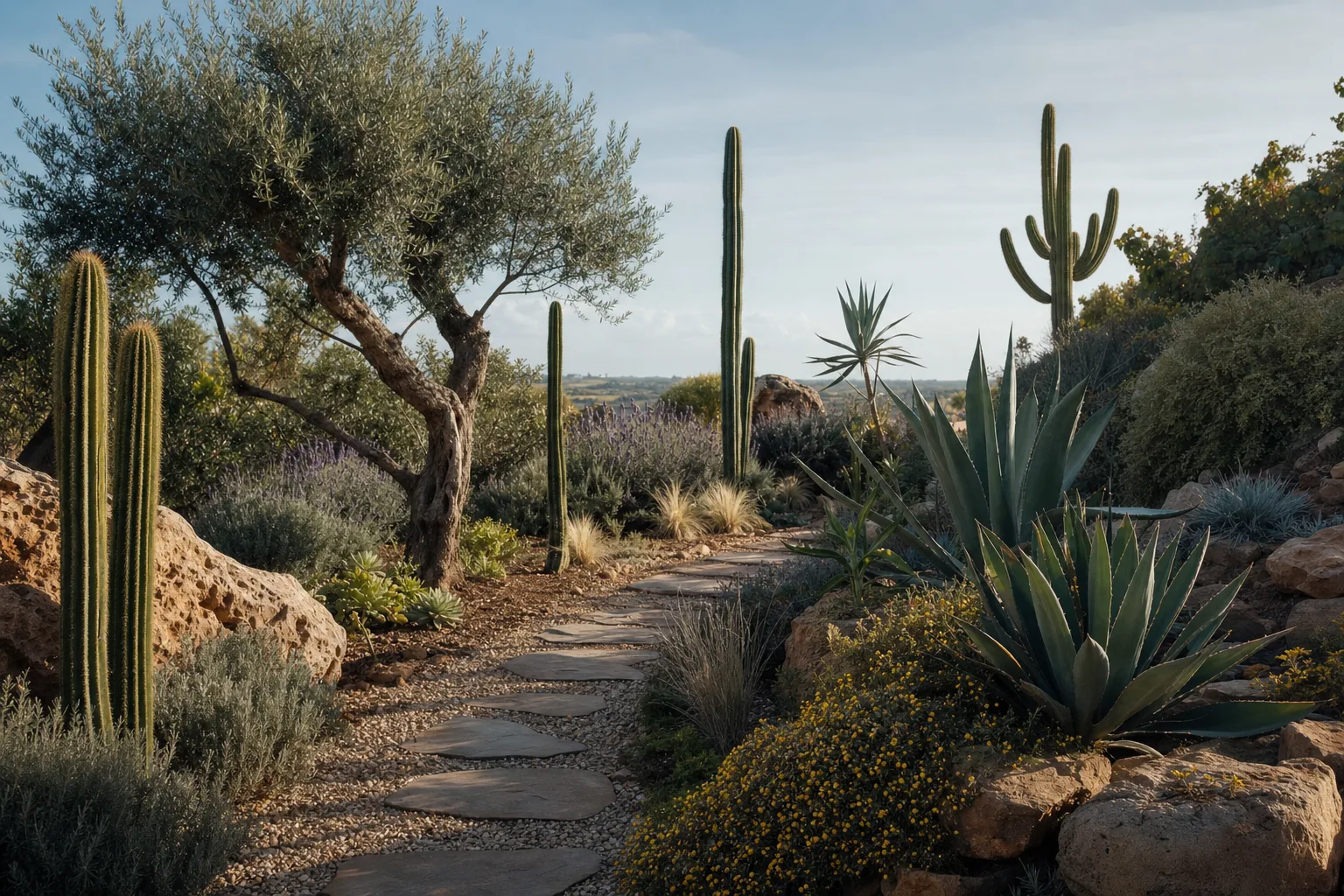
Columnar Xerophytic Cactus: Designing Mediterranean Gardens with Trichocereus
The xerophytic columnar cactus has become the structural vertical element of many contemporary Mediterranean gardens: it provides height without dense shade, consumes little water once established, and reads as plant architecture against gravel, walls, and silver aromatic plants. Within this language, Andean-origin Trichocereus offer a decisive advantage over ultra-slow columnar species: an establishment rhythm compatible with construction timelines and residential clients.
This article develops design criteria—not just cultivation—for integrating Trichocereus into Mediterranean xeriscaping: composition, distances, drainage, hydrozones, companion species, and low-input maintenance. As a wholesale producer in Murcia, Tricholand supplies homogeneous material to landscapers and garden centers across Europe; if your project requires specific measurements, you can request a wholesale quote or implementation advice.
What we understand by xerophytic Mediterranean garden
It is not a thematic desert or a garden without plants. It is a system that aligns the climate of dry summers and wetter winters with adapted species, draining soils, mineral mulch, and efficient irrigation. Recurring principles in Mediterranean xeriscaping guides include:
- Hydrozonation: grouping by actual water demand.
- Impeccable drainage (raised beds if there is clay).
- Mineral mulch 5–10 cm (gravel, local aggregate).
- Sectorized, deep, and spaced drip irrigation.
- Evergreen structure year-round and punctual flowering.
Trichocereus fit into the driest hydrozone, alongside agaves, selected opuntias, yuccas, and succulent groundcovers. General references for Mediterranean gardens—layers, gravels, olive, lavender—can be consulted in resources such as the Gardenia Mediterranean Gardens guide; the role of the columnar is to provide the backbone that these palettes often resolve only with cypress or sculpture.
Why Trichocereus works in a Mediterranean context
CAM physiology, photosynthetic stems, and origin in Andean valleys with a dry season allow them to withstand heat and relative drought better than many trendy tropicals. Trichocereus pachanoi (syn. Echinopsis pachanoi), documented on Wikipedia, illustrates the profile: active growth in warm weather, white nocturnal flowering, and tolerance to brief cold spells if dry. In sunny coastal and inland areas, once acclimatized, it maintains presence for twelve months without constant architectural pruning.
Design advantages:
- Rapid verticality (especially pachanoi and peruvianus) compared to slow-growing cardones.
- Low dry leaf: less cleaning than deciduous broadleaf plants.
- Aesthetic compatibility with stone, exposed concrete, steel, and aggregates.
- Scalability: from private patios to median strips with low spination lines.
Palette of Trichocereus species for the project
- Trichocereus pachanoi: versatile axis, good speed, ideal for residential and corporate settings.
- Trichocereus peruvianus: glaucous accent; excellent in contrasts with lavender and light gravels.
- Trichocereus bridgesii: more graphic silhouette; use with setbacks in pedestrian pathways.
- Trichocereus terscheckii / pasacana: monumental landmark, slow cycle, better relative cold tolerance; a protagonist in large spaces.
Check the complete catalog of varieties to combine textures and calibers in the same hydrozone.
Composition: modules, rhythms, and distances
Avoid solitary plants in gravel without context and also compact hedges without breathing space. Compositions that work:
- Modules 3-5-3: odd groups of columns 0.8–1.2 m apart (medium calibers 8–12 cm in diameter).
- Filtering alignment: permeable screen against boundaries; 0.6–0.8 m in zig-zag if visual density is sought in 2–3 years.
- Landmark and entourage: one tall terscheckii or multi-stem, three medium pachanoi, and mineral groundcover.
- Contemporary patio: 1–3 columns in a structural planter with at least 40–60 cm of usable substrate.
In public spaces or narrow pathways, select low-spination lines or set back the planting 40–60 cm from traffic. Safety in use is part of the design, not an addition.
Soil, drainage, and planting details
The typical failure in Mediterranean gardening is not drought: it is winter waterlogging in a pot hole within clay. Implementation protocol:
- Excavate wide and improve with 20–40% coarse aggregate if the soil is heavy.
- Prefer a mound or raised bed 15–30 cm in areas of intense rainfall.
- Plant collar at final level or slightly high; never buried.
- Temporary staking only if the caliber is high and lateral wind is strong; remove when anchoring.
- Mineral mulch leaving 3–5 cm free around the collar for ventilation.
In a cover or planter, a usable depth of 30–60 cm for medium columns; extensive covers of a few centimeters are not suitable for a Trichocereus except in juvenile format in an independent container. Avoid waterproofing that turns the planter into a pool after autumn storms.
Establishment irrigation vs. maintenance irrigation
The first year is not zero water. It is deep and infrequent watering to encourage rooting. Guidance in warm-dry climates:
- Months 1–3: settling irrigations after planting; then every 7–14 days depending on heat, soaking the root bulb.
- First warm season: 1–2 weekly pulses in drip (emitters 2 L/h at 10–15 cm from the stem), adjusting for rain.
- From the second year: reduce to summer supports; many coastal locations maintain aesthetics with minimal inputs.
- Winter: almost dry; cut automatic irrigation that equals lawn watering.
Water quality and pH are as important as in the nursery: very calcareous waters can induce chlorosis; acidify or provide chelated Fe if yellowing appears between ribs. EC of fertigation, if used, should remain moderate (around 0.8–1.2 mS/cm during growth) and cease in cold. Documentation of plant circulation in public works must align with the framework of the phytosanitary passport.
Xerophytic companions and design layers
Build in strata:
- Upper stratum: Trichocereus, yucca rostrata, existing olive, resistant palms depending on the area.
- Middle stratum: Agave (attenuata in mild coastal areas; americana with caution according to local regulations), Dasylirion, tree aloe, Euphorbia architectonica where regulations allow.
- Lower stratum: lavender, rosemary, teucrium, santolina, xerophytic grasses, sedum or delosperma at edges.
- Mineral soil: gravels 6–20 mm, local boulders, accent stones; geotextile only if weed control requires it and drainage is not compromised.
Keep the hard hydrozone (cacti and agaves) separate from meadows or hydrangeas: mixing demands in the same irrigation sector is the mistake that increases maintenance costs. Local guides on Mediterranean xeriscaping emphasize this zoning as the basis for water savings.
Light, wind, and microclimates
Full sun is the default. In very harsh west patios, afternoon shading in the first summer reduces burns on plants newly out of the nursery. Coastal wind requires anchoring and sometimes permeable windbreaks (mesh 40–60% or xerophytic hedge) in the first months. Avoid humid north corners with roof drips: there the columnar suffers more from fungi than from drought.
Hardiness: many lines of pachanoi are associated with USDA 8b–10 with dry management; terscheckii tolerates notable cold when dry. Always validate the local minimum and winter humidity of your plot, not just the label temperature. A dry plant at −4 °C can survive; the same wet plant at 2 °C can rot.
Low-input maintenance
- Quarterly inspection for mealybugs in areoles; act promptly (see IPM approaches from UC IPM).
- Do not paint wounds with unnecessary products; clean and dry cuts are sufficient in sanitary pruning.
- Do not accumulate wet leaf litter against the collar.
- Do not fertilize lawns by spraying over the cactus area.
- Renew mineral mulch when it mixes with soil or moss.
Summer nocturnal flowering is an experiential value of the project: it lights nearby paths and prevents pruning buds for daytime aesthetic cleaning. A light review calendar (spring and late summer) is usually sufficient in a well-designed residential setting.
Applications: residential, corporate, and public space
- Residential: patios, entrances, and party walls with modules of 3–5 columns; high emotional ticket.
- Corporate and hospitality: structural planters, contemporary desert reading, low maintenance for staff.
- Public: prioritize low spination, safety distances, and robust species; document establishment irrigation in the specifications.
In all cases, the homogeneity of caliber marks the photographic difference on the delivery day. Production with EU passport and specialized shipments facilitate work in various countries; company details can be found about us.
From the plan to the plant order
Translate the design into a purchasable list:
- Species or line, height, diameter, and mono/multi-stem.
- Units per module and total per construction phase.
- Container or rootball and approximate weight for lifting means.
- Preferred planting dates: temperate spring or autumn; avoid extremes of heat waves without settling irrigation.
- Acclimatization plan if the plant comes from the greenhouse to construction sun.
To finalize quantities and species, check caliber availability with the technical team. The blog expands on cultivation protocols that the project manager can attach to the maintenance manual.
Frequently asked project questions
Can I replace cypress with Trichocereus?
In many sunny patios, yes, as a permeable low-consumption screen. Do not copy the density of a conifer hedge: let the modules breathe.
Is it a garden without irrigation?
It is a smart minimum irrigation garden. Establishment requires water; maintenance requires much less than a lawn.
What about frost?
The real risk is frost plus wet substrate. Design drainage and cut autumn irrigation. In cold valley bottoms, choose species or locations with more tolerance or mobile containers.
How much space to leave from a wall?
15–30 cm minimum for ventilation; more if there is maintenance behind. Avoid continuous contact with plaster that condenses.
Can it be combined with grass?
Yes, but in a separate hydrozone. The lawn sprinkler is an enemy of the cactus collar.
What caliber to request for immediate impact?
For residential entrances, 1–1.6 m with a good diameter is usually sufficient; for plazas or hotels, combine 2 m milestones with medium modules. Adjust with the catalog and the sales contact.
Closure
Designing Mediterranean gardens with xerophytic columnar cacti means deciding on structure, drainage, and hydrozone before decoration. Trichocereus provides verticality, relative water savings, and a contemporary aesthetic aligned with stone and harsh light. When the material arrives with a homogeneous caliber and is planted in soil that drains excess water, the project ages well with little maintenance. For own production material in Murcia, EU passport, and technical support in implementation, contact Tricholand and build the palette from the varieties catalog.
Project mistakes to avoid
The most costly mistake is planting Trichocereus in a clay bucket without lateral drainage: the first rainy autumn turns the hole into a sinkhole. The second mistake is mixing a thirsty lawn and a cactus hydrozone in the same drip sector: the programmer waters for the lawn and rots the neck of the columnar. The third is requesting monumental caliber without an elevation plan or temporary support: the plant arrives well and gets damaged during the construction maneuver.
In public design, document setback, low-spination species, and establishment protocol in the specifications. This way, municipal maintenance does not inherit ambiguities. In luxury residential projects, invest in well-executed mineral mulch and in a well-supervised first irrigation season: this is where you gain the delivery photograph and those of the following three years.
If the project combines architecture and vegetation, align column heights with facade lines or parapets. A 3-5-3 module against a blind wall generates rhythm; a single column lost in a gravel expanse is often read as provisional. For material and landscape implementation advice, the Tricholand team can guide from the variety sheet to the construction packing.