
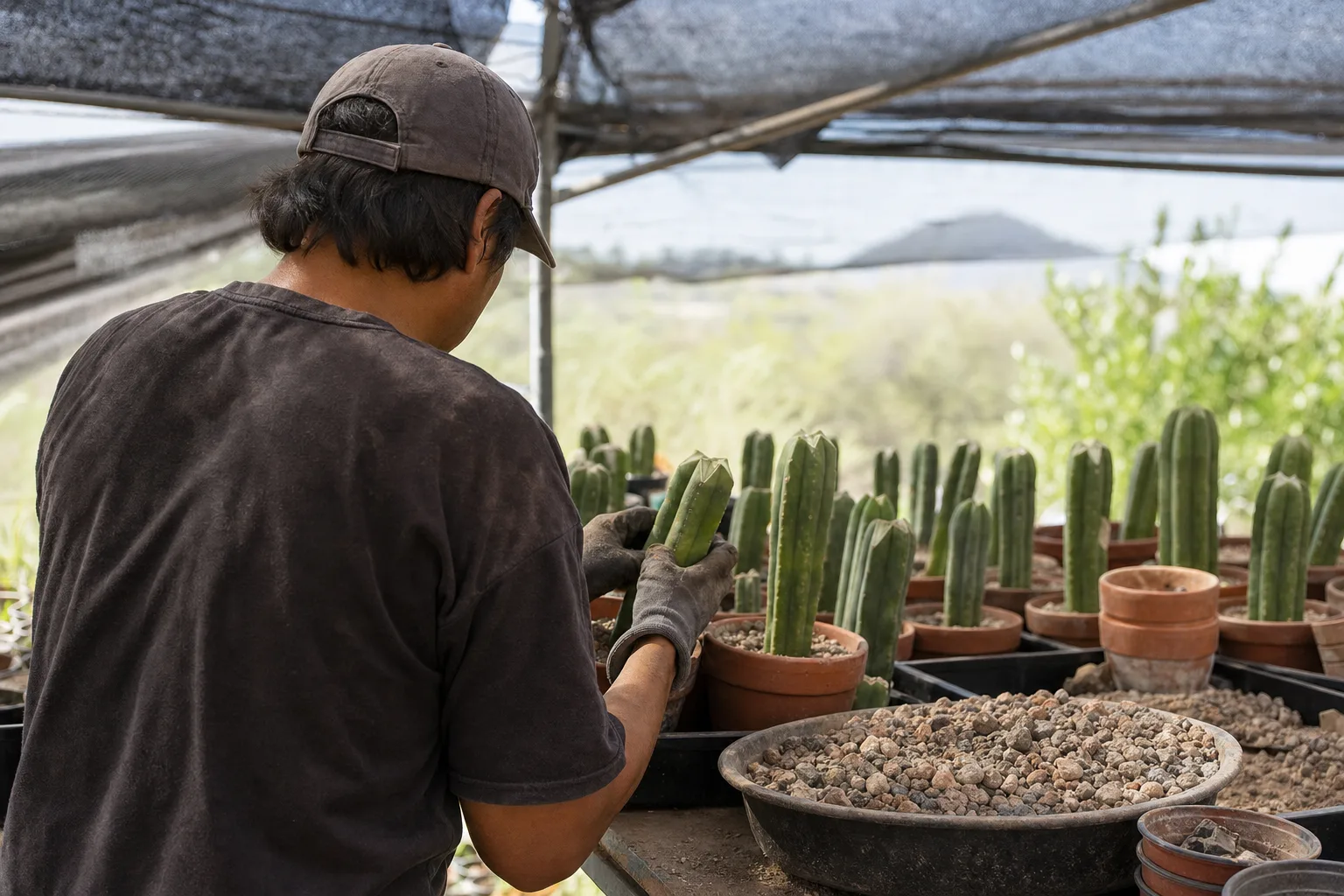
Cultivation of San Pedro cactus (Trichocereus pachanoi): professional nursery guide
In ornamental production, the San Pedro cactus is much more than a decorative column: it is a fast-growing crop, with good climatic plasticity and an excellent response to intensive management when the substrate, irrigation, and nutrition are designed with nursery criteria. Working with production Trichocereus pachanoi allows for the offering of homogeneous batches to garden centers, landscapers, and European distributors looking for verticality, glaucous color, and spectacular night flowering without relying on slow-growing species.
This guide includes practical protocols for professional cultivation in a Mediterranean climate (northern hemisphere), with pH ranges, EC, densities, rooting times, and plant health oriented to scale. The focus is horticultural and landscape-oriented. If you need batches or implementation advice, you can request a wholesale quote from the technical team at Tricholand.
Taxonomy and commercial identification
In nursery trade, the most commonly used name remains Trichocereus pachanoi, although many botanical authorities treat it as Echinopsis pachanoi. The Wikipedia entry on Echinopsis pachanoi summarizes synonyms and distribution; in specialized horticulture, Trichocereus macrogonus var. pachanoi also appears. What matters at the counter is not the nomenclatural dogma, but the coherence of the batch: stable morphology, low spination in selected lines, and traceability of clonal or seed origin.
Useful characters for commercial identification:
- Columnar habit, often basitonic over time; annual growth in cultivation of up to about 20–30 cm under optimal conditions.
- Typically 6–8 ribs, rounded, with green to glaucous epidermis.
- Short spines (often <2 cm) or almost absent in production selections; spaced areoles.
- Large white flowers (approx. 19–24 cm), nocturnal and very fragrant in summer; oblong greenish fruit.
It is advisable to differentiate it from Trichocereus peruvianus (more glaucous, more pronounced spination in many lines) and Trichocereus bridgesii (more pronounced ribs, different habit). A well-labeled catalog reduces claims and facilitates homogeneous replenishment in retail.
Origin, habitat, and climatic reading for the nursery
The species is native to the Andes of Ecuador and Peru, typical of inter-Andean valleys at altitudes between about 2,000 and 3,000 m, with contrasting seasons: concentrated rains in the austral summer and relatively dry winter. This “wet summer / dry winter” genetics explains why it tolerates deep watering in heat better than many coastal desert cacti, and why the cold + humidity binomial is its main weak point in Europe.
In outdoor cultivation, it is associated with approximate USDA zones 8b–10, with brief tolerance to temperatures close to −9 °C if the substrate is dry. In the Iberian Peninsula and the European Mediterranean coast, it performs very well in full sun once acclimatized; in a cold greenhouse or tunnel, it is used to accelerate fattening and control losses due to winter rain. Tricholand's own production in Murcia (~2,500 m²) is precisely supported by this climate: high radiation, mild winters, and dry management during dormancy. More context on the production model can be found about us.
Light, temperature, and acclimatization
The San Pedro requires intense light to maintain diameter, color, and lignification. A common mistake when receiving cuttings or juveniles is moving them from transport shade to full sun without transition: yellow chlorosis or epidermal burns appear. Recommended protocol:
- Week 1–2: 30–50% shade or east orientation, high ventilation.
- Week 3: 70–80% direct solar exposure according to local radiation.
- Week 4 onward: full sun for batches intended for outdoors; in the greenhouse, maintain high radiation and avoid nighttime condensation.
Optimal daytime temperatures for growth: 24–35 °C. Cool nights (10–18 °C) favor compaction. Below ~10 °C, it is advisable to aggressively reduce watering; with frost risk, prioritize radical dryness over any nutritional input. In extreme heat waves (>38–40 °C), temporary shading of 20–30% for juveniles prevents burns without completely halting fattening.
Mineral substrate and container
The substrate determines a large part of success. Objective: high aeration, rapid drainage, and moderate exchange capacity. Indicative formula for 3–20 L pots in production:
- 50–70% mineral fraction (pumice 3–8 mm, pozzolana, coarse perlite, or volcanic gravel).
- 20–35% blonde peat or washed coconut fiber (controlled retention).
- 5–10% very mature compost or humus (never fresh manure).
- Optional: 2–5% washed biochar; dolomite 2–4 g/L if the water is soft and lacks Ca/Mg.
Target pH of the substrate: 5.8–6.5 (broad tolerance ~5.5–7.2). Avoid compact clays and “universal” mixes without minerals. In loamy-clay garden soil, raise the neck with a mound or raised bed and add 20–30% coarse aggregate. Containers: prefer rigid plastic with multiple holes; terracotta accelerates drying in summer, useful in humid climates and more demanding in watering.
Growing densities in the nursery
For rapid fattening in 15–25 L pots, work with 30–40 cm between centers in the first year and open the spacing in the second if the diameter exceeds 8–10 cm. In a newly rooted cutting bed, higher densities are viable if there is lateral ventilation and control of foliar humidity. Height and diameter uniformity is the commercial argument against an irregular mix of calibers.
Professional irrigation: depth and dryness
Base strategy: deep and spaced irrigations, allowing 50–80% of the useful volume to dry between applications. In pots, this usually translates to watering every 5–10 days in midsummer (depending on wind, radiation, and size) and almost dryness from October to March in cold-humid climates.
Water quality: preferred EC <0.75–1.0 dS/m and moderate alkalinity. If the water is hard, acidify the solution to pH 5.8–6.2 to avoid iron chlorosis. In drip irrigation, emitters 2 L/h at 10–15 cm from the stem (1–2 per plant in the first year) avoid wetting the neck at night. Every 6–8 weeks, schedule a salt wash with 2–3 volumes of clear water pores. Without visible drainage, there is no real control of salinity.
Nutrition and fertigation
During active growth, provide 50–100 ppm of N per event every 2–4 irrigations, with low nitrogen and high potassium formulas (for example, 3-5-7 or 4-7-8) plus chelated micronutrients (Fe, Mn, Zn). Avoid urea as the main source of N. EC of the nutrient solution at peak vegetative stage: 0.8–1.2 mS/cm. At the end of summer, reduce N and reinforce K, Ca, and, if available, silicon to mature tissues before dormancy.
A more detailed protocol for conductivity and pH is developed in the technical line of the Tricholand blog; for tailored programs in commercial batches, it is advisable to speak with the technical team at Tricholand.
Propagation by cutting: the scaling method
The dominant method in the nursery is the apical or segment cutting. Summarized procedure:
- Cut with a disinfected tool; typical length 20–40 cm depending on target caliber.
- Dry the wound for 7–21 days in ventilated shade until a firm callus forms (longer time if there is high ambient humidity).
- Plant 3–5 cm in dry or barely moist mineral substrate; do not bury excessively.
- First gentle watering after 7–14 days; maintain low radical humidity for the first 3–4 weeks.
- Visible rooting typically occurs in 3–8 weeks with substrate temperatures of 20–28 °C.
Sowing is useful for genetic diversity and selection, but it extends the cycle to commercial caliber. Grafting onto vigorous rootstocks is reserved for collections or rescue; in mass ornamental, rooted cuttings offer a better cost/homogeneity ratio. Clean starting material and healthy mothers reduce losses more than any rooting hormone.
Plant health and IPM
The most costly losses come from rot due to excess water in cold conditions and mealybugs (both aerial and root). Reference guides such as those from the Missouri Botanical Garden on pests in cacti and the UC ANR IPM program for mealybugs agree on three pillars: quarantine of entries, bench hygiene, and early detection.
- Quarantine 2–4 weeks for new material; inspection of areoles, axils, and neck.
- Control of ants (they protect hemipterans).
- Removal of strong foci; isopropyl alcohol spot treatment or authorized soaps/oils with prior phytotoxicity testing.
- Root systems: if there is suspicion of root mealybug, renew substrate and check drainage.
- Neck fungi: reduce watering, improve aeration, do not bury the callus too deep.
For intra-EU circulation, professional material travels with a phytosanitary passport according to the framework of Regulation (EU) 2016/2031. Tricholand operates as a wholesale producer with European documentation; consult conditions according to destination when requesting the catalog.
Common problems and corrections
- Diffuse yellowing: high pH / blocked Fe → acidify irrigation, chelated Fe, check water carbonates.
- Etiolation (thinning): insufficient light → increase exposure or reduce shade density.
- Soft base: rot → cut to healthy tissue, callus, and re-root if the batch justifies it.
- Bronzed spots: sunburn after shade → gradual acclimatization.
- Stopped growth in heat: small pot or high EC in drainage → transplant or wash salts.
- Seasonal wrinkling: in dry dormancy it may be normal; do not respond with abundant watering in cold.
Annual calendar (northern hemisphere)
Invest approximately six months for the southern hemisphere.
- March–April: resume watering; first gentle fertigation; transplanting and cuttings.
- May–August: peak vegetative stage; deep watering; complete nutrition; weekly pest controls; temporary shading in extreme heat waves for juveniles.
- September: reduce N; mature tissues; last controlled fattening.
- October–February: almost dry; maximum ventilation; protection against cold rain; do not force growth.
Landscape use and retail value
In Mediterranean xerophytic gardening, San Pedro provides a rapid vertical axis, compatibility with gravels, and companions such as agaves, dasylirion, or aromatic plants. In retail, calibers of 40–80 cm in 3–7 L pots rotate well for immediate impact; formats of 1–1.5 m are aimed at premium projects and terraces. It combines well in composition with other entries from the Trichocereus variety catalog, including monumental forms like Trichocereus terscheckii / pasacana for contrast in texture and growth rhythm.
The presentation in linear displays benefits from a mineral base, clear watering label (“let dry between waterings”), and grouping by heights. Avoid saucers with permanent water under the pot: they communicate the opposite message that the plant needs.
Frequently Asked Questions
How much does it grow per year in the nursery?
Under optimal conditions of light, heat, and nutrition, it can reach 20–30 cm/year; in outdoor settings without fertigation, the growth rate decreases. Commercial diameter is as important as height for perceived value.
Does it tolerate frost?
Dry adults can withstand brief light frosts; the critical risk is wet substrate with cold. In zone 8b, better drained placement and occasional protection are recommended.
Pot or soil?
Both. In soil, drainage is non-negotiable. In pots, control of EC and scheduled repotting provide batch uniformity.
How often should it be watered in summer?
When the substrate has lost a good part of its usable water: typically every 5–10 days in pots in full sun, always with free drainage.
Can it be produced in a greenhouse year-round?
Yes, but the dry winter rest remains useful for health and lignification. Forcing growth with heat + constant watering increases rot and soft tissues.
What caliber should be requested for garden centers?
The 50–90 cm range with good diameter usually rotates well; juveniles of 25–45 cm serve as an entry assortment. For specific availability, check caliber availability.
Operational Closure
The professional cultivation of San Pedro cactus is achieved with mineral substrate, deep and dry watering in cold conditions, moderate nutrition rich in K, and a uniform clonal selection. With this framework, Trichocereus pachanoi behaves as a predictable crop for European wholesalers: it fattens, blooms, and maintains architectural presence with low relative water consumption. To request a catalog or shipping conditions with EU passport, the Tricholand team handles orders from professional volume and provides advice on substrate, fertigation, and landscape implementation from the contact page.