
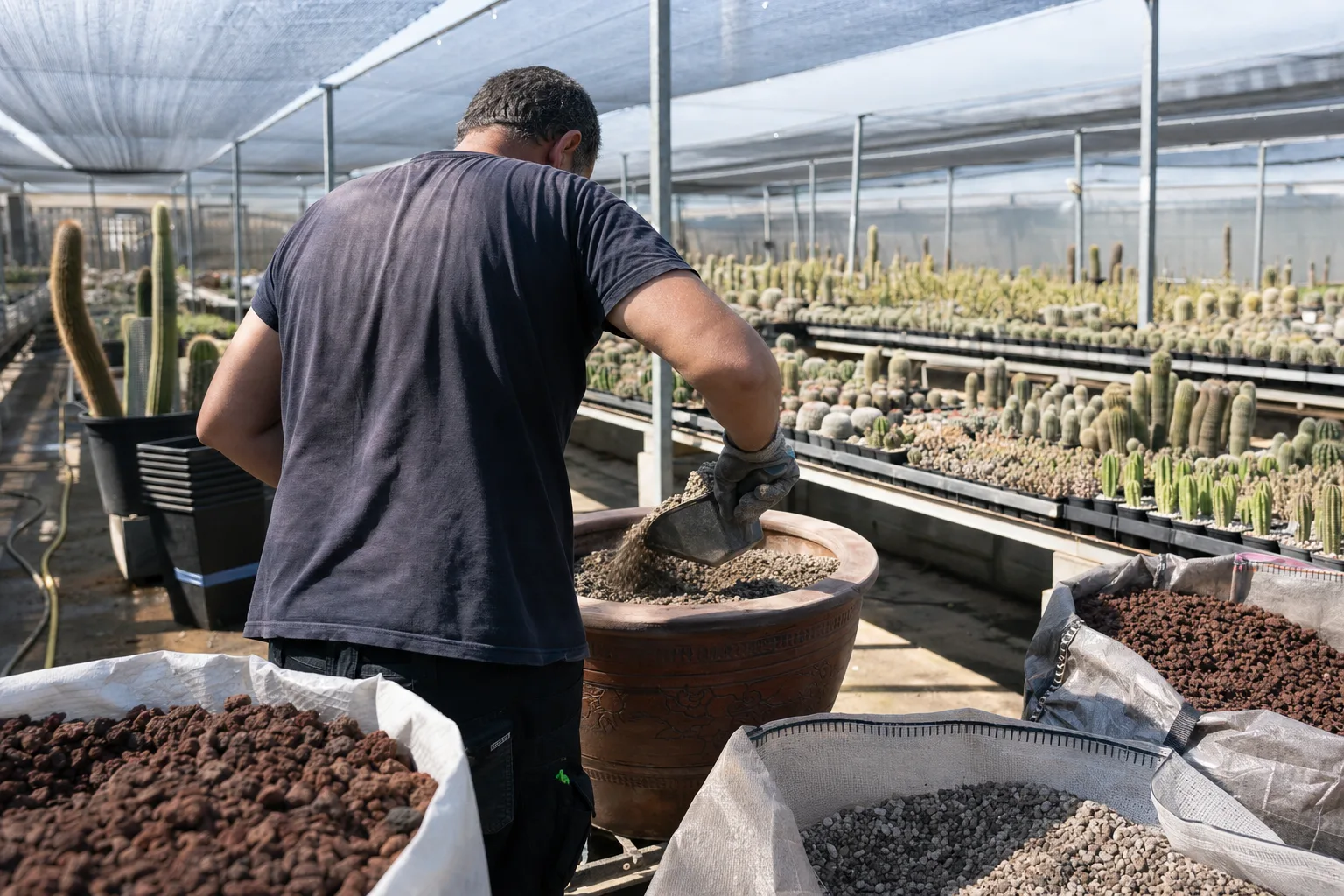
Drainage and Mineral Layers in Columnar Planters
In columnar gardening, drainage is not a finishing detail: it is the system that determines whether the root breathes or whether the neck remains for weeks in a saturated microclimate. Planters —whether on terraces, patios, rooftops, or in landscape projects using containers— concentrate errors that dissipate in open soil: limited volume, flat bottoms, accumulating saucers, overly fine substrates, and the habit of "putting gravel at the bottom for drainage." In Trichocereus and other ornamental columnars, this combination explains a significant part of basal rot, late yellowing, and losses after the first wet winter.
This article focuses on how to design useful mineral layers (and which to avoid), how to choose containers and holes, how to formulate a coarse and stable medium, and how to water without recreating a permanent water table. The approach is ornamental and professional, aligned with the production logic of a wholesale Trichocereus nursery in Murcia that supplies garden centers and landscapers in Europe. If you are setting up a container project or want to align size and type with a draining medium, you can check the availability of sizes with the technical team.
Why planters are harsher than soil
In the field, excess water has lateral and deep escape routes. In a planter, water only exits through holes (if they exist and are not blocked) or through evaporation. After each watering or rain, a saturated zone forms at the bottom of the container: the so-called perched water table. Its height depends on the texture of the medium, not the size of the container. Therefore, a shallow container with fine substrate can retain a much higher percentage of water than a deep container with coarse granulation.
The columnars of the commercial group Trichocereus —such as Trichocereus pachanoi, T. peruvianus, or T. bridgesii— develop fine absorbing roots when there is oxygen. If the bottom remains cold and damp, those roots deteriorate, the neck softens, and the plant "holds on" by using stem reserves until the damage is irreversible. The family Cactaceae includes species from very different habitats; the Andean columnars from dry valleys are not adapted to pots with a layer of organic silt at the bottom.
The myth of gravel at the bottom
The popular recommendation to place a layer of stones, tiles, or expanded clay "for drainage" often worsens the problem. When a fine-textured medium rests on a much coarser material, water does not easily jump to the macropores of the gravel: it first saturates the fine medium just above the interface. The result is a higher wet zone, closer to the neck, exactly where you don’t want it.
University horticultural extensions and classic container soil trials agree on this point: the "drainage layer" does not replace a well-designed substrate or real holes. A useful informative review is the document by Linda Chalker-Scott (Washington State University) on the myth of drainage material in containers. There are nuances in recent studies with soilless media, but the practical rule for columnars remains clear: homogenize a coarse mineral medium throughout the volume and do not build artificial capillary barriers beneath the root ball.
When a coarse material at the bottom does make sense
- Dead volume fill in very deep planters (due to cost or weight), as long as it does not reduce the useful root volume below what is necessary and does not create an abrupt interface with a fine substrate above.
- Wind stability: lapilli or volcanic gravel increases the weight of the container; better mixed in the medium or as a structural base if the rest of the profile is also coarse mineral.
- Decorative cachepot without drainage: gravel goes on the outside (between the growing pot and the cachepot) to elevate and separate, never as a substitute for holes in the growing pot.
What does work: mineral layers with a clear function
Talking about “mineral layers” in columnar planters makes sense if we separate three distinct functions: (1) homogeneous and draining growing mix, (2) surface mulch (top dressing), and (3) anchoring/weight. Confusing them is the origin of the myth of basal gravel.
1. Dominant mineral growing medium
The main layer —in fact, almost the entire volume— should be a mix with 55–80% mineral aggregates depending on climate and container depth. Reference components:
- Pumice 3–8 mm: stable aeration, some internal retention, low density. Ideal base.
- Lapilli / volcanic gravel 5–12 mm: weight, anchoring of tall columns, macropores in deep bottoms.
- Washed coarse silica sand 1–3 mm: improves drainage; avoid fine or beach sand.
- Coarse perlite: useful as a supplement; alone it stratifies and floats with heavy watering.
- Organic fraction (20–45%): washed coconut fiber or fibrous blonde peat; only very mature compost in low percentage.
For columnars in deep planters, a starting indicative formula could be: 35% pumice, 25–30% lapilli, 15% coarse sand or screened crushed granite, 10% zeolite or another optional CEC buffer, 10–15% stable organic matter. Adjust upwards the mineral content in humid climates or on terraces with frequent rain; slightly increase the organic matter in very arid climates if watering is infrequent.
2. Surface mineral mulch
A layer of 1–3 cm of pumice, volcanic gravel, or small river stones over the substrate does add value:
- Reduces splashes and surface sealing after rain.
- Decreases irregular evaporation and the appearance of algae/moss.
- Protects the neck of the plant from constant moisture in contact with fine organics.
- Enhances commercial aesthetics in B2B projects and showrooms.
Do not bury the neck under the mulch: the mulch surrounds, not buries. In slow-growing species such as Trichocereus terscheckii / pasacana, a clean and aerated neck is especially critical.
3. Transition layers (only in large projects)
In large-volume planters (several hundred liters), some landscapers use a profile with granulation that slightly increases towards the bottom —all coarse mineral, without extreme jumps— to favor water movement and stability. The key is that there is no "peat cushion" over a "clay ball cushion." If there is a transition, it should be gradual and always within a system with generous holes.
Container, holes, and elevation
Without real drainage, no mineral layer saves the crop. Professional checklist:
- Multiple holes at the bottom (and, in long planters, also low side holes). A single central hole can easily get blocked.
- Geotextile mesh or fine grid only to retain substrate, not as an "impermeable filter." It must allow water to pass freely.
- Elevation of the container 2–5 cm above the ground or saucer with blocks/feet: water must exit, not remain in permanent contact with a full saucer.
- Useful depth: columnars appreciate deeper containers than excessively wide ones, but a very shallow container with fine medium is a moisture trap. Prioritize depth + coarse granulation.
- Material: terracotta and porous ceramics dry faster; plastic and fiber retain more —compensate by increasing minerals. In windy terraces, the weight of lapilli helps anchor.
In rooftop projects, check the waterproofing and drainage of the terrace: a planter that "drains well" into a flat slab turns the plant's problem into a construction problem.
Watering in planters: the other 50% of drainage
A well-designed mineral medium forgives mistakes, but it does not replace proper watering criteria. Guidelines for the northern hemisphere (shift six months in the southern hemisphere):
- Spring–summer: water thoroughly when the upper third is dry and the container has noticeably lost weight; let it drain completely. Avoid daily superficial waterings that only wet the mulch.
- Autumn: reduce frequency; prioritize drying between waterings. Mediterranean rains can replace or saturate: cover temporarily if the container does not have sufficient drainage.
- Winter: almost dry. In Murcia and the Mediterranean coast, the risk is not just the cold: it is cold + root moisture. Columnars acclimatized to the outdoors tolerate dryness better than saturation.
Water quality: know pH and EC. Mineral media with low exchange capacity accumulate salts if there are no occasional washings. A low EC watering every now and then helps flush salts towards the drainage —as long as drainage exists.
Design by usage scenario
Terrace / balcony planter
Limited volume, wind, irregular watering by the end user. Use high mineral formula (65–80%), 2 cm mulch, low side holes, and stable sizes of Trichocereus varieties with good anchoring. Avoid permanent saucers with water.
Landscape container for hotels or outdoor garden centers
Prioritize weight, clean typology, and low maintenance. Lapilli + pumice, moderate fertilization in season, and access to empty saucers or trays. Document to the professional client: “let dry between waterings” is not a slogan, it is protocol.
Deep planter for Mediterranean patio
You can work with more root volume and a mineral profile with a heavy fraction. Ideal for xerophytic compositions with columnars as the vertical axis. Combine with continuous surface gravel for a dry garden reading.
Intermediate sales pot (transition to planter)
If the material arrives from the nursery in a pot and is transplanted to a planter, do not “fill” with garden soil that is silty. Respect the mineral logic of the root ball or renew the entire medium. Mixing a mineral root ball with clayey soil creates interfaces worse than the myth of gravel.
Frequent problems and diagnosis
- Soft or blackened base: chronic moisture at the neck; check saucer, holes, % organic matter, and watering frequency.
- Moldy smell / substrate mosquitoes: medium too retentive or saturated basal layer; renew and mineralize.
- Stoloniferous plant with poor roots: not just light: a cold and damp bottom limits absorption. Improve aeration and exposure.
- White salts on the surface: mulch + washings + lower EC; check poorly washed coconut.
- Toppling: more lapilli/weight, temporary staking, wider container at the base, not just taller.
- After heavy rain: if it takes days to dry, the design fails (granulation or drainage). Do not "fix" with more gravel at the bottom.
Maintenance schedule (northern hemisphere)
February–March: inspection of drainage holes, renewal of mulch, transplanting on already warm days. April–August: deep spaced irrigation, monitoring container weight, gentle fertigation if there is active growth. September–October: reduce EC and frequency; prepare for hardening off. November–January: prioritize root dryness; protect from prolonged rain in open terraces.
For more context on substrates and professional management, the technical blog of Tricholand provides guides for ornamental cultivation aimed at nurseries and wholesale channels.
Frequently Asked Questions
Can I use expanded clay only at the bottom?
As an exclusive layer under a fine substrate, it is not the best practice. If you use expanded clay, integrate it into the mix or use it as structural fill in dead volumes with an equally coarse medium on top.
Does geotextile at the bottom help?
Only to retain particles. If it clogs with fines, it turns the bottom into a saturated filter. Better: fewer fines in the mix and generous drainage holes.
What is the minimum recommended particle size?
Concentrate useful particles in 2–8 mm for most of the volume; remove dust <1–2 mm. In very deep planters, include 5–12 mm of lapilli for anchoring.
Do columnar cacti in planters need more watering than in the ground?
Sometimes yes in summer (limited volume), but never with more surface frequency. Abundant watering and complete drainage surpasses “a little every day.”
Conclusion
Effective drainage in columnar planters is built with real drainage holes, a coarse and homogeneous mineral medium, surface mulching, and irrigation that respects drying — not with a layer of stones under fine soil. If you design container projects for retail, hospitality, or landscaping, align plant typology and medium from the beginning. At Tricholand, we produce columnar cacti with a Mediterranean nursery approach; to request a wholesale quote or compare substrate and size with your project, technical contact is the next natural step.