
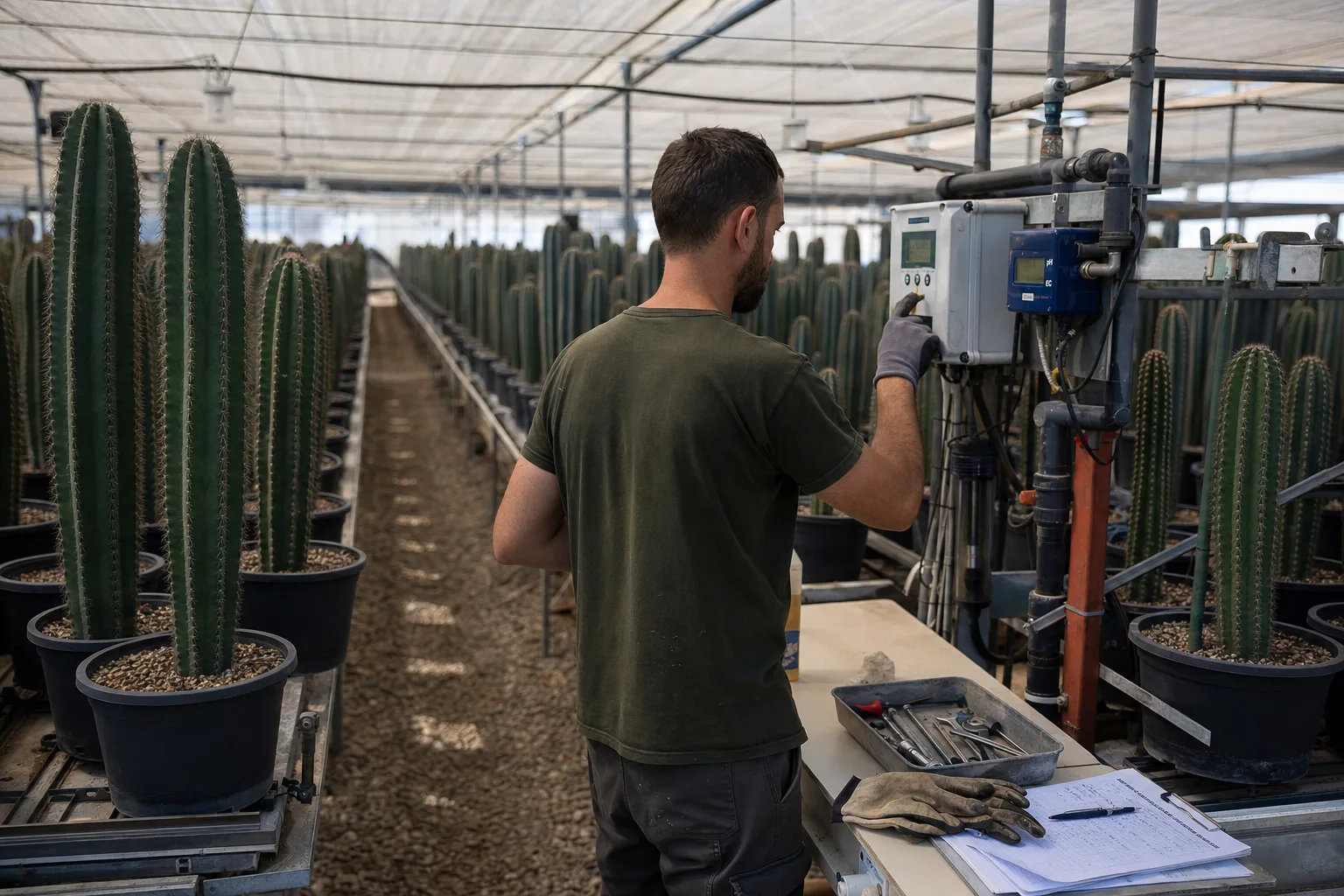
Fertigation in Trichocereus: EC, pH, and Nutritional Calendar for Production
Fertigation is the tool that transforms a Trichocereus “that survives” into a batch that grows with size, color, and predictable timelines. In ornamental production, managing EC, pH, and a nutritional calendar is not a laboratory luxury: it is cost control per square meter, the reduction of chlorosis, and the difference between an etiolate stem and a commercial column ready for garden centers or landscaping projects.
This guide focuses on columnar cacti from the Trichocereus group (T. pachanoi, T. peruvianus, T. bridgesii, T. terscheckii, and related species), with validated working ranges in Mediterranean nurseries. If you are designing a program for a greenhouse or outdoor bench, you can request a catalog and conditions or discuss solutions with the technical advice from Tricholand, a wholesale producer in Murcia with distribution to over 18 European countries.
Why the nutrition of Trichocereus is not “that of a generic cactus”
Many hobbyist guides recommend “almost no fertilization.” In intensive cultivation, this prolongs the cycle and generates uneven batches. Andean-origin Trichocereus, with a marked active growth phase, respond well to regular but moderate inputs, always with excellent drainage. CAM physiology limits daytime transpiration but does not eliminate the demand for N, K, Ca, and micros when there is rib elongation and diameter fattening.
The sought balance: sufficient nitrogen for growth rate, without watery tissues; high potassium for turgor and resistance; calcium for cell walls; iron available at controlled pH. General botanical references for the group can be consulted in entries such as Echinopsis pachanoi on Wikipedia; however, nutritional management is determined by measuring solution and drainage in your actual water.
Key parameters: EC, pH, and relationship with irrigation water
EC (electrical conductivity)
Work with two readings: input EC (solution) and drainage EC (or extract). Guideline ranges in active growth for Trichocereus in containers:
- Nutrient solution: 0.8–1.2 mS/cm at vegetative peak (spring–summer).
- Start / post-transplant: 0.4–0.7 mS/cm for 2–3 weeks.
- End of summer maturation: 0.6–0.9 mS/cm with less N.
- Cold rest: clear water or minimal EC; priority to dry, not to nourish.
If drainage consistently exceeds ~1.5–2.0 mS/cm (depending on batch sensitivity and base water salinity), schedule a wash with 2–3 volumes of pores. Ideal irrigation water with base EC <0.75–1.0 dS/m. Highly mineralized waters require reducing fertilizer dosage and more precise acidification. A calibrated conductivity meter checked weekly prevents blind decisions.
pH of the solution
Common target: 5.8–6.2 in fertigation (comfortable window 5.8–6.5). Above ~6.8–7.0, the risk of intercostal iron chlorosis increases, especially in fast-growing glaucous lines. With bicarbonate waters, use nitric or phosphoric acid according to anion strategy, always measuring after mixing. The substrate pH tends to rise over time if there is no acidification: sample every 4–6 weeks in long-term batches.
ppm of nitrogen per event
In active growth: 50–100 ppm N every 2–4 irrigations (not in every irrigation if watering very frequently). Preferred forms: nitrate and some low ammonium; avoid urea as a dominant source. An excess of N produces soft stems, visually “soft” internodes, and increased neck fungal pressure in wet autumn.
NPK balance and micronutrients
Recurring working formulas in ornamental cacti production:
- Type ratios 3-5-7, 4-7-8, or equivalent “cactus” low in N and high in K.
- Calcium and magnesium: via calcium nitrate / magnesium sulfate or compensated hard water; do not mix Ca with concentrated sulfates/phosphates in the same stock without compatibility.
- Cheated micros: Fe (EDDHA or EDTA depending on pH), Mn, Zn, B in microdoses; foliar corrections only if symptoms are present and with phytotoxicity testing.
- Silicon (if used): useful in maturation and abiotic stress; does not replace good drainage.
Species with slower or monumental cycles, such as the lines of Trichocereus terscheckii, can tolerate longer intervals between inputs; those with rapid fattening like Trichocereus pachanoi benefit more from the cadence every 2–4 irrigations in summer.
Substrate and fertigation: a single system
It makes no sense to talk about EC without discussing porosity. A substrate with 50–70% coarse mineral (pumice, pozzolana, coarse perlite) allows for thorough watering and predictable drying; a compact organic mix retains salts and prolongs time in the radical hypoxia zone. Target substrate pH: 5.8–6.5. Useful amendments: light dolomite if Ca/Mg is lacking; washed biochar 2–5% for CEC; never saline manures.
In drip irrigation, place emitters 10–15 cm from the stem. Moistening the neck at night is one of the fastest ways to lose plants in October. Alternate sectors to ensure drainage is visible and measurable: without drainage, there is no real control of salts. The washing fraction of 10–20% in open systems helps when the base water already contributes salts.
Professional nutritional calendar (northern hemisphere)
Adapt doses to actual radiation and temperature; the calendar is a compass, not a dogma. For the southern hemisphere, shift by about six months.
March–April — start
Resume watering when maximum temperatures rise steadily and the substrate is not cold. First phase: water at pH 5.8–6.2 with EC 0.4–0.7 mS/cm. After 1–2 clear irrigations, introduce 30–50 ppm N. This is the ideal window for transplanting and cutting: new roots are sensitive to high EC.
May–June — acceleration
Increase to 50–80 ppm N and EC 0.8–1.0 mS/cm. Keep K high. Monitor Fe if the water is calcareous. Weekly mealybug checks: the plant in active growth is more attractive to hemipterans. Review the IPM approach for mealybugs in ornamentals as a monitoring framework.
July–August — peak
EC 0.9–1.2 mS/cm if the drainage tolerates it; 50–100 ppm N every 2–4 irrigations. In heat waves >38–40 °C, prioritize quality watering and ventilation; sometimes it is advisable to slightly lower the EC to avoid adding saline stress to thermal stress. Young plants may need temporary shading of 20–30%.
September — maturation
Reduce N (30–50 ppm), maintain K and Ca, EC 0.6–0.9. Objective: firmer tissues before autumn. A salt wash mid-month helps if the summer was intensive.
October–February — rest
Almost no fertilizer. Sparse or no watering depending on the climate; if moisture is needed due to extreme substrate dust, use clear water at low EC. The combination of cold, wet conditions + residual salts is what triggers rot. Documentation and circulation of plants follow the framework of the plant health passport in Spain/EU; nutrition does not replace batch health.
Measurement protocol in the bench
Without data, fertigation becomes superstition. Minimum weekly routine in season:
- pH and EC of the tank after agitation.
- pH and EC of drainage in 3–5 test pots per sector.
- Visual inspection: epidermis color, firmness, new areoles, symptoms of Fe/Mg.
- Record of volume watered versus drained.
If the drainage pH rises month after month, increase acidification or review bicarbonates. If the drainage EC chronically doubles the input EC, increase the washing fraction or extend the interval between fertilizations. Keep a simple notebook by sector: base water, doses, symptoms, and actions. In two campaigns, you will have a refined protocol tailored to your well or network.
Adjustments by species and commercial objective
- Pachanoi / peruvianus (retail fattening): more frequent cadence, EC at the high end of the range in summer, selection of low spination. Consult the sheets for T. peruvianus and pachanoi in the catalog.
- Bridgesii: similar to pachanoi; monitor chlorosis in hard waters; see T. bridgesii sheet.
- Terscheckii / pasacana: less N, longer intervals, prioritize sun and drainage; the value lies in architecture, not speed.
- Landscaping batches of 1–2 m: diametrical stability and lignification above maximum elongation; low N at the end of the cycle.
The variety catalog helps align species, size, and nutritional program. For large projects, consulting availability of sizes avoids over-fertilizing material that is already at the point of sale.
Common mistakes that trigger losses
- Fertilizing in winter “because the plant is indoors.”
- Using abundant nitrogen foliar fertilizer on sensitive epidermis.
- Mixing incompatible stocks (Ca + concentrated SO₄/PO₄) and clogging drippers.
- Watering small volumes very frequently: salts in the upper third, roots fleeing to the bottom.
- Ignoring bicarbonate water until widespread chlorosis appears.
- Raising EC to “recover” a plant with damaged roots: first health and drainage, then nutrition.
- Changing fertilizers every month without measuring: makes diagnosis impossible.
Relationship with irrigation, light, and density
Fertigation only expresses potential if there is high light and an appropriate framework. Densities of 30–40 cm between 20–25 L pots work in fattening; if they shade each other, lowering N does not fix etiolation. In Mediterranean outdoor conditions, wind accelerates drying: it may require more frequent watering, not necessarily higher EC. In a closed greenhouse, nighttime condensation requires lowering volume and improving ventilation before adjusting fertilizer.
More cultivation and landscaping context appears regularly in the technical blog and in the trajectory described in about us.
Frequently asked questions
How often should I fertilize?
At peak, every 2–4 irrigations. If you water every 5 days, fertilizing at every event is usually excessive unless EC is very low and frequent washes are done.
What EC is dangerous?
It depends on the base water and drainage. As a practical rule, if drainage remains above ~1.8–2.0 mS/cm with symptoms of stagnation, wash and reduce dosage.
Is retail “cactus” fertilizer useful?
It may work for hobbyists. In nurseries, clearer solutions that are compatible with drippers, with analysis and controlled pH, are better.
Foliar or root?
The base is root. Foliar only for micro corrections, in microdoses and with testing.
Can I use calcareous well water?
Yes, with acidification to pH 5.8–6.2, appropriate chelated Fe, and periodic washes. Without this, chlorosis appears mid-season.
Should I fertilize plants ready for sale?
Keep maintenance doses low; avoid nitrogen pushes that soften tissues just before transport.
Conclusion
A professional fertigation of Trichocereus can be summarized in simple numbers and discipline: pH 5.8–6.2, EC 0.8–1.2 at peak, 50–100 ppm N at intervals, high K, scheduled washings, and dry rest without fertilization. With this framework, the nursery achieves uniformity in size and reduces losses due to salinity and rot. If you want to compare a program with material from your own production and EU passport, request a wholesale quote at Tricholand and review species in the catalog to align nutrition and commercial objectives.