
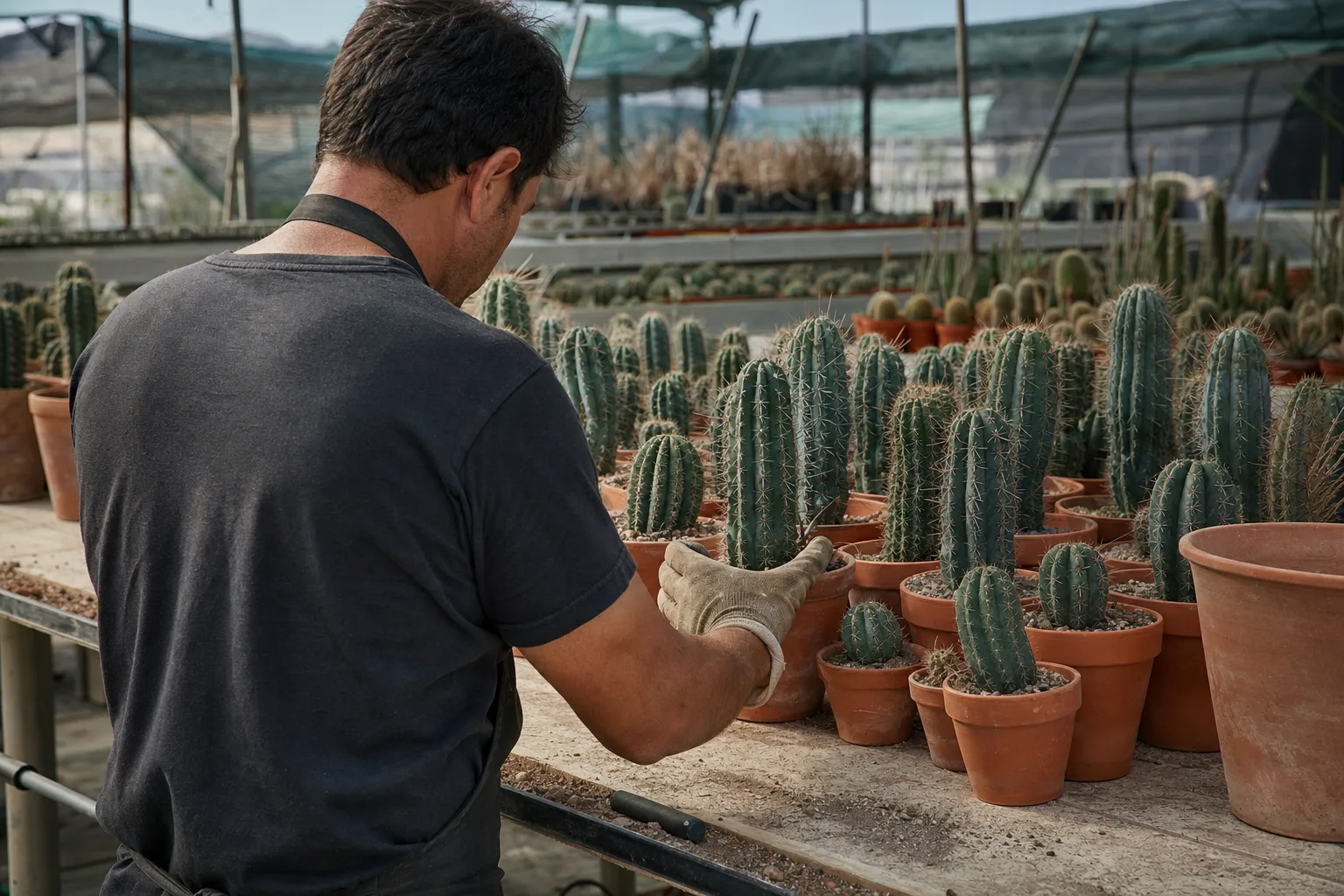
How to Choose Trichocereus Sizes for Wholesale Sale in Garden Centers
Choosing the right caliber of Trichocereus is the decision that most impacts the turnover of a garden center and the margin of a distributor. It is not enough to simply order columnar cacti: it is necessary to define height, stem diameter, number of arms, container format, level of spination, and point of sale. A caliber error translates into stagnant stock, transportation breakages, or plants that the end customer perceives as too small for the price.
This guide provides professional buyers — garden centers, green DIY chains, wholesalers, and landscapers — with guidance on how to read a batch of Trichocereus and align it with channel and climate. Tricholand produces homogeneous batches in Murcia for Europe; to compare measurements and species, you can check availability of calibers or review the catalog of varieties.
What caliber means in columnar cacti
In woody ornamental plants, caliber usually refers to trunk perimeter. In Trichocereus, nursery language mixes various metrics; it is advisable to specify them in the order:
- Plant height (cm), from the neck or from the edge of the pot — specify which.
- Stem diameter (cm) at 10–20 cm from the neck: an indicator of fattening and value.
- Number of columns / basal offsets (1 stem versus multi-stem).
- Container: diameter or liters (C.17, C.19, C.25, 3 L, 5 L, 10 L, 20 L, etc.).
- Approximate age / cycle (rooted cutting of the year versus 2–3 campaign plant).
- Finish: spination, color (green/glaucous), straightness, absence of scars.
An example from the market: European retail formats of compact columnars appear in wholesale channels with pots around 17 cm and total heights of 27–37 cm; in Mediterranean landscaping, C.25 and heights of 1–3 m are also worked according to species. The key is not to compare price solely by height: a pachanoi of 60 cm and 7 cm in diameter may be worth more on the shelf than an 80 cm etiolation of 3.5 cm.
Channel segments and calibers that rotate
1) Impulse and entry linear
Heights 25–45 cm in pots 12–17 cm. Customer: hobbyist trying a columnar. Prioritizes low spination, clear labeling (name and watering), and stable plant. Recommended species: lines of Trichocereus pachanoi and juvenile selections of T. bridgesii. Typical order: high homogeneity, low shrinkage, packaging with spine protection even if they are short.
2) Outdoor garden center — impact at 1 m
Heights 50–90 cm, pot 3–7 L or C.19–C.25, stem diameter of at least 5–6 cm. This is the sweet spot for average ticket: the plant appears well-formed without the logistics of a heavy specimen. Here, uniform batches win over height mixes. Avoid buying solely by centimeters of height if the diameter does not match.
3) Premium terrace and high retail
Heights 100–160 cm, container 10–25 L, diameters 7–12 cm, sometimes 2–3 arms. You need a reinforced cart, trained staff, and an exhibition area with gravel. The margin is attractive if the plant arrives straight, without transport scuffs. Acclimatization to full sun before display prevents complaints about burning.
4) Landscaping and construction
Calibers 1.5–3 m or dense multi-stem; sometimes staggered supply. Typical planting distance is 0.8–1.2 m between axes in medium caliber, more in diameters of 15 cm or larger. Combine pachanoi or peruvianus for quick rhythm with terscheckii/pasacana for monumental landmarks. Purchases are planned by construction phases, not by display.
Quality criteria you should demand upon receipt
- Straightness and healthy apex: firm apex, without necrosis or crushing.
- Diameter consistent with height: reject pencil lots if selling premium outdoor.
- Active root without rot smell: in destructive sample of 1–2 units per pallet.
- Drainage substrate: if it arrives in pure, waterlogged peat, assume risk of shrinkage in 2–4 weeks.
- Health: without mealybug cotton in areoles or active ants in the tray.
- Homogeneity: controlled height deviation (define tolerance, for example plus/minus 10%).
- Documentation: EU phytosanitary passport and batch traceability.
The most common reception pests in cacti are described in resources such as the Missouri Botanical Garden: a short quarantine in a shaded area and inspection of necks save contagions to the shelf.
Practical matrix species by use
- T. pachanoi: maximum balance of speed/management; ideal retail 40–120 cm; low spination in production lines.
- T. peruvianus: very glaucous aesthetic; excellent in compositions; verify spination when choosing family or public channel. See peruvianus sheet.
- T. bridgesii: marked silhouette; good differentiator of assortment; management of spines in picking.
- T. terscheckii: high ticket, slow cycle; do not use it as a low-price lure; if as an anchor for xerophytic section.
A visit to the producer's identity at about us helps to understand why clonal selection and fattening in Murcia's climate stabilize these criteria before European shipping. Basic morphological references also appear in Echinopsis pachanoi.
How to size the wholesale order
Before closing units, answer five questions:
- How many weeks of stock do I want to cover (4, 8, 12)?
- Do I have a sunny outdoor area or only indoor with medium light?
- Does my customer buy impulse or high-ticket project?
- Can I move pallets and plants over 15 kg without damaging apices?
- Do I need identical replenishment in 60–90 days (clonal homogeneity)?
Guideline for an average Mediterranean garden center opening a xerophytic section: 50–60% of the volume in the sweet spot 50–90 cm; 25–30% in entry 25–45 cm; 10–20% in premium above 100 cm. Adjust if your area has frequent frosts: reduce premium in soil and prioritize mobile containers.
To avoid overstock, start with a homogeneous pilot order, measure turnover in 6–8 weeks, and scale. The cost of a well-calibrated second order is usually lower than liquidating a poorly chosen first order with aggressive discounts.
Logistics, hidden shrinkage, and presentation
The caliber does not end at the delivery note. A 1.4 m poorly staked arrives crooked; a multi-stem without dividers arrives scuffed. Demand:
- Spine protectors and corner protectors in commercial diameters.
- Stacking that does not put weight on apices.
- Maximum agreed darkness/transport time; acclimatization 7–14 days before display sun.
- Label with botanical or commercial name, watering (dry between waterings), and internal caliber code.
On the shelf, present over gravel or mineral base: it communicates xerophytes better than a plate with water. Group by height (staggered) and mix textures with an agave or dasylirion; do not saturate twenty identical columns without visual rhythm.
Perceived value and purchasing errors
Without inventing prices: perceived value increases with diameter, straightness, color, and presence. Classic buyer errors:
- Buying only for cheap height centimeters.
- Mixing species in the same item code without staff training.
- Requesting landscaping caliber for indoor acclimatization with low light.
- Not reserving replenishment: the nice batch runs out and the next one comes in differently.
- Forgetting that the end customer fears spines: the low-spination line sells more in family.
- Ignoring the logistical weight of premium: shrinkage due to internal handling in the store.
To avoid surprises, talk to the Tricholand technical team about channel objectives before setting the packing. The material travels with EU documentation; specialized shipments are part of the wholesale service, without promising universal deadlines.
Calibers and design of xerophytic section in store
A profitable section tells a story in three heights: ground (low succulents), middle (agaves), vertical (Trichocereus). Use 3–5 medium caliber columns as the visual backbone and a premium specimen as an anchor. Rotate the anchor each season to generate traffic. Support the narrative with printed or QR fiches from the blog on care, always in ornamental key.
Brief staff training: differentiate pachanoi, peruvianus, and bridgesii; explain watering by dryness; teach not to water in a plate. That conversation reduces returns more than any sale sign.
Frequently asked questions from professional buyers
Which caliber sells fastest?
In most Mediterranean garden centers, the range 50–90 cm with good diameter. Premium rotates slower but elevates category image.
Black cultivation pot or sales container?
If the ticket is medium-high, a presentable container reduces friction. In impulse, a well-cleaned cultivation pot is sufficient if the price is competitive.
Mono-stem or multi-stem?
Mono-stem: modern reading and easy replenishment. Multi-stem: more specimens, more weight, and more risk of rubbing. Choose according to shelf and customer.
Can I mix pachanoi and peruvianus in the same code?
Not recommended: they change color and spination; the customer compares and claims. Better separate codes.
What is the minimum number of units to order?
It depends on the supplier and the packing. Work in multiples of tray or pallet to protect shrinkage and homogeneity; ask for professional volume from the sales contact.
How to manage winter in the store?
Reduce watering, avoid cold and humid corners, and do not force fertilization. A premium caliber with a wet neck in January is an expensive shrinkage.
Final checklist before confirming the order
- Height, diameter, and pot defined in writing.
- Species or line and level of spination agreed upon.
- Homogeneity tolerance and percentage of samples.
- Channel destination (retail versus construction) and desired display date.
- EU passport and UK or other destination needs consulted.
- Acclimatization plan and quarantine area in the store.
Closing
The right caliber is not the highest or the cheapest: it is the one your channel can display, care for, and replenish with the same visual reading. In Trichocereus, diameter, straightness, and homogeneity weigh as much as height. If you want to align the garden center assortment with the actual nursery production, request a wholesale quote at Tricholand, review species in varieties, and build a staircase of calibers that rotates without breaking margin.
Rotation and replenishment indicators
A professional garden center not only purchases by size: it measures turnover. Define simple KPIs: units sold per week, percentage of internal shrinkage, average ticket of the xerophytic section, and average time on shelf. If the sweet spot 50–90 cm rotates in less than six weeks, scale that code before opening too many premium items. If the premium has been stagnant for three months, move it from visual anchor to a project area on demand; do not liquidate it at impulse pricing: you will cannibalize the margin of the entire category.
Clonal replenishment is your brand insurance. When a customer returns for the same visual reading, a different batch in color or spination creates friction. That’s why it’s advisable to establish species, line, and tolerance of homogeneity in the supply contract and request catalog and conditions with a horizon of bell curve, not just for a one-time order.
In team training, dedicate fifteen minutes to three gestures: do not wet the neck, do not place saucers with water, and move columns by holding the container, never the stem. These three gestures reduce invisible shrinkage that does not appear on the delivery note but does in inventory. Complement this with reading the technical blog for section staff.