
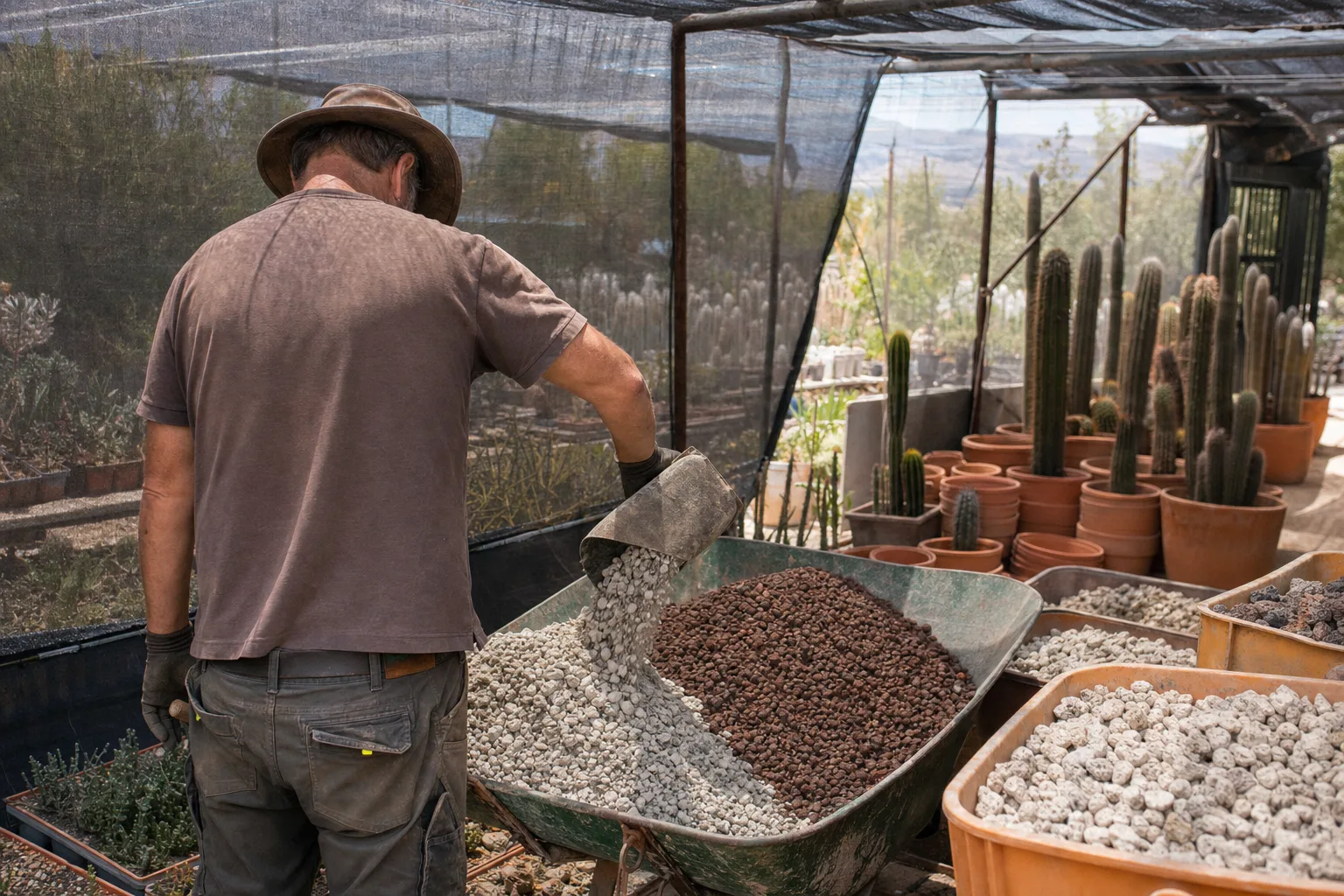
Mineral substrate for Trichocereus: formulas by species and cultivation density
The substrate is the primary irrigation system for a Trichocereus. Before the dripper opens or the hose moves down the aisle, the granulometry, mineral fraction, and bulk density of the medium have already determined how much oxygen will reach the root and how long water will remain in the container. In wholesale production of columnar cacti, a generic "cactus substrate" formula is often too fine, too organic, or too unstable after twelve months. This article proposes mineral formulas by species and cultivation density—rooting tray, sales pot, and large bed or container—with measurable criteria for pH, conductivity, and structure.
The focus is ornamental and nursery-oriented, aligned with Mediterranean production experience. At Tricholand, we adjust mixes according to species and caliber within our own cultivation program in Murcia; if you need to compare a recipe with your irrigation water or greenhouse climate, you can request a wholesale quote or technical advice.
Why mineralize the medium in Trichocereus
The columnar species of the Trichocereus / Echinopsis group develop aggressive root systems when oxygen is abundant. A compacted medium, rich in fines or excessively peaty, retains water in micropores and reduces air porosity. The usual result is slowed growth, subtle chlorosis, loss of absorbing roots, and, in the worst case, neck rot. The mineral fraction—pumice, lapilli, volcanic gravel, washed coarse sand, appropriately sized perlite—provides stable macropores that do not collapse after a season.
Organic matter is not prohibited: it provides calibrated retention, some exchange capacity, and ease of rehydration. The mistake is to invert the proportion. In professional nurseries, the guiding rule is dominant mineral: typically 50–80% mineral aggregates depending on phase and species, with stable organic matter (washed coconut fiber, fibrous blonde peat, very mature and sieved compost) making up the rest.
Serious horticultural references on cacti and succulents agree on prioritizing drainage and aeration; professional substrate sheets with pumice 3–8 mm and volcanic lapilli show relatively low dry bulk densities and drying times of one to three days depending on container and climate. The Cactaceae family groups species from very different habitats, but Andean columnar species from dry valleys respond particularly well to coarse, oxygenated media.
Target properties of the substrate
Before copying a recipe, set objectives:
- Useful granulometry: concentrate particles in 2–8 mm for pot cultivation; remove fines below 1–2 mm that migrate and clog pores.
- Air porosity: high after free drainage; the container must aerate quickly between irrigations.
- Retention: sufficient to avoid daily watering in summer, insufficient to leave the root ball cold and wet for three days in winter.
- Working pH: indicative 5.8–6.8 (broad tolerance towards neutral depending on water); avoid extremes and accumulated salts.
- Starting EC of the medium: low to moderate; it is better to nourish through fertigation than to load the substrate.
- Structural stability: that after 12–18 months it has not turned into organic sludge at the bottom of the pot.
The dry bulk density of mineral mixes with pumice usually falls within ranges compatible with medium and large pots without excessive compaction. The critical aspect is not to memorize a catalog number, but to measure in your pilot plant: surface drying time, container weight at irrigation and after 48–72 hours, and root color at transplanting.
Components: what each contributes
Pumice
It is the reference aggregate in many European cactus nurseries. The volcanic pumice provides stable porosity without decomposing like organic matter. Lightweight, stable, with some internal retention and excellent aeration when used in grit 3–7 mm. Ideal as the majority fraction. Avoid excessively fine sand fractions if you seek quick drying in a humid winter.
Lapilli / volcanic gravel
Provides weight, anchorage for tall columns, and drainage. Useful in mixes for large calibers and for outdoor use. It can increase the density of the container and improve stability against wind.
Perlite
Inexpensive and aerating, but more fragile and floating. Useful in rooting phases or as a complement, not always as a unique long-term base. In intense overhead irrigation, it can stratify.
Washed coarse silica sand
Improves drainage and weight. It must be coarse and washed; beach sand or sand with fine silt is counterproductive.
Coconut fiber and blonde peat
Working organic fraction. Prefers well-washed coconut (salt control) or fibrous peat. Avoid very decomposed black peat as a base. Compost only if it is very mature, sieved, and in a low percentage (for example, 5–15% of the total).
Minor amendments
Dolomite or carbonate in low doses (on the order of a few g/L) when the water is very soft and the peat acidifies. Zeolite or calcined clays at 5–10% can improve CEC without destroying drainage. Beneficial fungi (Trichoderma) and mycorrhizae are nursery tools, not miracles: they work best in oxygenated media.
Base formulas by cultivation phase
The following proportions are volume/volume and should be validated with your water and climate. They serve as a professional starting point, not as dogma.
Formula A — Rooting cuttings (high aeration)
- 70–85% coarse mineral (pumice 3–6 mm or coarse pumice/perlite mix).
- 15–30% fine and stable organic (washed coconut or fibrous peat).
- No fresh compost. Very low starting EC.
- Container: deep trays or pots 8–12 cm with free drainage.
Objective: dry callus prior, moderate first watering, white and fast roots without basal rot. In Trichocereus cuttings, an overly retentive medium is the primary cause of hidden loss.
Formula B — Sales pot / intensive cultivation (balanced)
- 55–70% mineral (pumice 3–8 mm + 10–20% lapilli or gravel 4–8 mm).
- 30–45% organic (coconut/peat + up to 10–15% sieved mature compost).
- Target pH 5.8–6.5; fertigation with irrigation water EC usually around 0.8–1.4 mS/cm during active growth, adjusting according to species and light.
This is the most commonly used mix for commercial calibers intended for garden centers. It balances growth speed and safety against irregular watering in the channel.
Formula C — Large container / landscape / mother plants (anchorage and stability)
- 60–75% mineral, with a higher heavy fraction (lapilli, volcanic gravel 6–12 mm).
- 25–40% stable organic.
- Surface mineral mulch 2–5 cm (pumice or gravel) to reduce irregular evaporation, algae, and splashes.
In Mediterranean outdoor conditions, this structure tolerates occasional rains better than a peaty root ball. In mother plants for cuttings, the stability of the medium reduces tipping and micro-root injuries.
Adjustments by species
Within the commercial genus Trichocereus, water management is similar, but the typology and rhythm justify nuances. Always consult the sheets of varieties when planning a monospecific program.
Trichocereus pachanoi
High vigor and commercial demand for clean typology. It tolerates Formula B well with 55–65% mineral. If you push for intense spring growth, do not compensate with more peat: compensate with light, root temperature, and fertigation. An overly coarse medium (much >80% mineral without retention) may require such frequent watering that it increases labor costs without improving quality. Cultivation details and typology can be found in the sheet for Trichocereus pachanoi.
Trichocereus peruvianus
Often benefits from a mineral fraction in the high band (60–80%) to maintain aeration and express better color and compactness. Avoid prolonged waterlogging in winter. In tall and narrow pots, add a heavy component for stability. More details at Trichocereus peruvianus.
Trichocereus bridgesii (Echinopsis lageniformis)
Bolivian species very tolerant of relative drought and appreciative of draining media. Formula B or C with light mineral; do not punish with heavy organics. Its vigor allows interesting densities if drainage is guaranteed. See the sheet for Trichocereus bridgesii.
Trichocereus terscheckii / pasacana
Slower growth and structural plant logic. Prioritizes long-term stability and drainage (Formula C), with less temptation to "force" with nitrogen-rich organics. Excess fertility does not turn a cardón into pachanoi; it only compromises tissues. Reference at Trichocereus pasacana / terscheckii.
Cultivation density and container volume
"Density" here means two things that the nursery must separate in the spreadsheet: plant density per square meter and the apparent density of the substrate. Both interact with irrigation.
Rooting tray or table
High density of cuttings requires maximum drainage (Formula A). Leave space for visual inspection of bases. A retentive medium in a dense table raises baseline environmental humidity and losses due to fungi.
Pot 12–20 cm (young sales caliber)
Formula B. More frequent watering than in a large container; therefore, aeration remains critical. Avoid saucers with standing water at the point of sale: educate the professional customer with a handling sheet.
Pot 3–10 L or landscape container
Formula C. The volume cushions watering errors, but a closed bottom without real drainage remains a risk. In landscape planting, improve the hole with volcanic aggregates and do not bury the neck.
As layout guidance (to be validated by caliber and tutoring): outdoors, separations of 80–120 cm between columns allow development and maintenance access; in production greenhouses, densities are higher because the sales caliber has not yet displayed adult stature. The important thing is that the increase in density is never "compensated" by degrading the substrate.
Water, fertigation, and interaction with the medium
A well-designed mineral substrate is less forgiving of accumulated salinity if there are no occasional washes, because the CEC is usually lower than in very organic media. Good practices:
- Know the EC and pH of your raw water.
- Fertilize in season with low balances in N and sufficient in K and chelated micronutrients; avoid urea as the dominant source.
- Schedule washes or low EC irrigations when drainage comes out too high.
- In winter, reduce or cut fertilization and prioritize drying.
The pH of the water and that of the substrate must communicate. If you irrigate with very alkaline water over acidic peat without control, the result is nutrient precipitation and chlorosis. Dolomite and controlled acidification are tools; do not improvise strong doses.
Quality control of the substrate in the nursery
Before adopting a mix at scale:
- Prepare 100–200 L of test and plant a control of each key species.
- Weights at container capacity and after 48 hours in summer and winter conditions.
- Root inspection at 8–12 weeks.
- Evaluation of stratification (perlite on top, fines below) after heavy watering.
- Cost per liter versus growth rate and loss: the cheapest mix rarely wins after twelve months.
Record supplier and grain size of each mineral. Changing from pumice “3–8 mm” to a batch with 30% fines completely alters behavior even if the commercial label is identical.
Common problems and corrections
- Ball that does not dry: increase coarse mineral, reduce organic matter, check container drainage and watering frequency.
- Stoloniferous plant with poor roots: it’s not just substrate; check light. Still, waterlogged media exacerbates the problem.
- Surface salts: mineral mulch, washings, lower EC, check poorly washed coco.
- Column tipping: more heavy fraction, wider pot, temporary stake, do not increase plant height without anchoring.
- Basal rot in cutting: insufficient callus, Formula A too retentive or premature first watering.
Guideline calendar (northern hemisphere)
End of winter: transplanting and media renewal on already mild days; avoid cold and wet roots. Spring–summer: active fertigation, monitor drying during heat waves. Autumn: reduce EC and frequency; prepare for hardening. Winter: media almost dry, maximum aeration, zero waterlogging. In the southern hemisphere, shift the schedule by six months.
To expand the context of species and ornamental uses, the Tricholand blog and the about us page describe the framework of European wholesale production in which these formulas are applied.
Frequently asked questions
Can I use only pure mineral?
Yes, in expert collections and some rooting protocols. In a garden center channel, a moderate organic fraction facilitates end customer handling and rehydration after transport. The 100% mineral extreme requires disciplined watering.
Is perlite sufficient as a mineral?
As the only mineral long-term, it is usually inferior to pumice or lapilli in stability and anchorage. Use it as a complement.
What pH is mandatory?
There is no single magic number. Work in a slightly acidic to neutral range, monitor, and avoid sharp fluctuations.
Does the substrate replace the phytosanitary passport?
No. They are distinct areas: the medium speaks of agronomy; the passport, of professional movement of plants in the EU. Both are important in an exporting nursery.
Closing
A good mineral formula for Trichocereus is not a trendy recipe: it is a measured balance between air, water, anchorage, and stability, fine-tuned by species and cultivation density. Start by removing fines, mineralizing the base, validating with controls, and only then scale to hundreds of square meters. If you want to compare mixes with production material or request a catalog and conditions, the Tricholand team can help you align substrate, caliber, and European logistics.