
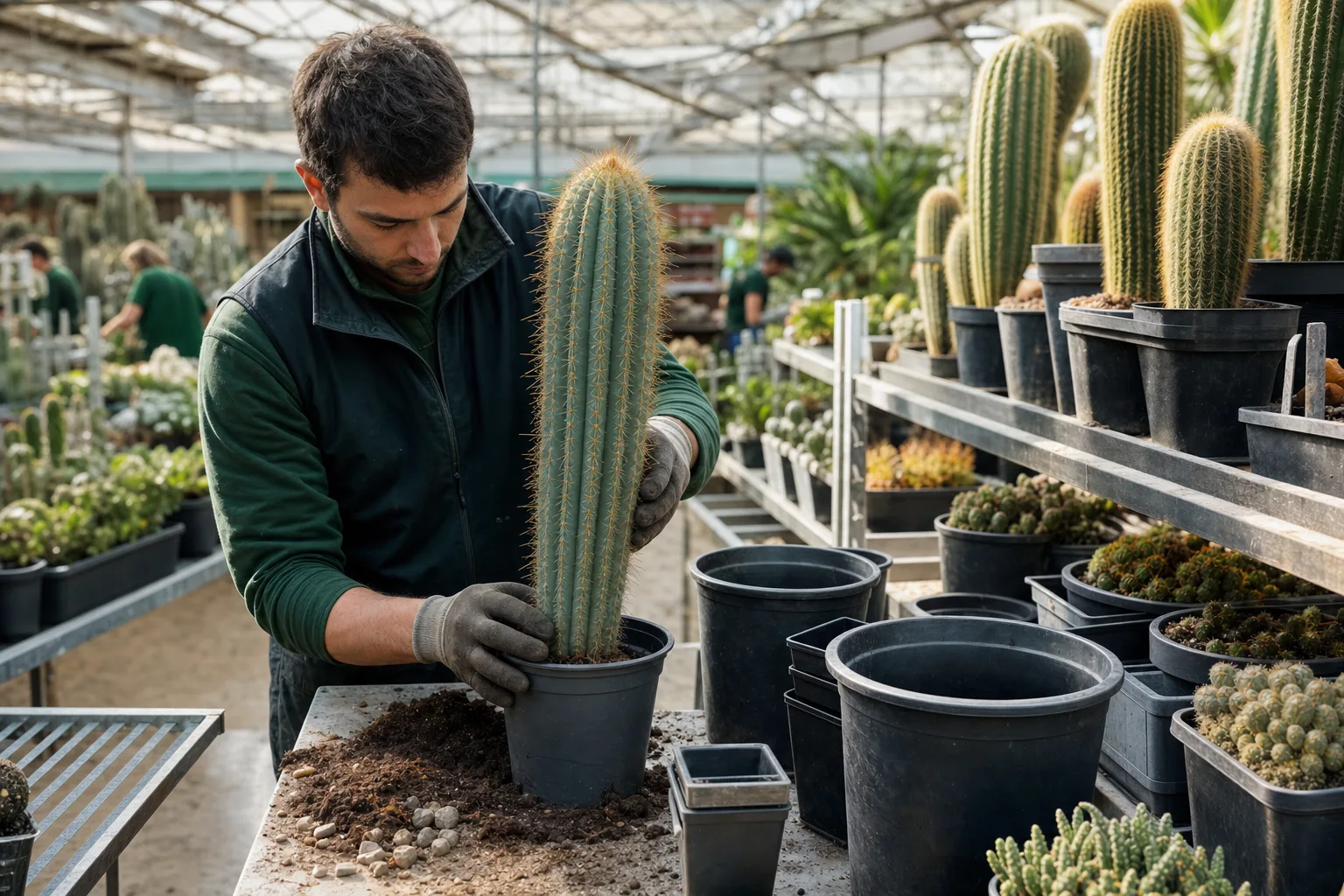
Pots and container sizes for Trichocereus in garden centers
In a garden center, Trichocereus is not sold solely by species: it is sold based on the visual reading of the container. A column of 70 cm in a narrow pot appears unstable; the same plant in C.19 with a good stem diameter conveys quality, ease of handling, and value. Choosing the wrong pot format or container size is one of the most common causes of shrinkage, returns, and stagnant stock in the xerophytic display.
This guide provides direction for buyers, section heads, and nursery managers on how to align plant height, substrate volume, container material, and sales channel. At Tricholand, we produce Trichocereus in Murcia for European distribution; if you need to align container assortment with actual batches, you can check availability of sizes or review the variety catalog.
What is a container size in ornamental plants
In European nursery language, the container is described in two ways that are often mixed in the same delivery note:
- C Code (approximate diameter in cm of the upper edge): C.12, C.14, C.17, C.19, C.21, C.25, C.30, etc.
- Volume in liters: 1 L, 2 L, 3 L, 5 L, 7 L, 10 L, 15 L, 20 L, 25 L…
They are not exact equivalents between manufacturers: a C.19 from one supplier may hold about 3–4 L and another may approach 5 L depending on height and taper. Therefore, in professional orders, it is advisable to specify diameter + liters + plant height + stem diameter. In Trichocereus, volume matters because the columnar root system requires depth and stability, but excess wet substrate increases the risk of rot in-store.
The practical repotting rule used by many specialized nurseries is to increase only 2.5–5 cm in diameter from the current root ball. Oversized containers retain too much water and slow down the drying of the profile. Cultivation guides for columnar plants agree on prioritizing multiple drainage and mineral mixes over compact peat in large pots.
Why the container defines rotation in garden centers
The end customer does not buy "liters": they buy presence, perceived safety, and ease of taking the plant home. Three effects of the container on the ticket:
- Visual stability: a tall column in C.12 is perceived as a tipping risk; the same stem in C.19–C.25 generates confidence.
- Internal handling: very wide containers take up more space in carts and pallets; very narrow containers increase falls and tip damage.
- Maintenance on display: more substrate volume requires more disciplined watering. Untrained staff water "by habit" and rot necks in winter.
Therefore, the pot size must be decided along with the channel: impulse entry, premium terrace, or anchor of the xerophytic section. It is not the same container for a Trichocereus pachanoi juvenile of 35 cm as for a specimen of 1.2 m.
Practical matrix: plant height × recommended container
Guidance for ornamental production (northern hemisphere, European retail). Adjust according to species, stem diameter, and substrate weight:
- 20–40 cm in height: C.12–C.14 / 1–2 L. Ideal for impulse and entry display. Prioritize homogeneity and clear watering labels.
- 40–70 cm: C.17–C.19 / 2–5 L. Sweet spot for Mediterranean garden centers: good presence without heavy logistics.
- 70–110 cm: C.19–C.25 / 5–10 L. Medium-high ticket; requires stable cart and sunny outdoor area.
- 110–160 cm: C.25–C.30 / 10–20 L. Premium terrace or visual anchor. Consider heavy pot or lower ballast.
- More than 160 cm or dense multi-stem: 20–40 L or landscape container. More construction/landscaping channel than impulse retail.
A classic mistake is to order a “90 cm plant” without specifying the pot: the supplier may deliver a well-fattened specimen in C.25 or an etiolate one in C.17. The price per centimeter is misleading; perceived value follows stem diameter and overall stability.
Pot materials: plastic, terracotta, and ceramic
Black cultivation plastic
This is the wholesale standard: lightweight, economical, stackable, and resistant to handling on pallets. Advantages: low logistical cost and easy replenishment. Disadvantages: it heats up in the sun (increasing root temperature in summer) and, if the substrate is too organic, retains moisture. In medium-ticket retail, a clean, undistorted pot is sufficient if the price is competitive.
Terracotta and unglazed clay
Promotes transpiration and reduces waterlogging. Ideal for advanced hobbyists and patio displays. Disadvantages: weight, breakage in transport, and higher evaporation (more frequent watering in summer). Use it as a presentation upgrade, not as a mass cultivation container for long-distance transport.
Glazed ceramic and cachepot
Elevates ticket and terrace aesthetics but requires discipline: many cachepots do not drain. If you sell a plant + decorative pot set, train staff not to leave standing water at the bottom. A Trichocereus in a dish with permanent water is a deferred shrinkage of 2–6 weeks.
Drainage, shape, and depth: what is not visible in the display
Demand from the supplier (and verify upon receipt) these technical points:
- Real drainage holes: not a symbolic hole. Preferably several exit points.
- Sufficient depth: Trichocereus roots explore vertically; very shallow trays create instability and water stress.
- Proper taper: facilitates pot removal without breaking the root ball during transplanting.
- Rigid edge: prevents crushing during stacking; soft pots deform the batch and complicate picking.
- Mineral-draining substrate: if pure saturated peat arrives, assume a high risk in a closed display or with automatic irrigation.
In professional cultivation, the container and substrate form a system. A C.25 with an aerated mix behaves better than a C.17 with fine saturated peat. For formulas and densities, Tricholand's technical blog and production advice are the natural complement to this packaging guide.
Growing container versus sales container
There are two assortment strategies:
- Clean cultivation pot: maximum rotation at price; the customer transplants at home. Requires training at the point of sale (“do not water the dish”).
- Presentable container / kit: reduces purchase friction in medium-high tickets. The margin absorbs the cost of the container if the plant arrives straight, with good color, and without transport scars.
In green DIY chains, labeled black plastic usually wins. In independent garden centers with a well-maintained xerophytic section, a presentable C.19–C.25 or an upgrade to heavy ceramic justifies the premium positioning of species like T. peruvianus or selections of T. bridgesii.
Stability, weight, and shelf safety
A column over a meter acts like a sail: wind, customers, and carts hit it. Practical mitigations:
- Reasonable height/diameter ratio of the pot (avoids “pencil in a glass”).
- Substrate with mineral fraction (gravel, pumice, clay) that provides ballast.
- Wide base or wide empty dish (without water) to expand the support polygon.
- Display area without strong drafts from automatic doors.
- Discreet support only during acclimatization; in final sale, prioritize self-supporting plants.
Upon receipt, reject batches where the container is clearly insufficient for the billed height: the end customer’s complaint will come regardless, but with damage to the section's brand.
Trichocereus species and container reading
- T. pachanoi: relatively fast growth; fattens well in C.17–C.25. Excellent for the retail size ladder. Low spination facilitates picking.
- T. peruvianus: glaucous aesthetic; in a presentable container, it elevates premium perception. Watch weight and spines during handling.
- T. bridgesii: marked silhouette; protects spines during transport even if the container is correct.
- T. terscheckii / pasacana: slow cycle and high ticket; do not force it in C.12. Better anchor in C.25+ or landscape project. Check the terscheckii sheet.
The botanical identity reference for pachanoi appears in resources like Echinopsis pachanoi; in commercial nurseries, the name Trichocereus is maintained out of catalog tradition.
How to order containers in a wholesale order
Include in the contract or order email, in writing:
- C Code or liters (better both).
- Plant height and measurement criteria (from neck or from pot edge).
- Minimum stem diameter at 10–20 cm from the neck.
- Single-stem or multi-stem.
- Color/type of pot (black cultivation, gray, presentable).
- Tolerance of homogeneity (±10% height, for example).
- Need for EU phytosanitary passport in the commercial unit.
If your garden center is opening a new xerophytic section, start with a pilot: 60% sweet spot C.17–C.19 (40–70 cm), 25% entry C.12–C.14, 15% premium C.25+. Measure rotation in 6–8 weeks before expanding. You can request a wholesale quote with that breakdown to avoid overstock.
Repotting in-store: when it is advisable and when it is not
Repotting at the point of sale adds labor costs and health risks. Do it only if:
- The arriving container is unstable for the height.
- The substrate arrives waterlogged or collapsed.
- You are going to create a premium kit with a decorative pot.
Brief protocol: remove from the pot dry, do not water immediately, use a draining mix, increase diameter slightly, leave 7–14 days for settling before generous watering, and acclimate light if the plant came from transport shade. Never bury the neck more than it was.
Frequent purchasing and display errors
- Buying only for cheap height in an insufficient pot.
- Mixing different species in the same item code.
- Exposing to full sun on the same day as delivery without acclimatization.
- Using dishes with permanent water “to not forget watering.”
- Stacking containers deforming edges and crushing tips.
- Ordering C.30 for low ticket impulse: weight kills rotation.
- Forgetting ballast on a windy terrace: tipping = shrinkage and complaints.
Section presentation: the container as part of the narrative
A profitable xerophytic section tells a story in three heights. The container helps to modulate that reading: C.12–C.14 in the front line, C.17–C.19 as the backbone, C.25+ as the anchor. Present over gravel or mineral base, not over puddles. Group by container size so that the customer understands the price ladder without the need for dense signage.
Train staff in three gestures: hold by the container (never by the stem), do not wet the neck, and explain dryness between waterings. These gestures reduce more loss than any offer. Learn about the producer culture at about us to convey the origin of Murcia and ornamental criteria to the professional customer.
Frequently Asked Questions
Which pot sells faster in garden centers?
In Mediterranean climates, the range C.17–C.19 with plants of 40–70 cm and good stem diameter tends to rotate better. The premium C.25+ enhances image but requires more exposure time.
Is it better to request liters or code C?
Request both and, if possible, a reference photo of the batch. The heterogeneity among manufacturers necessitates dual measurement.
When to switch from C.19 to C.25?
When the height exceeds ~90–100 cm, the stem diameter exceeds ~7–8 cm, or the target customer is terrace/landscaping with a high ticket.
Black pot or presentable?
Black for rotation and price; presentable for margin and image. Do not mix criteria in the same code.
Does a larger container accelerate growth?
Not necessarily. An excessive jump in volume favors moisture and slow rooting. Better to have moderate increases with aerated substrate.
What documentation should accompany the batch?
EU plant passport in commercial unit, delivery note consistent with species and quantities, and batch traceability. For destinations outside the standard EU logic, consult requirements with the supplier.
Container Reception Checklist
- Diameter/liters match the order.
- Reasonable stability of height/pot.
- Pot without cracks or serious deformation.
- Free drainage (not blocked by film or label).
- Substrate does not smell of anaerobiosis.
- Apexes free of crushing due to stacking.
- Botanical and care label legible.
- Phytosanitary passport present.
Indicative Assortment Calendar (Northern Hemisphere)
- February–April: replenish entry C.12–C.17; careful acclimatization after cold transport.
- May–July: maximum sweet spot C.17–C.25; monitor linear watering.
- August–September: premium terrace; avoid heat shocks in black plastic under full sun without temporary shade.
- October–January: reduce watering, do not force wet transplants, protect from cold corners.
In the Southern Hemisphere, shift the cycle six months. The container logic does not change: less water in cold, more control of substrate volume.
Conclusion
The correct pot is not the largest or the cheapest: it is the one that stabilizes the column, allows the profile to dry, fits your logistics, and communicates the price you want to defend. In Trichocereus from garden centers, the caliber of the container is as strategic a commercial decision as the species. If you want to build a coherent format ladder with actual production, talk to the technical team at Tricholand, request a catalog and conditions, and align C.12–C.30 with the rotation of your xerophytic line.
One last criterion for professional buyers: measure not only sold units but also claims for tipping, neck rot, and “small plant for the pot.” These three indicators tell you if the container is well chosen. When the metric improves, scale the same code with the same supplier to maintain visual homogeneity season after season.