
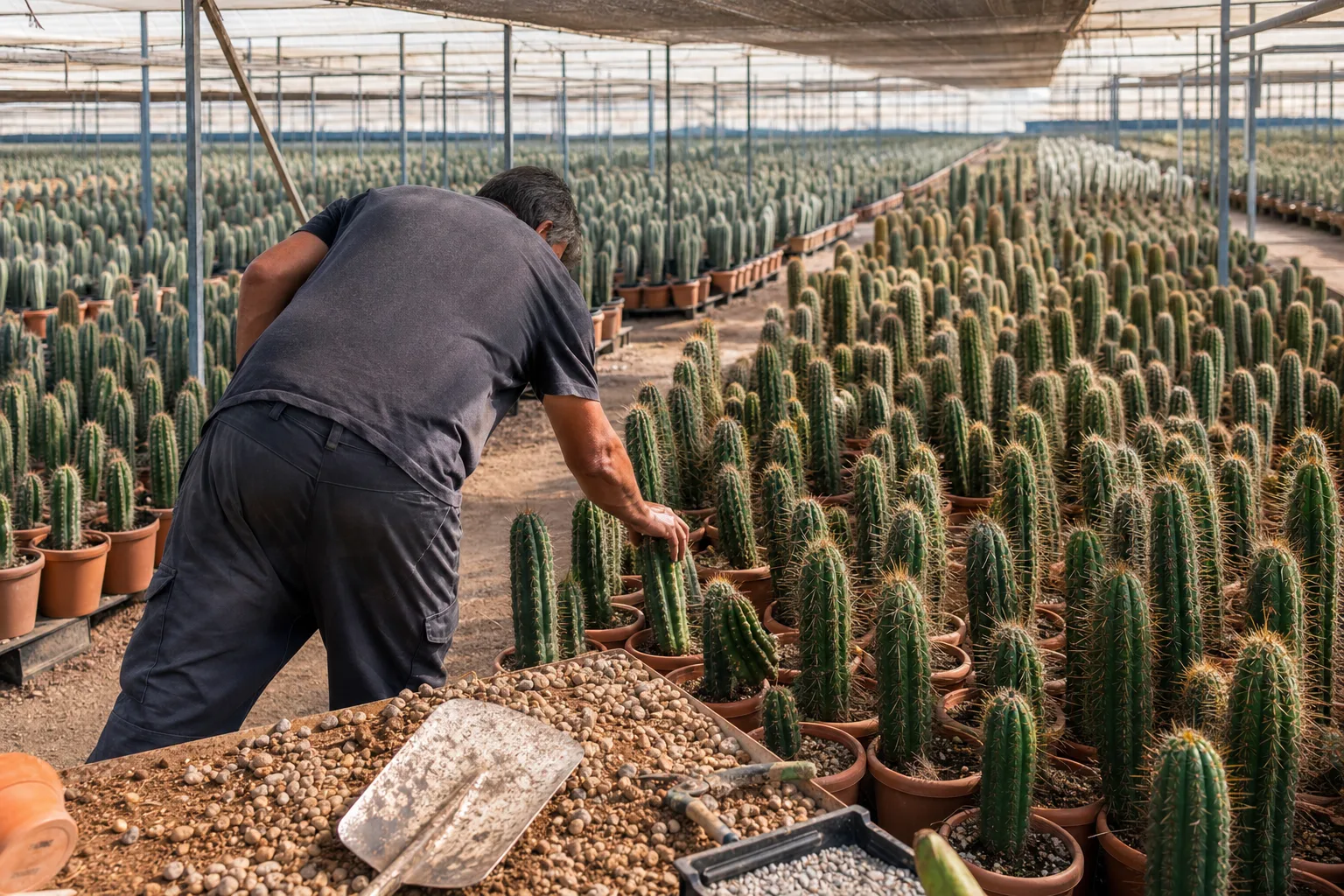
Production of Trichocereus in Murcia: Mediterranean Climate and Nursery Advantages
Producing Trichocereus and columnar cacti in the southeastern peninsula is not a recent trend: it is an agronomic decision. The semi-arid Mediterranean climate of the Region of Murcia provides high sunlight exposure, relatively mild winters, and a water deficit that, when well managed, promotes the hardening of epidermis and the acclimatization of plants intended for xerophytic gardening throughout Europe. Tricholand operates as a wholesale producer nursery with its own facilities of approximately 2,500 m² in Murcia, focused on serving nurseries, garden centers, and distributors in over 18 countries, with EU plant passport and cultivation aimed at professional calibers.
This article explains why Murcia is a coherent location for the ornamental production of columnar cacti, what real advantages it offers compared to greenhouses in Northern Europe, and how this translates into batch quality, logistics, and technical advice —without inventing stocks, prices, or specific logistical timelines.
The climatic framework: semi-arid Mediterranean with high sunlight exposure
According to reference climatological series from the State Meteorological Agency (AEMET) for the Murcia station, the annual thermal regime shows mild winters and warm summers, with accumulated sunlight exposure of nearly 3,000 hours of sun per year in the published climatological normal period. The average annual precipitation is around 300 mm in many areas of the region, with strong irregularity and marked summer drought: a pattern that, in terms of cactus cultivation, reduces the permanent moisture pressure on necks and roots.
The Climatic Atlas of the Region of Murcia and regional studies agree on placing the regional average temperature close to 16 °C, with contrasts by altitude: warmer valleys versus cooler northwest areas. For a columnar nursery, that combination —abundant radiation + relative aridity + the possibility of managing microclimates with shade cloth and greenhouse— is the main productive asset.
What this means for Trichocereus cultivation
The columnar cacti of the Trichocereus / Echinopsis complex come from Andean environments with strong thermal amplitude and mineral soils. In Murcia, the radiation allows reasonable cultivation densities without forcing artificial lighting for much of the year. Summer heat accelerates the vegetative growth of vigorous species such as Trichocereus pachanoi or Trichocereus peruvianus, as long as irrigation and substrate are designed for drainage.
The Murcian winter, although it can register occasional frosts in inland areas, is generally more manageable than that of Central Europe: many campaigns allow maintaining plants with active roots for more days of the year or, at least, avoiding entire months of intensive heating. This does not eliminate the need for protection against humid cold or torrential autumn rains; it does change the structure of energy costs and the acclimatization profile of the sold plant.
Advantages of the nursery in Murcia compared to Nordic or continental production
1. Mediterranean acclimatization "from the factory"
A plant grown under real sunlight and with controlled water deficit typically arrives at the European customer with thicker epidermis and better response to terraces and xerophytic gardens in the south and the Mediterranean arc. Garden centers in France, Italy, or Spain value material that does not "cook" in the first outdoor summer after hyper-protected cultivation. Acclimatization at the source reduces post-sale shock.
2. Less dependence on artificial heat
Protected horticulture in southern Spain has demonstrated, in vegetables, that solar radiation can replace much of the heating. In ornamental succulents, the principle is analogous: fewer boiler hours, more hours of useful sunlight. The margin is reinvested in substrate quality, clonal selection, and phytosanitary control.
3. Logistical position towards the European market
Murcia and the southeastern peninsula concentrate horticultural export corridors. For a cactus wholesaler, this translates into access to logistics operators accustomed to live plants, packaging, and documentation. Tricholand works in the European professional channel; the location facilitates connection with EU destinations and the documentation management associated with the plant passport. Route details and timelines are defined on a per-order basis —there is no single "standard timeline" that applies to all destinations.
4. Specialization in columnar cacti, not in generic assortment
A nursery of ~2,500 m² focused on Trichocereus can concentrate knowledge in calibers, densities, cutting rooting, and batch homogeneity. This specialization is the competitive advantage over broad but shallow assortments. Those seeking Trichocereus bridgesii or forms of cardón for landscaping need technical dialogue, not just a catalog photo.
Facilities and production model (verifiable facts)
Tricholand produces in its own facilities of approximately 2,500 m² in Murcia. The model is that of a wholesale producer nursery: professional orders, cultivation on demand when the project requires it, and advice on substrate, fertigation, or landscaping implementation. Distribution reaches nurseries and distributors in more than eighteen European countries. No inventories or rates are published here: the availability of calibers and commercial conditions is consulted directly.
To request a catalog and conditions, or to request a wholesale quote, the usual channel is the contact form or the email info@tricholand.com. The added value lies in aligning species, caliber, and delivery schedule with the client's campaign.
Climate management on the farm: sun, shade cloth, and water
The sunlight in Murcia is both an asset and a risk. In mid-summer, peaks of radiation and substrate temperature can burn the tips or sides of young plants if there is no gradual acclimatization or temporary shading. A professional protocol combines:
- Seasonal shade cloth in sensitive phases (newly rooted cuttings, transplants).
- Dry profile irrigation, often early in the morning, avoiding wetting wounds and tips during peak heat hours.
- Mineral substrates with rapid drainage, consistent with occasional torrential rains.
- Drainage and slopes that prevent waterlogging after cold drop episodes.
The low average precipitation does not imply "no watering": it means that water control is almost entirely the responsibility of the grower. This is a precision advantage: each fertigation cycle is decided, not imposed by the Atlantic climate.
Batch quality for the European market
The European professional buyer evaluates: turgidity, straightness, absence of pests, diameter homogeneity, root cleanliness, and documentation. Producing in Murcia helps with turgidity and epidermis color if the light and nitrogen regime is well calibrated; homogeneity depends on mother plant selection and the cutting protocol. The Tricholand blog develops these topics (fertigation, calibers, EU passport) because technical SEO and channel training are part of the service.
In Mediterranean landscaping projects —hotels, residential areas, xerophytic public works— the columnar cacti acclimatized in southeastern Spain fit the visual language of the dry garden: less irrigation, less maintenance, sculptural presence. Murcia is not the Sonoran Desert, but it is a realistic laboratory of mild water stress that prepares the plant for final use.
Water, substrate, and energy: the operational triangle
Producing in a semi-arid environment requires precise water design: quality (salts, pH), flow rate, and time of day. Irrigation water with high EC requires occasional profile washes and substrates with good washing capacity without losing structure. The dominant mineral fraction —pumice, volcanic gravels— fits with short and intense storms: the water passes, it does not stagnate. In greenhouses, nighttime condensation is managed with ventilation; outdoors, shade cloth and table orientation reduce unwanted humid microclimates around sensitive necks.
Free solar energy does not completely eliminate expenses for pumps, mobile shading, or, in exceptional episodes, emergency heating. It does shift the cost curve compared to a northern nursery that heats almost all winter. This margin allows investment in mother plant selection, batch homogeneity, and staff training —factors that the European buyer notices in the repeatability of the order.
Quick comparison: producing here vs. importing without acclimatization
Importing material from very different climates without a hardening phase generates losses at the point of sale: burns, water collapse, or reverse etiolation. Producing in Murcia does not guarantee success on its own —a protocol is needed— but it aligns the cultivation climate with much of the Mediterranean demand and with sunny terraces in the rest of Europe in summer. For continental north, the customer must inform the end consumer about winter protection; the nursery can advise on species more tolerant to cold, such as certain forms of cardón (Trichocereus terscheckii / pasacana).
Plant health and traceability
Intra-community trade of ornamental plants requires monitoring of quarantine pests and phytosanitary passport in accordance with EU regulations. An exporting nursery in Murcia integrates inspection, substrate hygiene, control of mealybugs and mites, and batch records. Relative aridity helps limit some humidity-related foliar diseases, but does not replace IPM: mealybugs and mites remain common enemies in cacti under plastic or at high densities.
General botanical references on the group can be consulted in authority sheets such as Echinopsis pachanoi; the commercial decision of which species to produce for each market is marked by channel demand and local cultivation behavior.
Indicative production calendar in Murcia
Late winter–spring: start of growth, cutting of cuttings, transplants, replenishment orders for the gardening campaign.
Summer: maximum vegetative growth; management of shading and irrigation; monitoring of thermal stress.
Autumn: hardening, progressive reduction of nitrogen fertilization, preparation of batches for sale and for winter.
Winter: relative rest, minimal irrigation, protection against humid cold episodes; planning of mother plants and orders.
This calendar overlaps with the demand of the European retail (spring peaks) and with public works projects that plant in autumn in a Mediterranean climate. Coordinating production and orders is part of the wholesale service.
FAQ
Why Murcia and not just a heated greenhouse in the north? Due to natural sunlight, acclimatization, and energy cost structure; the north remains a market, not necessarily the best production site for all columnar cacti.
Are ~2,500 m² enough to be a wholesaler? In a specialized crop with high value per unit area, the key is rotation, calibers, and B2B relationships, not competing in hectares of low-margin annual plants.
Are delivery times fabricated? No. Each destination and volume has its logistics; it is confirmed upon closing the order.
Is there technical advice available? Yes, on substrate, fertigation, and implantation; it is part of the Tricholand model.
Closure
The production of Trichocereus in Murcia takes advantage of a semi-arid Mediterranean climate with high sunlight exposure to obtain acclimatized plants, with less dependence on heating and a natural position towards the European market. The facilities of about 2,500 m² of Tricholand concentrate this logic in a wholesale production nursery: specialization, EU passport, and technical conversation with the professional channel.
If you are a distributor or purchasing manager for a nursery and want to align your campaign with material produced in southeastern Spain, request a catalog and conditions or check the availability of sizes. The next step is both technical and commercial: species, size, documentation, and date of need. You can also learn more about the project at about us and browse the variety catalog before formalizing the order.