
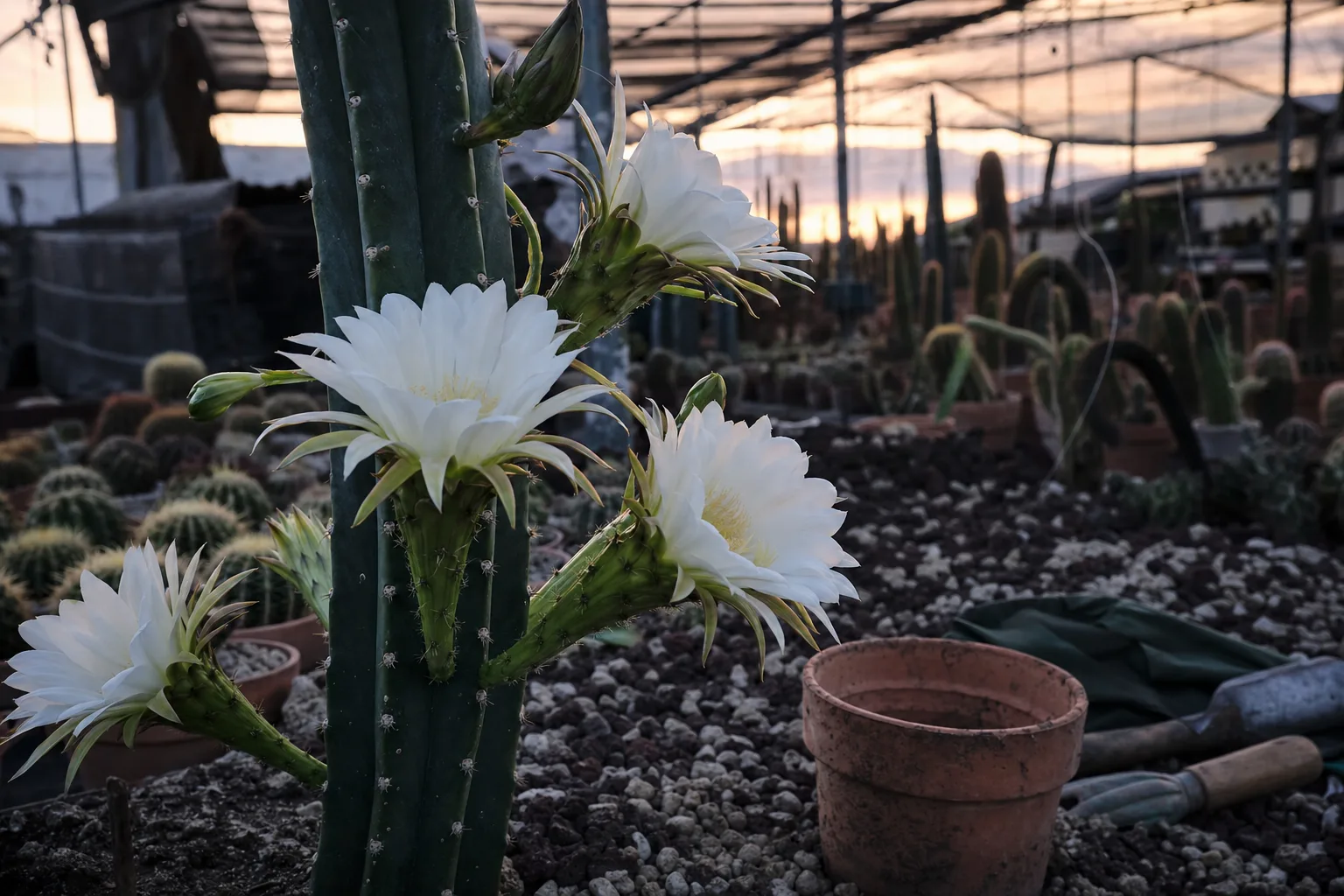
Trichocereus Flowering: How to Induce and Care for Night Blooming Flowers in Cultivation
The flowering of Trichocereus is one of the most valued spectacles in collections and xerophytic gardening: large flowers, often white or light-colored, that open primarily at night and have a short lifespan. Inducing it reliably in cultivation does not depend on an isolated "trick," but rather on the interaction between the maturity of the specimen, radiation, dry and cool winter rest, and a nutritional regime that does not prioritize only vegetative greenness.
This article summarizes nursery and advanced cultivation criteria to promote flower buds, care for the open flower, and understand why so many healthy specimens do not bloom. The tone is ornamental and agronomic; it cites evidence of cold and light induction published in the complex Echinopsis, which can be cautiously applied to the columnar species of the Trichocereus group marketed in Europe.
What are the nocturnal flowers of Trichocereus
In common catalog species — T. pachanoi, T. peruvianus, T. bridgesii — the flowers emerge from areoles, are usually funnel-shaped, large (often in the range of 15–20 cm or more depending on species and vigor), and release an intense aroma at dusk. The nocturnal opening is related to natural pollinators in their Andean habitat (sphingids and, in wild contexts, also nocturnal fauna). In European gardens, manual pollination with a brush is the practical tool if fruits and seeds are desired.
The flower usually lasts one or a few nights. This is not a cultivation failure: it is the biology of the species. The ornamental value lies in the anticipation of the bud, the night of opening, and in photography; the productive value is in the seed or in the prestige of the mother lot that demonstrates reproductive capacity.
For the general botanical framework of the group, the Echinopsis pachanoi entry on Wikipedia provides synonyms and distribution context; commercial nomenclature continues to use Trichocereus in nurseries, and both readings can coexist transparently.
Maturity: the factor that cannot be improvised
A Trichocereus reaches physiological flowering capacity with age and stature. Approximately, from seed, several years (often around 5–10 depending on species and management) are usually needed before the first flower. From a cutting of an adult plant, the timeframe shortens: the tissue is already mature and, with good cultivation, it can bloom in 2–4 years if size and reserves allow.
Height and diameter matter. Cultivation observations indicate that well-developed columnar specimens (often above one meter or one and a half, depending on species) are more likely to bud. Forcing a young, thin plant with fertilizer usually results in more green stem, not more flowers.
Induction: cool, dry rest and radiation
The most cited experimental evidence in the Echinopsis environment (studies of floral induction in cultivars like ‘Rose Quartz’) shows an optional requirement for exposure to cold (around 5 °C for several weeks) followed by growth under good irradiance conditions, with responses also to long days in some treatments. Not all Trichocereus from nurseries behave like a potted hybrid, but the practical message is clear: a warm, humid winter with poor light reduces flowering; a cool, dry rest followed by sunny spring favors it.
Growing experiences in the southern hemisphere have correlated buds with particularly dry winters, even when the cold was not extreme. In pots, a simple strategy is to place mature specimens under ventilated cover, without watering or with minimal watering, during winter, and return them to full sun in spring.
Induction checklist for professional cultivation
- Mature plant, without etiolation, with good diameter.
- Autumn: reduce nitrogen; assess potassium/phosphorus contribution in cactus fertilizer.
- Winter: dry substrate, cool temperatures without destructive frosts on turgid wet tissue.
- End of winter–spring: increase light (minimum 6–8 hours of direct sun or high PPFD in greenhouse), progressive watering, and thermal amplitude day/night.
- Avoid aggressive repotting right in the bud window.
Nutrition: greenness vs. flowering
Excess nitrogen produces fast, soft columns, attractive in juvenile size but poor in flowering. A balanced fertigation program during the active season, with ratios that do not spike only N, and a cut in fertilization towards autumn, helps to accumulate reserves. "Blooming" fertilizers rich in phosphorus and potassium can be used moderately at the end of the growing season; they do not replace winter rest.
EC and pH of the water must be maintained within safe ranges for cacti (indicative pH 5.8–6.8 in fertigation; moderate EC depending on phase). Accumulated salts and high pH cause chlorosis and stress that delay any induction. For details on the nutritional program, Tricholand's technical blog develops fertigation in production.
Care of the bud and the open flower
When buds appear, management becomes conservative:
- Regular watering but without waterlogging; sudden water stress can abort buds.
- Do not spray aggressive phytosanitary products on open buds.
- Avoid bumps and handling; Trichocereus buds are fragile at the base.
- Emergency shading only in extreme heat waves that could cook tender tissues; in general, they maintain high light levels.
On the night of opening, the flower benefits from the absence of scorching wind and observation without manipulating the perianth. If pollination is desired, do it with fresh pollen from another compatible flower (or the same if the species allows), preferably during peak receptivity hours. After flowering, the ovary can set fruit; if there is no interest in seed, it can be left to dry and fall.
Why it does not bloom: quick diagnosis
- Immaturity: wait and thicken, do not "stimulate" with more N.
- Warm winter and continuous watering: impose dry and cool rest.
- Little light: move to southern exposure or reinforce lighting; etiolation is the enemy of flowering.
- Chronic stress: mealybug, rotten roots, tiny pot, or collapsed substrate.
- Aggressive annual repotting: respect a complete cycle after a large container change.
In wholesale production, not all lots are cultivated for flowering: many sizes are sold in vegetative phase. Nevertheless, the mother plants in the nursery must enter the reproductive cycle to verify vigor and, when applicable, obtain seed. Tricholand, with production in Murcia and a European channel, can advise on the management of mothers and on species selection according to the client's ornamental objective.
Pollination, fruit, and seed in ornamental context
If the goal is to obtain clean seed to renew lines or for seedling sales, manual pollination must be recorded: date, donor and recipient plants, and resulting lot. Pollen is transferred with a soft brush between open flowers on the same night or on consecutive nights if receptivity allows. After setting, the fruit evolves over weeks; it is harvested when ripe, and dark seeds are released, which must be dried and stored in a cool and dry place. In an ornamental garden without reproductive interest, letting the flower wither without intervention is perfectly valid and reduces handling.
Avoid unwanted crossings in mixed collections if maintaining a clonal or species profile is sought. In nurseries, flowering mothers are physically separated or access to pollinators is controlled when purity matters. This discipline is the same as that applied to any ornamental improvement program for cacti.
Species and nuances of flowering
Not all columnar species in the catalog bloom with the same ease in Europe. Vigorous forms of pachanoi in good Mediterranean sun bud with some regularity upon reaching stature. Peruvianus and bridgesii also offer spectacular flowers with adequate rest. Slow-growing cardones (T. terscheckii / pasacana) may take longer to produce the first flower, but they compensate with monumentality and, in maturity, large nocturnal flowers.
Ornamental hybridization within Echinopsis has generated cultivars with earlier flowering in pots; they are useful as physiological references (cold + light), not as an exact copy of the management of a 2 m columnar.
Calendar (northern hemisphere)
September–October: last gentle push of growth; nutritional transition; pest cleaning before rest.
November–February: dry, cool, maximum possible winter light; no growth fertilization.
March–June: typical window for buds and flowers in many European and Mediterranean crops; increasing watering and sunlight.
Summer: possible additional flowering in warm climates; monitor for abortion due to extreme heat or absolute drought in small pots.
In the southern hemisphere, shift six months. In Murcia and the Mediterranean arc, the combination of bright winter and long summer favors intense vegetative cycles; the producer must "impose" dry rest if rainy autumn prevents it under cover.
Landscape use of flowering
In night gardens, patios, and boutique hotels, the flower of Trichocereus is scheduled as an event: soft peripheral lighting (never thermal spots on the flower), safe paths, and communication to visitors that the opening is ephemeral. In retail, a plant in bud is a powerful selling point; it requires careful logistics to avoid breaking buds during transport.
For projects that combine flowering and columnar structure, it is advisable to mix species with different rhythms: fast columnars for volume and slow cardones for permanence. The variety catalog helps to assemble that palette; commercial contact allows requesting the catalog and conditions according to the type of work.
Health during flowering
Sweet flowers can attract ants and sometimes favor mealybugs in nearby areoles. Inspect and act with methods compatible with pollinators if the garden is open. Avoid broad-spectrum insecticides during the peak of natural pollination at night. Bud rot is often related to persistent moisture and fungi; ventilation and watering the substrate, not the flower, are the preventive basis.
FAQ
How many hours of sun does it need to bloom? As a guideline, 6–8 hours of direct sun or equivalent in a high-transmission greenhouse; less light, fewer flowers.
Is cold mandatory? A cool period greatly improves the odds; the exact extreme varies by genotype, but a warm, humid "living room" winter is the worst scenario.
Can I force with artificial light? High irradiance helps; photoperiod is not always decisive in all Echinopsis, but long days after cold have shown a response in studied cultivars.
Does the flower last little? Yes, it usually lasts from one to three days; plan for observation.
Does a newly rooted cutting bloom? Rarely. First roots and thickening; the flower comes with maturity and reserves.
Closing
Inducing the nocturnal flowering of Trichocereus is an exercise in technical patience: maturity, sunlight, dry and cool winter rest, and nutrition without excess nitrogen. Caring for buds and flowers is, above all, about not ruining them with careless watering or handling. When the cycle is respected, the ornamental reward justifies years of cultivation.
If you are cultivating mother plants in a nursery or designing a garden where flowering is part of the narrative, you can talk to the technical team at Tricholand for guidance on species and sizes, or request a wholesale quote for our own production material in Murcia. More context about the nursery can be found about us and more guides in the blog.