
Trichocereus Variety Catalog for Distributors: What to Order and Why
A distributor entering the Trichocereus genus without assortment criteria ends up with a warehouse full of similar columns, stockouts on the best-selling reference, and gaps in those that provide differentiation margins. Simply asking for generic “San Pedro cactus” is no longer enough: the professional channel —garden centers, reselling nurseries, xerophytic landscaping— distinguishes growth rates, spination, stature, and commercial storytelling. This guide explains what to order from the Trichocereus variety catalog and why each block makes sense in a European distribution network.
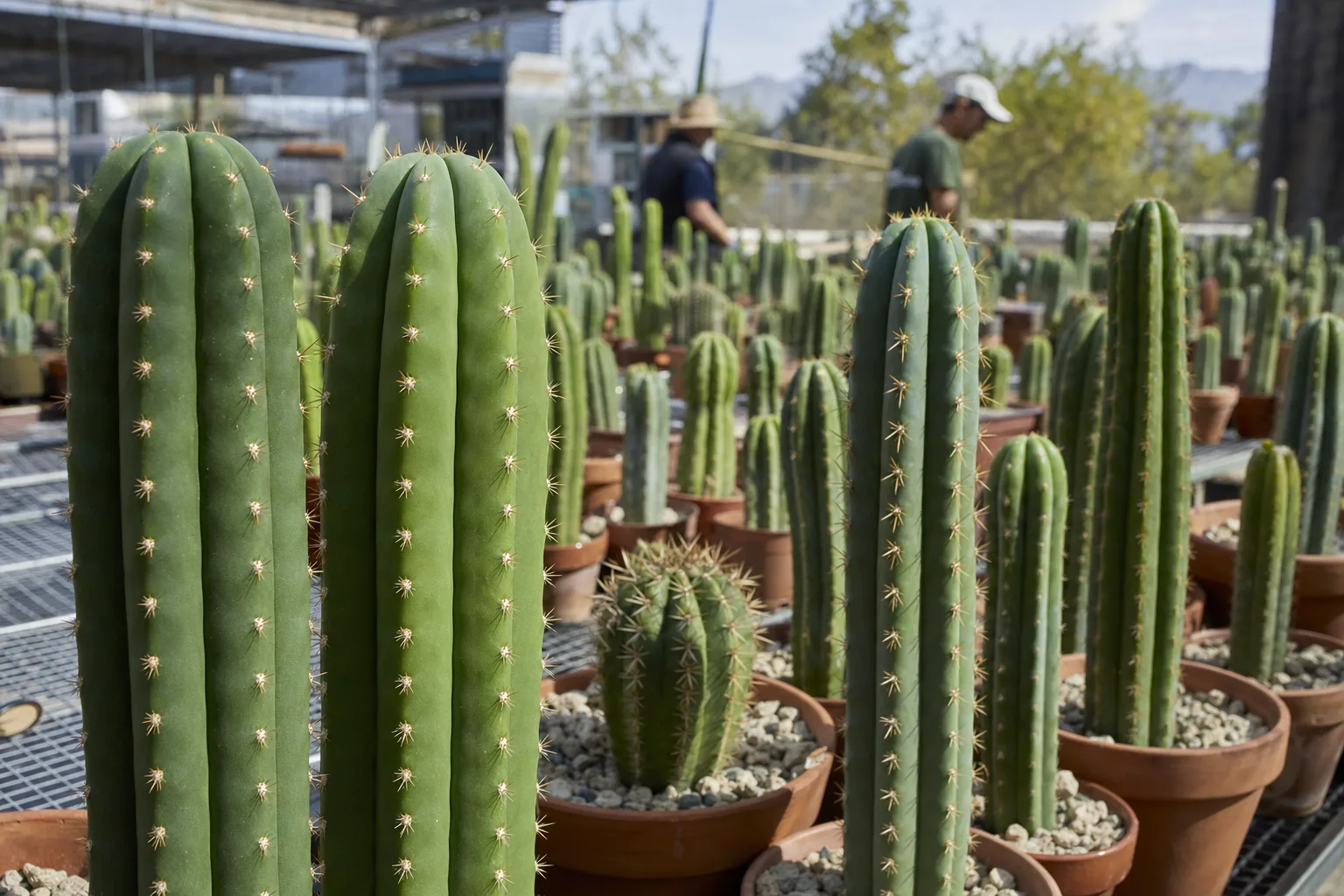
Tricholand produces in Murcia, with a wholesale focus and EU plant passport, the most demanded main lines of the genus in ornamentals: pachanoi, peruvianus, bridgesii, terscheckii/pasacana, and a line of other cacti. The goal of this article is not to replace a complete technical sheet but to help you build an intelligent order: a mix of species, logic of calibers, and sales arguments that your end customer understands.
How to think about the catalog before sending the purchase email
Before discussing species, define the channel. The assortment for a high-volume garden center is not the same as that for a collector's nursery or a landscaping contractor. Three questions organize the order:
- What percentage of my customers is looking for an “easy and green” column versus a piece with character from spines or monumental stature?
- Fast rotation in 20–40 cm or perceived value in larger calibers?
- Do I need lot homogeneity for shelves, or diversity for a collection table?
With those answers, the catalog stops being a list and becomes an assortment with roles: volume locomotive, differentiator, slow premium, and impulse wildcard. If you want to contrast real availability by caliber, consulting caliber availability with the team avoids designing a planogram based on imaginary stock.
Trichocereus pachanoi: the locomotive of the shelf
The Trichocereus pachanoi (San Pedro; in botany often treated as Echinopsis pachanoi) is the reference that most often supports the volume. Vigorous growth, clean ribs, short or less aggressive spines in many commercial lots, and immediate ornamental reading: “elegant green column.” It fits in terraces, Mediterranean gardens, gravel compositions, and sales to non-specialist public.
Why to order it
- High rotation and recognizable shape.
- Good performance in Mediterranean nursery and garden climates.
- Relative ease of cultivation for the end customer compared to more delicate columnar species.
- Ideal base for mixed packs and for the first order of a new point of sale.
How to order it
For general distribution, prioritize a homogeneous entry caliber —for example, the size that your network sells as table or small patio plants— and a second caliber for upselling. Avoid mixing very etiolated plants with compact plants in the same cart: the consumer compares on the shelf and is left with the feeling of irregular quality from the supplier, not from the producer's climate.
Sales argument for your team: immediate verticality, low water maintenance compared to hedges, nocturnal flowering in mature specimens, and contemporary xerophytic aesthetics. Keep the discourse focused on ornamental and sustainable gardening in water.
Trichocereus peruvianus: character and differentiation
The Trichocereus peruvianus (Peruvian torch; commonly synonymous with Echinopsis peruviana) provides what the pachanoi does not always offer: more pronounced spination, deeper ribs, and a “collection” presence without abandoning its landscaping use. It is the piece that allows for higher ticket sales and attracts the advanced hobbyist or designer looking for texture.
Why to order it
- Clear visual differentiation alongside pachanoi on the same shelf.
- Appreciated clonal variability in specialized channels.
- Narrative of Andean origin and robust stature.
- Natural complement in “Trichocereus assortment” packs.
How to order it
In generalist networks, peruvianus works well as a second reference in moderate quantity compared to pachanoi —for example, a 2:1 or 3:1 ratio in favor of pachanoi— unless your channel is distinctly collector-oriented. Require lots with representative spination and clean diameters: the customer choosing peruvianus examines the spines and glaucous color closely.
Train store staff not to sell it as “the same San Pedro with spines.” They are different proposals; confusing them leads to returns and loss of trust.
Trichocereus bridgesii: the niche differentiator
The Trichocereus bridgesii (achuma/wachuma; frequently associated with Echinopsis lageniformis) has a recognizable morphology: deep ribs, sections that narrow and widen, long spines, and a visual personality that enthusiasts identify in seconds. In production, it is usually more limited than pachanoi; precisely for this reason, it interests distributors seeking relative exclusivity.
Why to order it
- High differentiation value on the collection table.
- Good product story for digital content at the point of sale.
- Premium complement to the columnar assortment.
- Qualitative demand in specialized European nurseries.
How to order it
Do not treat it as a volume commodity. Order quantities aligned with your ability to explain the plant. A poorly presented bridgesii next to a pachanoi without a sign ends up going unnoticed or, worse, generating fear due to the spines without context. Use brief signage: Bolivian highland origin, ornamental columnar stature, sun cultivation, and drainage.
If your network has several points, concentrate bridgesii in stores with trained sellers or in seasonal campaigns, rather than diluting six units per store without a narrative.
Trichocereus terscheckii (pasacana / cardón): the landscaping anchor
The Trichocereus terscheckii (large cardón; Echinopsis terscheckii) operates in another league of time and stature. Slower growth, monumental vocation, numerous ribs, and the presence of a “xerophytic tree” in the long term. It is the reference that captivates landscapers and large-format garden customers, not necessarily the one with the highest weekly rotation at a low ticket.
Why to order it
- Landscaping projects and high-impact low-water gardens.
- Medium-high ticket and perception of specimen.
- Catalog balance: not all the genus is fast-growing.
- Narrative of longevity and plant architecture.
How to order it
Work calibers and expectations honestly: those buying cardón should know it does not grow at the pace of pachanoi. In distribution, it works as a showcase piece, as a made-to-order request for projects, or as a premium reference in stores with established garden clientele. Avoid positioning it at the same psychological price as a young, fast-rotating pachanoi; degrading the cardón means losing margin and confusing the market.
Other cacti: the wildcard that completes the basket
The line of other cacti allows you to round out orders, create mixed packs, and respond to demands for special shapes or complementary species without opening a thousand new references in your ERP. Use it wisely: the wildcard serves to enrich, not to blur the specialization in Trichocereus that justifies your positioning.
Commercial usage ideas:
- Welcome pack for new points of sale.
- Impulse table alongside the “star” column.
- Response to landscaping orders that mix xerophytic genera.
Calibers: the second decision (and often the most profitable)
Choosing species without selecting caliber is leaving money on the table. A simple matrix helps:
- Entry caliber: volume, accessible price, rotation, ideal for pachanoi and part of peruvianus.
- Medium caliber: better margin, patio/garden customer, less impulsive.
- High caliber/specimen: low volume, high value, select bridgesii and terscheckii, plus pachanoi XXL for projects.
Request homogeneity within each lot: aligned height and diameter, healthy tips, no recent sun marks if the destination is immediate sale inside the store. If the material comes from production under mesh and your customer will place it in full sun, inform about the acclimatization protocol; it is part of the wholesale service and reduces complaints.
Indicative assortment proportions
There is no universal formula, but as a starting point for a generalist European distributor of ornamental columnars:
- Pachanoi: 45–60% of the Trichocereus volume.
- Peruvianus: 20–30%.
- Bridgesii: 5–15%, depending on advised sales capacity.
- Terscheckii: 5–10%, plus made-to-order project requests.
- Other cacti: variable, as pack flexibility.
A collector's nursery will invert that pyramid towards more bridgesii and selections; a high-volume chain will push it towards pachanoi. The important thing is to consciously decide the pyramid and review it each season with sell-out data, not with shelf intuition.
B2B arguments you should demand from your supplier
Beyond the photo, a serious wholesale catalog should allow you to support:
- Clear identification of species and nursery name.
- EU plant passport for European shipments.
- Own production or real traceability —in the case of Tricholand, cultivation in own facilities in Murcia—.
- Ability to repeat calibers over time (cultivation on demand/reservation of production when applicable).
- Substrate, irrigation, or implantation advice if your customer is a landscaper.
- Additional documentation when the destination is the UK or other markets with certification.
If your supplier cannot explain the difference between pachanoi and peruvianus in two useful sentences for the shelf, you will have to do it yourself. It is better to work with someone who already speaks the language of the channel. The about us page summarizes the producer model; the technical blog provides depth to train your team.
How to structure the first order and subsequent ones
First order
Objective: validate rotation and perceived quality. Take pachanoi as a base, a block of peruvianus, a small trial of bridgesii, and, if you have garden customers, a handful of terscheckii or a reservation commitment. Include minimum signage and a mixed pack for impulse table.
Continuity orders
Replenish what rotates; do not automatically repeat what only “looked nice in the photo.” Negotiate supply windows and, if your volume justifies it, production reservation for the peak season. Stockouts on pachanoi hurt more than stockouts on a rarity: it is your locomotive.
Project/landscaping orders
Here, homogeneity, planting densities, and acclimatization calendar take precedence. A large volume of uniform pachanoi may be more interesting than a mosaic of species. Coordinate logistics and, if the destination is the UK, documentation in advance.
Typical mistakes of new distributors in Trichocereus
- Ordering only the trendy species and discovering that the general public wanted the “soft” column.
- Mixing calibers within the same internal article code.
- Not training the staff: all columns end up with the same generic sign.
- Ignoring bridgesii due to spines and losing the niche margin.
- Selling terscheckii with promises of rapid growth.
- Buying without an acclimatization plan for the customer planting in full sun.
- Forgetting that packaging and phytosanitary labels are also part of the B2B product.
Quick mental decision table
- Volume and easy sale? → Pachanoi.
- Texture and upselling? → Peruvianus.
- Niche and story? → Bridgesii.
- Monumental landscaping and patience? → Terscheckii.
- Pack and flexibility? → Other cacti + mix of the above.
This table does not replace your sell-out data, but it avoids the emotional order of “I want a little of everything” without weights.
Frequently Asked Questions
Can I start only with pachanoi?
Yes, and it is a valid strategy to open the channel. Add peruvianus as soon as the shelf can handle the comparison; it is the second most natural step.
What species do I recommend to a garden center without a specialist seller?
Pachanoi first, peruvianus next, bridgesii only with signage and brief training. Terscheckii on demand or in stores with garden clientele.
How can I prevent the customer from confusing species?
Signage with nursery name, a detailed photo (spines/ribs), and three cultivation bullets. Do not use a single sign “columnar cactus” for the entire genus.
Do the synonyms Echinopsis / Trichocereus matter on the label?
They matter for document consistency and searchability. Keep the stable commercial name you use with your supplier, and if the botanical synonym appears, ensure it is consistent across the website, invoice, and sheet.
Where can I request the complete assortment?
You can review sheets in the catalog and request a wholesale quote indicating species, calibers, and shipping destinations. The general channel of Tricholand is also available for initial guidance.
Conclusion: order with expertise
The Trichocereus catalog for distributors is not won by choosing the most spectacular photo, but by assigning roles: volume, differentiation, niche, and landscaping anchor. Pachanoi supports, peruvianus distinguishes, bridgesii specializes, terscheckii monumentalizes, and the line of other cacti provides flexibility. With homogeneous calibers, a clear ornamental story, and a capable producing supplier to repeat quality, the assortment works in favor of your margin throughout the season.
If you are designing the next campaign or opening a new point of sale, start from the variety catalog, choose weights with your channel data, and finalize the order with someone who can assist you in production and documentation. Requesting the catalog and conditions is, in practice, requesting an assortment plan—not just a price list.